


The debate over taxing Australia’s gas exports has returned with the same predictably and, of course, the same paralysis. At Senate Estimates last week, the question of a 25 per cent export tax on liquefied natural gas was the centre of attention again, not as some radical leftist idea but as a long-delayed correction to a complete failure in how Australia taxes its natural resources.
This argument should be pretty straightforward: gas is a finite resource formed over millions of years, owned collectively by the Australian people, and extracted largely by multinational corporations for export. The only meaningful mechanism through which the public can benefit from this arrangement is through the taxation system, which can then be used to apply to other public benefits for the entire community. Yet as we enter the third decade of the LNG boom, Australia continues to receive far less value from its resources than many other countries in the world.
At Senate Estimates, Ken Henry, the former Treasury Secretary and architect of the 2009 Henry Tax Review that produced a comprehensive blueprint for reform, provide a simple but blunt assessment – “stop the crap”, “just do it” and raise the taxes on gas: governments license private companies to extract public resources, and if the tax system fails to receive an appropriate return, the public loses out. In Australia’s case, domestic consumption of gas is only a small fraction of total production, meaning the overwhelming economic benefit should come from how these exports are taxed.
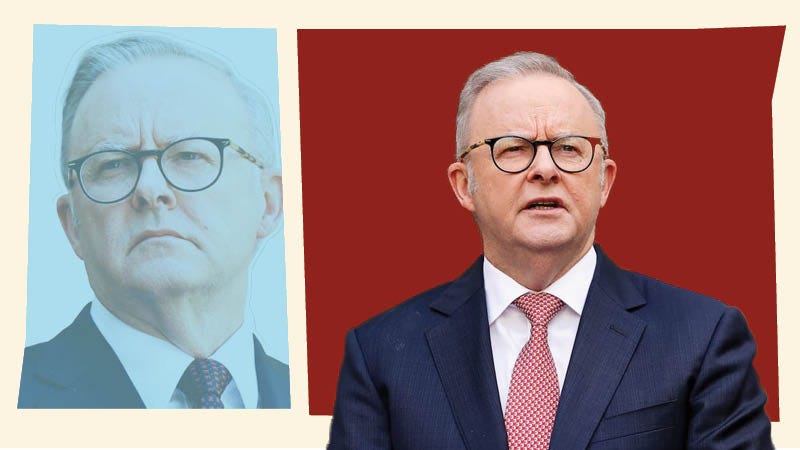
It’s not clear if the Albanese government hasn’t got the ability read, or is too politically dumb for its own good, but it has signalled strongly that it will not be proceeding with a new export tax. The Prime Minister has emphasised the importance of maintaining Australia’s reputation as a reliable trading partner – once again, a Labor government prioritising the markets rather than the community – particularly during recent diplomatic engagements in Southeast Asia, where both Albanese Trade Minister Don Farrell has reiterated that existing export arrangements will be kept.
The argument from government and industry is that LNG producers already contribute tens of billions in taxes and royalties, and that raising the burden risks undermining investment and supply. It’s a weak argument – countries apply new taxes on existing arrangements all the time, and the government of Japan applies a tax on Australian gas for its own domestic market, resulting in the outrageous situation where Japan raises more taxes on Australian gas, than the Australian government does. Gas is working in the interests of the countries of Japan, China and South Korea, but not in the interests of the Australian community, and for this, the Albanese government should be admonished for allowing this bizarre situation to continue.
Albanese might be the master of incrementalism, but this is proceeding so slowly, that it’s actually going backwards: a weak prime minister in a powerful once-in-a-generation position, who refuses to take an easy option that will clearly be a benefit to the public interest. The core proposition – that Australians should receive a fair return on their own resources – is a very clear principle, yet repeatedly ignored by our political leaders.
Instead of implementing this reform, there’s the ongoing consultation and listening to debate; instead of action, Treasury produces new modelling; instead of the introduction of policy, there’s the political management of the issue and, ultimately, the deferral of this idea to the neverland. And that gives time for industry groups to mobilise quickly and create the fear campaign to suggest that any change at all will be a form of economic self-harm on everyone. The result is this meandering policy vacuum in which the public interest is clearly acknowledged by everyone – except by the government and the resources industry – and the loss of tax revenue continues.
These are not trivial amounts that we’re talking about. Estimates suggest that a 25 per cent gas export tax could raise in the order of $15–20 billion per year, depending on the market conditions. Even at the lower end, that’s a level of revenue that would transform public finances: funding the health and education systems that are currently under strain, stabilising the National Disability Insurance Scheme, funding housing supply properly instead of using an inadequate housing future fund or, if the government is not prepared to do that, reducing the structural deficits that have been building up for almost two decades.
Australia’s approach is in contrast to other countries such as Norway, which has built a sovereign wealth fund exceeding US$1 trillion by capturing the value of its petroleum resources through clear taxation and public ownership policies. Every country is different, and a Norwegian solution might not fit perfectly into an Australian context, but it shows that the resources of a country can be converted into long-term national prosperity if governments are willing to assert the public claim over it and, at the moment, we have a Prime Minister who is supposedly from the left of the Labor Party, totally unwilling to do this.
The failure to act also reflects a deeper reluctance to engage with the broader reform agenda outlined in the Henry Review all the way back in 2009. Only three of the 138 recommendations were implemented – since removed – but had those reforms been phased in during the early 2010s, and kept, Australia’s budgetary position would have been significantly stronger today, with higher and more stable revenue streams, better resources management, and a more efficient distribution of capital. Instead, the country has accumulated rising public debt while leaving major revenue sources underutilised.
The point is not to bemoan the fact that nothing of the Henry Review exists today – the water under that bridge passed a long time ago – but that governments always have to consider future generations, and a future that they will actually be a part of. Anthony Albanese was a senior member of the Rudd–Gillard–Rudd government between 2007–13. This is not to suggest that he alone could have pushed for the implementation of tax reform, but how much easier would his task have been 13 years later as the Prime Minister, if all these reforms were already in place? He’s unlikely to be Prime Minister in another 13 years, but how easier will the task for Prime Minister Jim Chalmers be in 2039, if a new 25 per cent gas export tax was implemented now? How much would the public benefit over that time from this greater source of revenue?
Applying a 25 per cent tax on gas exports would at least address some of the anomalies and inconsistencies in the application of government revenues. The Albanese government is willing to commit billions of dollars to defence spending at the drop of a hat – $53 billion in new spending announced last week – or maintain the outrageous tax concessions in negative gearing that benefits the already wealthy, while every other area of government spending such as education, health, aged care, disability support, is debated, argued for, and finally drip-fed with a range of caveats that demand that every cent is accounted for, because we simply don’t have enough money.
This isn’t just something that relates to economics, it’s the management of powerful industry stakeholders in the resources and media sectors. It’s the government’s preference to manage that risk, rather than electoral risk, bearing in mind that governments face the electorate only once every three years, but they have to deal with the revolving door of industry lobbyists pestering them every single day of the year. And this is Albanese’s focus – managing the risk of these key stakeholders, rather than acting in the interests of the public.
The timing for reform – in the unlikely event that anything will happen – is also critical. We have now completed the first third of this term of government and, historically, the second year of a government’s term offers the best opportunity to introduce major policy changes, allowing time for implementation and adjustment before the next election cycle. If a gas export tax is not implemented in the upcoming budget, it’s increasingly unlikely that it will be introduced at all in this term, if ever.
There’s also the question of political legacy. Leaders enter office with finite time and finite opportunity, even those such as Albanese who have been a part of the parliamentary woodwork for over 30 years. The choices they make – or avoid to make – not only define the legacy of their governments but the future of the country.
In 2022, soon after he became Prime Minister, Albanese spoke about the importance of leaving office with a sense of purpose, rather than regretting the opportunities that were missed. Albanese is veering into the second part of that equation, four years in office, with not too much to look back at with a sense of purpose. Albanese has often talked about wanting the Labor Party to become the “natural party of government”, but this is just empty rhetoric and is code for a party wanting to be in government just for the sake of it and enjoy the trappings of office.
Australia remains one of the most prosperous countries in the world, but prosperity without the correct political leadership will just follow the laws of a diminishing return. We don’t want “natural governments”; we want governments that will govern in the national interest, not pander to vested and powerful interests and give them exactly what they want.
Albanese is the incrementalist, he’s made that point very clear. But he’s not even moving incrementally at all on the management of our stock of natural resources which, just like his own political career, is finite, and to continue exporting gas under the current terms is a failure of political will. The question that now faces the Labor government is no longer whether it understands the problem, but whether it’s prepared to solve it – and so far, it has shown that it’s unwilling to do so.


"Incrementalist" was used repeatedly in Eddie and David's piece on the failings of the PM. it is far too polite as you suggest but I'm afraid I would lean more towards "excrementalist" as the best adjective for the worm, Elizabeth. His ability to ignore the advice of so many prominent experts and to soak up the lobbyists' playbook is truly "CRAP" as Ken Henry said.
Vote Independent or Green ("political party") next election and take more care with your preferences please.
It must be our karma that we are cursed with leaders who forget their origins and seek to pander to wealthy vested interests, thereby depriving all those less fortunate like they themselves were once, from benefiting from the wealth of the country, merely to get pats on the head from a US President and other assorted leaders in foreign countries.
If our so called leaders can be so vacuous and stupid then we clearly deserve to be condemned to become, as Lee Kuan Yew memorably said, the “poor white trash of Asia”.