


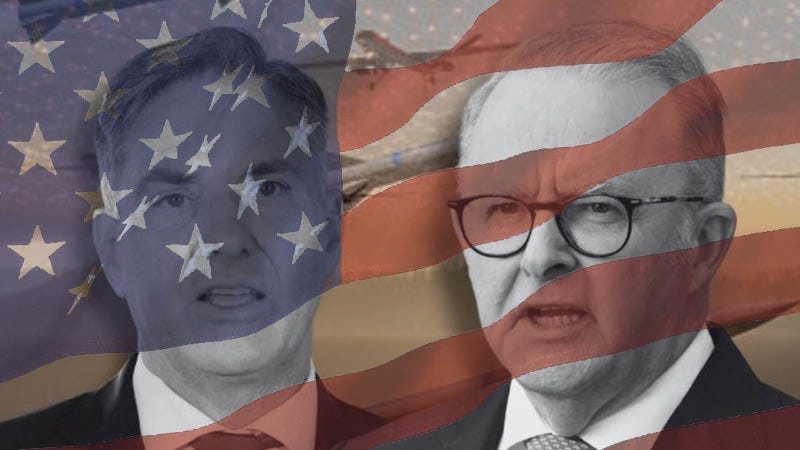
Australia’s actions in the latest stage of the on/off/on/off US war against Iran shows the familiar and uncomfortable truth about its government, whether it’s led by the likes of Anthony Albanese, Scott Morrison or Malcolm Turnbull: foreign policy and defence continues to revert to a lap-dog obedience and providing all the sacrificial offerings that the United States could ever ask for.
In June 2025, the federal government rejected calls from the US Defence Secretary Pete Hegseth to increase defence expenditure to 3.5 per cent of GDP, with the Prime Minister Anthony Albanese suggesting “what we need is things that defend us in real terms, and that’s what we’ll provide,” offering a commitment to boost defence spending by $10 billion but keeping to 2.3 per cent of GDP.
It’s a resistance that didn’t last too long: less than a year after Albanese’s commitment, Australia has announced a massive expansion of defence expenditure, with an additional $53 billion over the next decade, pushing spending toward 3 per cent of GDP. It might be short of the 3.5 per cent demanded by Hegseth, but we’ll eventually get there. Because when the United States makes demands, Australia will eventually comply: that’s what happens in a captured state, whether it’s the AUKUS payments of $798 million in February 2025, another $800 million in July, and another unknown “down payment” at the end of 2025, or simply tossing $5.3 billion each year into the defence pool for the next ten years. And why not share the love with Britain, where we provided another $310 million for the SSN-AUKUS submarines just a few months ago in February.
What makes this shift so galling is not just the scale, but all the contradictions it reveals. Every dollar directed toward any other form of government spending – housing, healthcare, education, disability services, aged care, infrastructure – always has to pass through many layers of scrutiny by governments and oppositions, justifications need to be provided in triplicate, then there’s a delay and, finally, funding becomes available, just like the drips coming through from a leaking tap.

Governments constantly speak of fiscal discipline, have concerned looks on their faces about a worrying budget outlook, and the need for the strict prioritisation of spending, because we haven’t got the money to fund everything. Or so we keep being told. The health minister, Mark Butler, has detailed the “savings” – in other words, cutbacks – that will be made to the NDIS scheme because it “costs too much”, which will then be used to fund showering and the management of incontinence in aged care facilities, essentially robbing one social service, to pay for another. It’s not exactly being pissed on from a great height, but it’s a similar kind of sentiment.
Yet when it comes to defence spending, particularly to achieve the defence objectives of the United States, those funding constraints magically disappear, it never “costs too much”, and there is money to be found, after all. Tens of billions are committed with relative ease by the defence minister, Richard Marles, announced with such a casual demeanour, as though no alternative exists and there’s no further justification required, except for the stage-managed media conference where all of this spending is announced, followed up by one or two questions asked by government-friendly journalists.
We’re not naïve enough to think that there was a golden age in Australia’s mystical past where these issues have never existed, or that there was a golden fleece on call to provide us with every fiscal need and desire, but what does it say about a government’s worldview when social investment is treated as a burden, yet military expenditure is treated as a necessity, with no questions asked?
All of these defence spending announcements are being made against the backdrop of a Middle East crisis that bears the unmistakable signs of the American instability that we’ve come to expect since early 2025. Under Donald Trump, US foreign policy has become a volatile mix of impulsive decision-making, performative aggression and complete incoherence, as recently shown when Trump unilaterally extended a ceasefire agreement with Iran in the middle of negotiations in Pakistan, and continues to blockade a number of Iranian ports, even though a previous ceasefire explicitly ruled out such actions.
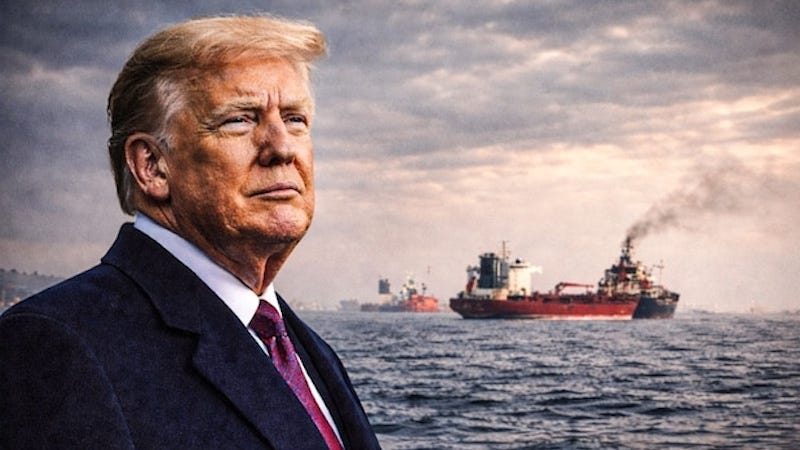
Since this conflict began in late February, Trump has issued deranged late-night threats and contradictory commentary through Truth Social, followed by vague references to negotiations that might exist – or might not – and allies and negotiators are then left to interpret these incoherent messages that shift almost on an hourly basis.
At various points he has called for regime change in Iran, only to backtrack into more limited and undefined objectives, claiming that the war had already been won, even as military operations continued. His timelines have been equally unreliable – initially framing the conflict as a short, decisive campaign ending in weeks, if not days, before insisting he couldn’t be rushed and that this war would end on his own terms. He’s oscillated between violent threats of complete destruction, and openness to negotiation, sometimes suggesting a deal is imminent and Iran is desperate to talk, while in reality, diplomatic talks have been on the verge of collapsing.
This is the lunacy and incoherence that Australia is supporting, taking funding away from much needed public services in health and aged care, and funnelling it towards the American war machine to the tune of an additional $53 billion over the next decade, on the top of the commitment of $368 billion for AUKUS.
Yes, Australia is a part of the US alliance, whether we like it or not, and will be affected by the irresponsible actions of the United States, even if we have no part in the cause of these actions. The United States acts, Australia pays: each and every time. When will enough be finally enough, and give Australia all the reasons to finally say no?
Australian political leaders such as Marles frequently talk about the importance of sovereignty and the national interest, yet never refer to the fact that the decisions that relate to these matters are defined by the leaders who reside in Washington. We might get to make the announcements – thank you, kind sirs – but it’s the more powerful people in the White House who are really pulling the strings. It’s the language of independence that exists with the reality of dependence, and to explain this reality is, to use Churchillian language, as complex as a riddle, wrapped in a mystery, inside an enigma.
The broader issue is not just whether Australia should increase its defence spending or support its traditional allies – it’s whether it can hold a strategic position that reflects its own interests, values and capabilities, rather than supporting a faraway power whose priorities and pursuits are radically different to our own.
At a time when global instability is increasing because of a Trump regime that comprises ineffective, corrupt, incompetent and compromised leaders – topped off with the bizarre sight of Christian Zionists performing exorcisms to cleanse the White House of evil spirits, when a kinder act would have been to call in psychiatrists – the need for a rethink is becoming more urgent, if not simply to assess the financial cost of this alliance.
A more mature and confident political culture in Australia would recognise that alliances are not obligations to follow blindly, but relationships to be managed with judgement that are in our own interests. There should be bipartisanship on standing up to the United States; instead, it’s a bipartisan commitment to acquiescence at all times, irrespective of the cost, or the damage that we’re doing to ourselves. America has colonised our minds, and it’s gone on for such a long time, that we don’t even realise it, let alone how to decolonise ourselves.
Until that decolonisation of mind does occur, Australia will remain caught in that same old situation: supporting conflicts it didn’t have anything to do with, funding military hardware that it did not design nor will ever control, and absorbing the consequences of whatever is thrown at us, whether we like it not. When ministers take delight in announcing “savings” from disability services will now be used to fund hot showers and incontinence programs in age care homes, while billions of defence dollars are being flushed down through the sink of American imperialism, we all know that something is seriously wrong.
It’s a theme that we constantly come back to – and apologies for the repetition – but until Australia finds the courage to think and act for itself, it will remain a nation that pays the price of other people’s wars and political mistakes, while trying to convince itself that it’s an act of loyalty. But it’s all a charade, and, as the world becomes more uncertain, it’s a cost that will only continue to keep rising.


It’s a line from the Kenyan writer Ngugi wa Thiongo, arguing that before a country can be decolonised, the mind has to be decolonised first. Also now used by Traore in Burkina.
Correct in every detail . That this government is more than happy to cut social services and the Public Interest , well nigh across the board , in order to hurl unlimited billions of dollars to America’s War Machine is indescribably despicable .
It is a form of betrayal , both of our democracy and our future . And thus unforgivable . What kind of soulless species
happily cuts funds for disabled children and adults ( NDIS ), and also underfunds Aged Care , support for Mental Health,
Public Education, and Public Health ( especially in rural areas ) ??? How does Albanese even attempt to defend this level of betrayal ?? Naturally he does not attempt it , which says everything about him , and nothing positive .