


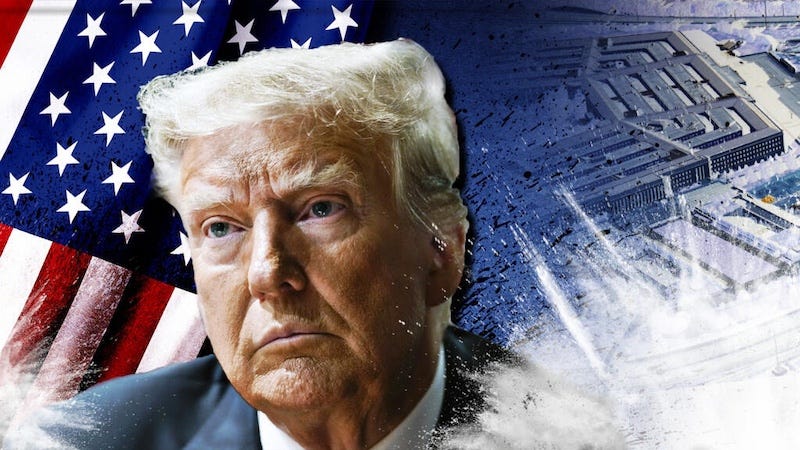
A temporary ceasefire in the escalating conflict involving the United States, Israel, and Iran, has created somewhat of a lull – although the United States has blockaded the Strait of Hormuz after the calls by Donald Trump for many weeks for Iran to open it up, threatening to “bomb Iran back to the stone age” and “obliterate” if it didn’t – but at least it gives us just enough time to ask the question that’s always buried beneath the spin and noise of a US President throwing his toys out of the cot: who actually benefits from war?
While governments try to frame these conflicts in terms of defence, deterrence and geopolitical considerations, the economic signals will always tell you a different story, where rising share prices, the surging energy markets, and a well-established system of instability is monetised and promoted by corrupt leaders such as Trump.
The global reaction to the Iran conflict still continues, affecting trade routes, energy supplies and national economies, including that of Australia, and the scramble for oil, the volatility in shipping lanes, and the knock-on effects in fuel prices have hit ordinary people the most. Relief at the petrol pump has been marginal at best, while the diesel costs that are critical to freight and supply chains, continue to push up the price of goods across the board. For households and small businesses – the ones who suffer the most at these times – the impact has a tangible effect and will linger long after this conflict is over, if that can even be achieved. But for a different class of players – the defence contractors, the oil barons, energy corporations and institutional investors – these conditions have actually delivered significant gains.
Historically, war has always had an economic dimension, but in the modern era, that relationship has become more corporatised and technocratic. Defence companies such as Lockheed Martin and Raytheon Technologies have seen substantial increases in their market value since the start of this conflict – 12 per cent and 50 per cent respectively – reflecting investor confidence in continuing demand for military hardware and services. War kills people, but it’s also good for business. Energy giants like ExxonMobil similarly benefit from these supply disruptions and rising oil prices, translating into billions of dollars flowing through to shareholders, most of whom are large institutional corporations, rather than the small “mums-and-dads” investors.
This isn’t the result of a conspiracy, but the predictable outcome of a system that’s built around incentives. War drives demand, and demand drives profit. The profit attracts more capital and capital, in turn, exerts influence on those decision-makers and war mongers – through lobbying and political donations. Over time, this creates a feedback loop where the machinery of conflict and the machinery of profit become increasingly mixed up and, quite often, it’s hard to tell the difference. The so-called “military-industrial complex” isn’t just a phrase used by radical activists – it’s a structure that links governments, corporations and financial institutions in ways that are often murky, but of great consequence to humanity.
In the United States, where defence spending is both massive and politically entrenched, these relationships are far more obvious. Political figures and parties receive substantial backing from the industries that stand to benefit from military engagement. The incentives are clear, even if the mechanisms are a little more obtuse. It’s not a case where executives from Blackrock will pick up the phone to the White House and order a war, but rather that the system as a whole is finely calibrated to reward the conditions that a war creates. When conflict breaks out, markets respond instantly – and those positioned to capitalise on that response will do so with remarkable efficiency.
Ordinary citizens – whether it be in the United States, in Australia or West Asia – don’t experience war as an economic opportunity. Their experience is based around rising living costs, the uncertainty, and in many cases in the Middle East, a direct exposure to violence or the threat of it. The benefits, meanwhile, are accumulated elsewhere – in the boardrooms of Lockheed Martin, Raytheon, ExxonMobil and Blackrock – those who have the capital and connections to profit from the chaos.
The Iran conflict also highlights the fragility of the global systems that depend on security and political stability. The Strait of Hormuz, a critical part of the global oil supply, is the more obvious point of global tension at the moment, but even minor disruptions will result in significant economic consequences – and create the pressures that flow through the global economy, affecting everything from energy prices to food supply chains.
Political leadership in these times also becomes crucial. The decisions made in Washington, Tel Aviv or Tehran will go far beyond their own borders, shaping not only the direction of this conflict but determining the economic conditions that will follow. The true role of political leadership is to navigate these complex situations with restraint and with some intellectual gravitas, but when that leadership is erratic or driven by corruption and short-term calculations, the risks become massive, not just for those directly involved, but for peace in the region and the entire global order.
There’s also that question of the political narrative – how wars are explained by political leaders, how they are justified and how they are remembered. Unlike conflicts with clearly defined ideological stakes, such as the struggle against fascism and Nazism in the mid-20th century, modern wars initiated by the United States are lacking a coherent public rationale. Although the excuses were pathetic and sold under the banner of the weapons of mass destruction that never existed, at least the invasion of Iraq in 2003 went through the process of attempting to seek approval from a reluctant international community, even if the entire process was a sham.
These days, the United States has given up with the pretences. Instead, we have a US President who changes his mind about the military actions in the Strait of Hormuz as often as he changes pads, and spends his time insulting the Pope and releasing AI generated images depicting himself either as God, or as Jesus Christ, mainly as distractions from the main event of funnelling war profits and oil revenues into the pockets of his corporate backers and supporters. It will take immense efforts to explain to future generations how a creature such as Trump managed to survive in the political system with such corrupt and infantile behaviour, let alone how he managed to reach the position of such political power, not just the once, but twice.
To understand Trump’s behaviour and survival, and of modern conflict, it’s not enough to look at the battlefields, the blockade of the Strait of Hormuz, the diplomatic statements, or the latest inane and incoherent posting on Truth Social. It just requires following the money, examining the incentives that exist in the political and economic systems, and recognising the ways in which profit and power mingle. War, in this sense, is not just a failure of diplomacy or a continuation of politics by other means – it’s a system that rewards this potent mix.
The temporary ceasefire in Iran may hold, or it may collapse. With Trump, it can never be predicted, but history suggests that it might not matter too much, particularly when the underlying drivers of conflict still remain unaddressed. What is clear, however, is that the consequences of war extend far beyond the immediate theatre, in this case, Iran. They influence economies, politics, and send the wealth upwards in ways that are often hidden from the public view.
In the end, the most uncomfortable truth is also the most important: the world is always at war, not because of fear, ideology or political mistakes, but because it works for the select few and the vested interests.
And as long as war and conflict continues to generate profits for these vested interests and military corporations, which then translate into political influence, the incentives to sustain this vicious circle of doom will continue. The challenge is to break this cycle, and the system that makes these wars continuous: one will end, and then another pops up somewhere else in the world, conveniently placed near United States bases that can then exert influence and domination. It’s also clear that for as long as that cycle remains in place, the question of who benefits from war will always have the same answer.
This is an excellent article. The US in particular, is a society predicated - that is structured - on war. Its economy depends on war. And the narrative that is co-opted in the service of enrolling the public to support war involves patriotism, justice, safety, security and outrage at the crimes of others. All of these jingoistic utterances are meaningless and facile but they do get the public behind the war effort, and so they help the machinery of war run more smoothly. It may all be a scam, but you have to admit - it’s really well done.
War and profit always makes me think of Bertolt Brecht's play Mother Courage and her Children, and I seem to remember a refrain of ' nothing earns profit like a good war' or something. To be honest, I have probably butchered and / or misremembered that quote because it was over 35 years ago in the last century that I was a lit major... But basically Mother Courage profits from the 100 year war as her children die as result of it.
And so it goes on as you rightly point out 😔