


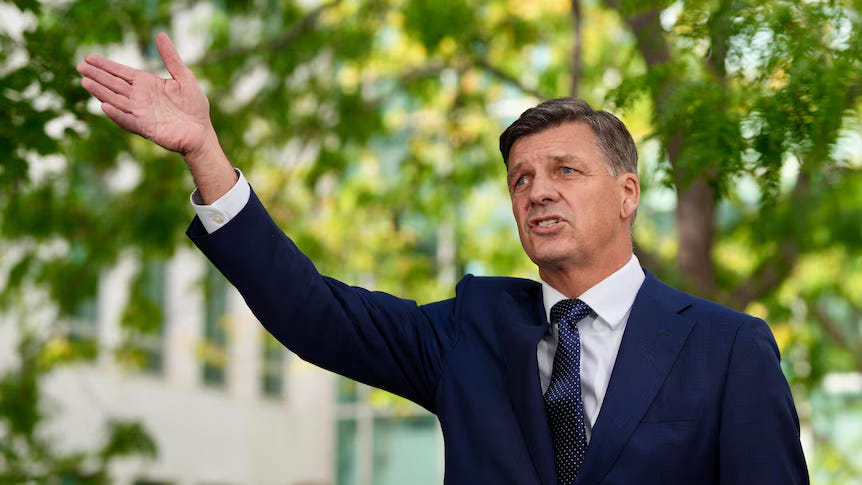
The Liberal Party’s push for a so-called “values-based” immigration system, including proposals to scrutinise migrants’ social media accounts, is a real troubling development in Australian politics, not so much because we think it’s a politically winning strategy – it’s not – but because one of Australia’s mainstream political parties – and, supposedly, representing the essence of true liberalism – feels that this is its way of reaching electoral nirvana.
Framing its policy as a necessary defence of national cohesion, in reality, it’s a reflexive move to the culture war politics that have hampered the Liberal Party for well over 30 years, and an attempt to import elements of the ideology associated with figures such as Donald Trump in the United States, albeit without the extreme edges that we’ve come to expect from Trump’s new dystopian world.
Yet even in diluted form, the strategy is very similar: confuse the questions of Australian identity, loyalty and belonging, while constructing a narrative of the eternal threats that demands a constant vigilance and the perpetual fear of the migrant.
What is difficult to comprehend is not just the contents of this Liberal Party policy, but the timing of it. Less than a year after the Australian electorate so thoroughly rejected this style of politics at the 2025 federal election, the party has decided to double down with a different leader, Angus Taylor, and go further to the right in the search for the voters that have been stolen by One Nation, and unlikely to ever return.
At the centre of this draconian shift is the effort to draw a distinction between what Taylor describes as migrants of “noble and patriotic intent” – reflective of the racist undertones of 18th-century European philosophy and the noble savage – and the migrants of “subversive intent”. He doesn’t need to name these subversives or indicate where they actually reside: not providing these details means his audience can fill in the gaps with their own imaginative construct of the other, and insert the specific migrant group of choice that they dislike.
Of course, Taylor is all big on the rhetoric but intellectually shallow, reducing complex social realities into an easy to digest binary that invites suspicion and division in the electorate that can easily be shouted at. Taylor’s rhetoric also relies on a deeply questionable premise, making a causal link between the Bondi terror attacks and pro-Palestinian protests and antisemitism, and then further extending that link between criminal acts, political expression and immigration itself.
Bereft of any other ideas, Taylor feels that he’s hit the political jackpot, encouraging the electorate to associate migration with insecurity, and dissent with disloyalty to Australia. The political logic behind his approach is easy to see: the Liberal Party is still trying to work out how to deal with the new world of a splintered conservative base, challenged on one side by Labor’s complete electoral dominance, and on the other, One Nation, and other creatures lurking in the shadows of the far-right mindset.
Historically, the party has navigated pressures from the far-right by absorbing elements of their rhetoric. Under John Howard in the 1990s, this strategy proved to be electorally effective, neutralising Pauline Hanson’s early rise by adopting a harder edge on issues of national identity and immigration, even though the Howard government actually maintained high levels of immigration for most of their 11 years in office.
But that was many years ago – adopting the politics from 30 years ago, is not going to work in 2026, especially when the stocks of the Liberal Party are so low. For sure, it worked for Howard in the 1990s and early 2000s, but Taylor seems to be testing his lines in public to see what floats, rather than offering coherent policies. And, as a result, the Liberal Party is behaving like a fringe party, shouting at the clouds, and searching for electoral relevance.
The entire premise of moving towards a “values-based” immigration system implies that the values are currently not there, but Australia has always operated with a values-based system in practice, as does every other country in the world. Visa requirements, character tests, and the citizenship process already provide expectations about adherence to the rule of law, democratic values and social participation. Short of suggesting executions, there’s not much more that Taylor could recommend.
Migrants coming to Australia are not entering a value-free space; they are entering a society with established institutions, legal frameworks and civic expectations. Taylor’s suggestion that Australia has somehow abandoned these standards – without indicating which standards, or how they have dropped – is not supported by evidence, but it doesn’t have to be. All it’s doing is serving a political purpose: it’s the classic case of identifying a problem that doesn’t exist, and then offering the solutions that won’t work anyway.
But what is new – and concerning – is the proposed policy of enforcement. The idea that prospective migrants should have their social media activity examined introduces a level of state surveillance that sits uneasily with the very values being claimed by Taylor. Freedom of expression, belief and the right of individual dignity can’t be reconciled in a system where individuals are assessed on their opinions, associations and surveillance of their digital history.
In a direct paraphrase of Howard’s words from 2001, Taylor claims that “we will decide who deserves protection and the circumstances in which that protection is granted”, but who will decide what constitutes acceptable speech, either on the streets or through social media? What level of dissent will determine someone’s ability to become an Australian citizen? How will such judgements be insulated from political bias and interference? It’s simply not good enough to declare a commitment to that jingoistic “fair go”, while creating exclusions that are based on subjective interpretations devised by a team of bureaucrats.
Australia’s post-1788 history is quite different to the one that Taylor wants to promote. From the presence of Muslim cameleers in central Australia, to the waves of European migration after World War II, to the removal of the White Australia policy in 1973, the country’s development has been shaped by successive waves of inclusionary migration policies. These processes were often imperfect and up for debate – Howard always claimed multiculturalism was “a mistake” – but these processes also established a broad consensus about Australia’s national identity. Crucially, that consensus – ignoring the shallow men like Howard – has been more or less bipartisan.
In political terms, the social risks are considerable, considering that an opposition party – irrespective of how poor its electorate position might be at the moment – is only one election away from returning to office. By adopting the language and the rhetoric of the more extreme actors in Australian politics, the Liberal Party is hoping to recapture those voters who have drifted off further to the right. But in doing so, it legitimises those very narratives, and all it does is reinforce the fragmentation that it’s seeking to reverse.
The recent South Australian election, where the Liberal Party fell behind both Labor and One Nation on primary votes, confirms that splintering of the right that started off with the 2025 federal election. Rather than consolidating the conservative vote, strategies such as the ones promoted by Taylor will split it even further, leaving the party squeezed between a more moderate centre and a more radical fringe. Chasing the votes garnered by One Nation – a fringe party of right-wing white noise – means that the Liberal Party will also become a fringe party, and this continuing pursuit is unlikely to result in the renewal that the party so desperately needs: it will just cement its continuing decline.
Yet the implications for this go far beyond the low number of seats held by the Liberal Party, or how difficult it will be for them to return to office at the next federal election in 2028. Policies that frame sections of the population as inherently suspicious – and we know who Taylor is talking about when he brings up the rhetoric of the “migrant of subversive intent” – that equate dissent with disloyalty, and expand state surveillance on a select few, have lasting effects on the social fabric of society, and sends a strong message that they… them… the other… and whoever is deemed to not fit in, just don’t belong to that white Australian construct.
In a diverse society, cohesion is not achieved through suspicion, but through shared institutions, mutual recognition and the consistent application of the law. “Social cohesion” seems to be the fashionable phrase of the day, but excluding the brown and black people from our society, just because Taylor wants to decree this to be the case, doesn’t make social cohesion any easier: all societies are difficult to manage politically, irrespective of how homogenous they might be, but the Liberal Party wants us to believe that social cohesion is achieved by ironing out all the kinks of colour, and achieving pure white, if not literally in appearance, but through a colonisation of the mind. It’s a corrosive style of thinking.
What is ultimately at stake is not simply the direction of immigration policy, but the character of Australian democracy itself. Taylor is a tin-pot leader who might not even be the leader of the Liberal Party at the next election, but he’s likely to implement a system that treats values as something to be policed rather than lived, and prioritises political expediency over principled governance, undermining the very foundations that he claims to defend.
The challenge for all political leaders is not to manufacture division in the hope of short-term gain – which is obviously what Taylor is attempting to do – but to articulate a vision of national identity that is confident enough to accommodate difference and celebrate and accept it. After all, no two people on this planet are the same. Anything less than this is not a sign of strength, but Taylor’s own insecurity masquerading as policy – and voters, as recent elections have shown, are increasingly unwilling to reward it.
Not only is this manufacturing division. It’s manufacturing distrust that leads to hate and the inability to recognise what’s real and what isn’t. Already Israel knows it can’t escape the label of being a genocidal nation. The zionists are out to deflect as much criticism as possible by blaming peace loving Muslims. Australia is already experiencing violence and intimidation by Israel supporters and those returning from killing children in the IDF- other countries also experiencing these violent clashes between humanitarian values and the deranged thinking that allows rape pillage, destruction and murder. It seems inconceivable that ‘leadership’ supporting Israel could have got it so wrong. So we Ozzie’s keep suffering zionist rhetoric and zionist values. Those misguided pollies want surveillance via Israeli tech - Palantir- to sort out ‘good from evil’. Just look at what Israel has already done. “By their works you shall know them”. We the humanitarians of our world don’t want Israel’s standards here.
The analysis needs to take into account what Labor has actually legislated - Labor can’t be valorised on this issue. It’s driving authoritarianism on immigration and refugee law
https://substack.com/@ritajabrimarkwell/note/c-246619531?r=pacl0&utm_medium=ios&utm_source=notes-share-action