


America and Israel’s war on Iran and other parts of Western Asia has moved into a dangerous and uncertain stage, and it’s one that’s still defying an easy-to-define narrative or follow a quick conclusion. What was supposed to be a limited and calculated attack initiated by the US and Israel on Iran, has now become a far more complex and volatile conflict. Iran has also proven to be a far more resilient adversary than many anticipated, including the US President Donald Trump, and the longer this conflict drags on, the more it threatens to reorganise not just the regional balance of power but the broader structure of global politics.
History has seen these types of actions play out before: great powers, when stretched across too many fronts and driven by a sense of urgency, often panic and overreach. The United States, already managing extensive global military installations all around the world, as well as too many domestic economic pressures, now finds itself caught up in yet another high-stakes conflict with very uncertain objectives and no clear exit strategy.
It’s not an isolated incident either, but it’s part of a longer timeframe in which American foreign policy has repeatedly been at the centre of almost every geopolitical crisis – in Cuba, South America, Central America, Africa, Southeast Asia and the Middle East – as well as many other countries where it interferes in their domestic politics. Whether the attacks on Iran are seen as the claimed “necessary” intervention or the usual overreach by the United States, the overall effect can’t be denied: the burden of maintaining global dominance in the way that it might have been up until the end of the Cold War in 1989, is becoming increasingly difficult to sustain.
What makes the current situation particularly important is the potential for the realignment of global politics. This is a conflict that’s exposing the limits of American hegemonic influence, under the watch of a foolish and increasingly deranged President, and other nations are watching closely and reassessing their alliances both with each other, and with the United States.
Emerging and regional powers are likely to seek new partnerships, and are already creating new frameworks – BRICS, for example – that can and will operate independently of American influence. This is how geopolitics has shifted throughout history – not just because of the one single event, but through a gradual erosion of the old frameworks and the steady creation of new ones. If this process accelerates because of this war on Iran – which, incidentally, is already a member of BRICS – then, the United States will no longer be at the centre of global affairs and, perhaps this is what it fears the most.
There are risks here for Australia too. The country’s longstanding alignment with the United States has been a key feature of its foreign policy for many decades, but it’s been a handbrake on Australia’s independence. When the dynamics of global politics begins to shift, nations that are too tightly tied to a single power – such as Australia with the US – can find themselves excluded from these new global alliances.
This was precisely the conundrum that former Prime Minister Paul Keating was seeking to address in the 1990s, when he argued that Australia should not see Asia as some kind of distant frontier, but as a strategic partner in its immediate neighbourhood, a country embedded in this region, and economically and diplomatically engaged with its closest neighbours. But that approach was ridiculed by his conservative opponents at the time, reset by his successor, John Howard, who firmly guided Australia in the direction of the United States, a situation that remains in place to this day.
Today, the consequences of those choices from the late 1990s are becoming very clear. As these new alliances begin to take shape now – particularly across Asia and the Middle East –Australia risks being left on the outer – not through choice – but by having been too closely integrated with the United States, especially when it comes to the military relationships it’s been so eager to create and maintain, such as AUKUS.
The economic impact of this relationship is already being felt domestically. While the relationship with the United States is not the major factor behind these higher domestic prices – this is being caused primarily because of the war – the energy markets have reacted quickly, with fuel prices rising in response to this instability. Governments do have limited control over international commodity markets, but their political responses to these price rises can influence how the public interprets and apportions the blame for it.
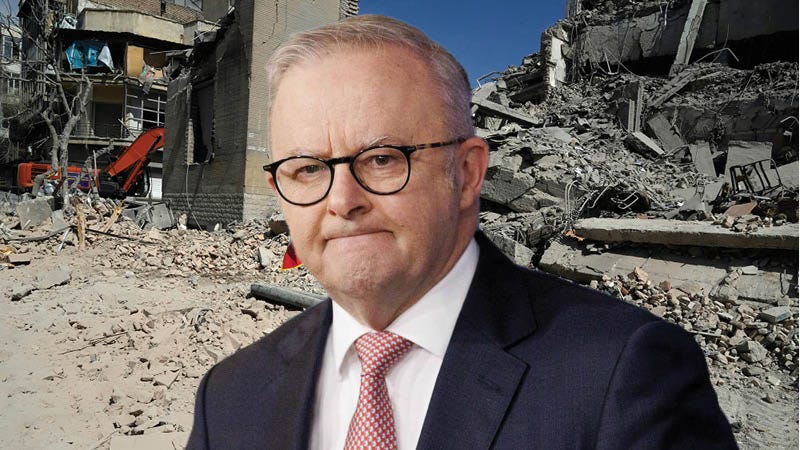
This is where strong domestic leadership is crucial, and at this stage, we can see that there are significant weaknesses. Prime Minister Anthony Albanese has found himself navigating a multitude of issues – international conflict, economic problems, and growing public dissatisfaction – but his responses have, so far, taken a long time to arrive and when they do arrive, they’re inadequate. The government’s decision to cut fuel excise will provide short-term relief, but at a significant cost to the budget, and without addressing the underlying drivers of the price surges.
Political leadership, particularly in times of a crisis, is defined not only by the decisions that are made but by the timing. The ability to anticipate events before they become a political problem, to maintain a distance from the cause of the problem – clearly, the United States and Israel – and then to communicate a clear narrative to the public, are absolutely essential. It’s also the true art of politics: achieving your own political goals, and distancing yourself from the problems caused by others.
It’s a skill that Albanese seems to lack, and it’s a balance that is increasingly important in a fragmented global environment that’s only going to become more fragmented, not less. What did Albanese do to address all of our concerns? He provided a three-minute national address on the eve of Easter where, essentially, he told the public to use less petrol, and take public transport. High prices? Well, that’s got nothing to do with me. “We’re an optimistic country” said Albanese, “we will deal with the problems, the Australian way”. Which is code for: we’re not going to deal with these issues, let’s just hope they go away.
Once a government is seen to be politically invested in a conflict – and Australia is invested in this conflict, despite the denials from Albanese and Foreign Minister Penny Wong – it becomes far more difficult to criticise the consequences and causes of the conflict, or even take the time to explain its rationale. And in the absence of a clearly articulated position, the government will eventually bear the political cost, even if the current opinion polls suggest the public at this stage are still blaming the United States government.
It’s clear that Albanese is a good manager of political issues – two consecutive election victories attest to that – but modern political leadership needs more than the manager; it requires the ability to respond to unexpected events with a great deal of flexibility and vision. We can see that Scott Morrison had neither of these skills – management of political problems, or leadership during a crisis – and Albanese has the former, but not the latter. As former British Prime Minister Harold Macmillan famously observed, the greatest challenge in politics is “events” and the unexpected developments that quickly arrive in rapid succession, and the quality of leadership becomes apparent when these events do arise.
The war itself against Iran is showing no immediate signs of resolution, with Trump still threatening that a “whole civilisation will die”, if Iran does not make a deal. Israel is facing mounting pressures – domestically and internationally – and its quest for the Greater Israel project has to be resisted, and that’s exactly one of the issues Iran is fighting against and, far from being subdued, has demonstrated both endurance and ability to fight back against these belligerents.
The United States now needs to manage this complex situation that it has created, and surely the wiser heads within the administration – if there are any left – must be wondering how on earth did they become so deeply embedded within this conflict so quickly, and without a clear exit route.
For Australia, events seem to be moving too quickly for the government to truly reflect upon what it needs to do, but it’s almost a case of needing to put itself way past this event and work out how to reposition itself in a drastically changing world. One wonders how much difference having the Iranian ambassador in Australia would have made today in navigating this changing world, instead of expelling him last year on a false premise and at the behest of Israel – it certainly would have helped in being able to clear the access for oil tankers heading towards Australia through the Strait of Hormuz.
In the end, wars do more than just redraw borders or alter the global balances of power – they reveal the strengths and weaknesses of the systems that produce them, and the political leaders that make up that system. They test not only the military capabilities, but the political judgment of these leaders and, in the case of Trump, he’s been exposed as belligerent and bellicose fool, preferring potty-mouthed insults and vulgarity, rather than clear-headed diplomacy.
Insults aside, it’s becoming increasingly clear that the greatest challenge isn’t in the physical battlefield taking place on the plains of Iran, but in the ability of governments – both in Australia and around the world – to understand there is a new world that is emerging from this conflict, and to act before it ends up being too late.
Very well said. Unfortunately no politicians, as far as I know, have the foresight or intestinal fortitude to make the hard decisions and step back from the US and Israel in particular.
We as a country need to look elsewhere for alliances that benefit both, not just the one.
Brilliantly well said 🎯John Howard famously said , “The times will suit me “, as they obviously did . ( See Amy Remeikis’ excellent survey , “Where it all went Wrong . The Case against John Howard” ). “The times” , on the other hand , do not suit
this PM Albanese , more suited as a middle manager . We are seriously ill-served by his ill-timed and appeasing policies to foreign powers at the dire cost to our own people and future generations.