


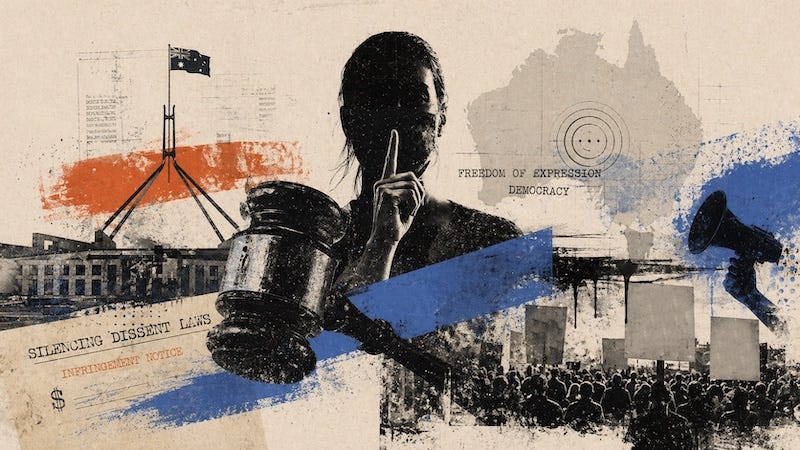
What began as peaceful protest in Brisbane – the usual placards, people calling for an end to the war in Gaza and justice for Palestinians – has been transformed into a test case for the limits of political expression in Australia. This demonstration descended into a confrontation with police, not because of any violent threats or personal intimidation, but because of the use of words that a certain group of people do not like.
Protesters chanting the phrase “from the river to the sea” were surrounded by police officers, resulting in around 20 arrests and multiple charges tied not to any of these actions, but because of their political viewpoints. It reached a surreal level when, in response, a flash mob tried to evade these laws by singing the same words to the tune of a song by the Australian music legend, John Farnham, a sight that captured both the absurdity and the seriousness of these new anti-protest and anti-Palestine laws.
This continues that broader and more troubling pattern that’s developing in Australia: a steady expansion of undemocratic laws that blur the line between genuine hate speech and political dissent. In all jurisdictions, Australia already has the legal frameworks to address incitement, harassment and discrimination. Yet these newer measures, particularly in Queensland, are pulling those definitions into the field of political crackdowns that the former East German Stasi police would be proud of. The result is a legal environment where individuals can face arrest not for harming others, but for uttering innocuous words that a powerful group of people have decided offends their sensibilities, and deflects from their violent intentions to erase an entire group of people from Gaza and the West Bank.
The contradiction becomes even more problematic when considering that the same phrase – from the river to the sea – has been used by many Israeli and Jewish people, including Israel’s prime minister Benjamin Netanyahu, raising questions about consistency, interpretation and enforcement of these laws. How will the law interpret the situation were a pro-Israel Zionist uses the same words or unfurls a banner claiming only Jewish settlers can hold the land, from the river to the sea?
It’s obviously not a legal issue; it’s a political one, and this will be challenged once the laws in Queensland are taken to the Supreme Court to test their constitutionality. In New South Wales, the attempts by Premier Chris Minns to restrict protests have already been dismissed, with the Supreme Court agreeing that the laws are unconstitutional. Minns was advised that this was going to be the likely result by his lawyers, but he persisted anyway, and his competence to enact legally viable laws needs to be questioned.
The consequences of pushing these boundaries go far beyond the immediate arrests or court challenges. Once laws of this kind are enacted, however flawed they might be, they remain in place until they are successfully challenged – which in itself, is an expensive, time-consuming process that places the burden on citizens to prove them wrong, rather than the political leaders who implemented them in the first place.
It raises a bigger question about the style of governance that politicians are happy to ride with: if they knowingly introduce legislation that doesn’t withstand judicial scrutiny, what does it say about the integrity of the legislative process itself? What other laws have they introduced that restrict people’s freedoms, but are not high profile enough for anyone to mount a legal challenge?
This issue has become more complicated by the evolving public debate around the actions of Israel and its obvious desire to erase the state of Palestine, despite what many say when they talk about their “commitment” to a two-state solution, which no longer has much meaning anyway. Over the past decade – especially since the events of October 2023 – public opinion has become more polarised in Australia, but also more critical and nuanced, depending on which new draconian laws need to be navigated.
Criticism of the policies and actions of the Israeli state has become more widespread, including within progressive Jewish communities and across the political spectrum – implementing a genocide in Gaza tends to do that – yet in this climate, the accusations are used in ways that conflate criticism of a state with genuine antisemitism, creating a disingenuous and often confusing public debate. There are dangers here: yes, genuine antisemitism must be confronted, but definitions that encompass every minute detail – including saying “from the river to the sea” – makes the term irrelevant and is just being used to stitch up, silence and jail the people that the state no longer tolerates, and supported by its powerful benefactors.
This factor is not just evident in anti-democratic protest laws, but in cultural and institutional responses as well. Just last week, the decision by University of Queensland Press to cancel and pulp a children’s book authored by Jazz Money, due to unrelated comments made by its illustrator, Matt Chun, highlights how the boundaries of acceptable expression are being redrawn and calibrated according to the interests of the Zionist expansionist project in Israel. Chun’s commentary or opinions didn’t appear in the book itself, yet this link was enough for UQP to justify completely destroying this project, claiming that it breached the university’s policy on antisemitism. The book was considered to be acceptable by UQP even to the point where they spent the $25,000 to print 5,000 copies of the book: who intervened to cause as much damage as possible to this project?
Australian universities have adopted the working definition of the International Holocaust Remembrance Alliance to act against antisemitism on campus, but all it’s going to do is create the situation where institutions will act pre-emptively to avoid controversy, often at the expense of artistic and intellectual freedom. We should expect to see more books pulped over the coming years, due to the weak leadership at many Australian universities, and this will fuel the further decline of their academic credibility: this is what these laws are doing, and this is what their original intention was.
Political leadership also plays a crucial role in the creation of this anti-democratic and anti-intellectual environment. Figures such as Penny Wong and Jim Chalmers, like many of their peers, have engaged in study tours to Israel – essentially, “re-education” and propaganda tours – and diplomatic exchanges that direct their perspectives towards a pro-Israel narrative when they return. Chalmer’s hasn’t had much to say about Israel and Palestine, but Wong certainly has, frequently condoning the actions of Israel by claiming that it’s “difficult to judge” from far away, or raising her voice slightly to the level of concern, or deep concern before whisking the issues away, hoping they never return. It’s certainly been the case with Chris Minns, who attended one of these tours long before he became the Premier of New South Wales, and is now happy to create laws that are disconnected from the shifting public sentiment on Israel. It’s a system that creates convenient political fools and represents an excellent return on investment.
This also continues the overreach that’s eroding democratic principles. Laws that are supposedly designed to promote “social cohesion” are generating division and resentment. And the normalisation of legislation that restricts certain types of protest, will pave the way for new laws that gradually expand the level of state control over everyday life, primarily because not enough people were paying attention when the bad laws were created.
Robust democracies depend not only on the rule of law, but on the legitimacy of those laws in the eyes of the public. When laws are perceived as arbitrary, inconsistent or politically motivated – and we’ve had quite a few of those over the past few years in New South Wales – that public understanding of legitimacy begins to erode. Citizens might comply with new laws out of fear or convenience, but the underlying trust that democratic institutions depend on becomes much weaker.
The question isn’t just about whether particular slogans should be permitted or prohibited – and by now, we should have gone way past this Stasiland type of mentality – but whether the country is willing to uphold the broader principle that political expression – even when it’s uncomfortable or controversial – is a key part of democratic life in Australia. Shouting out “from the river to the sea” isn’t going to destroy our way of life. But criminalising these words certainly will.


It's devastating to watch the swerve towards authoritarian overreach and ludicrously punitive micromanaged shackling of justified dissent.
Any form of meaningful democracy is shrivelling as we watch . This is a form of betrayal of all Australians by governments,
state and federal .