


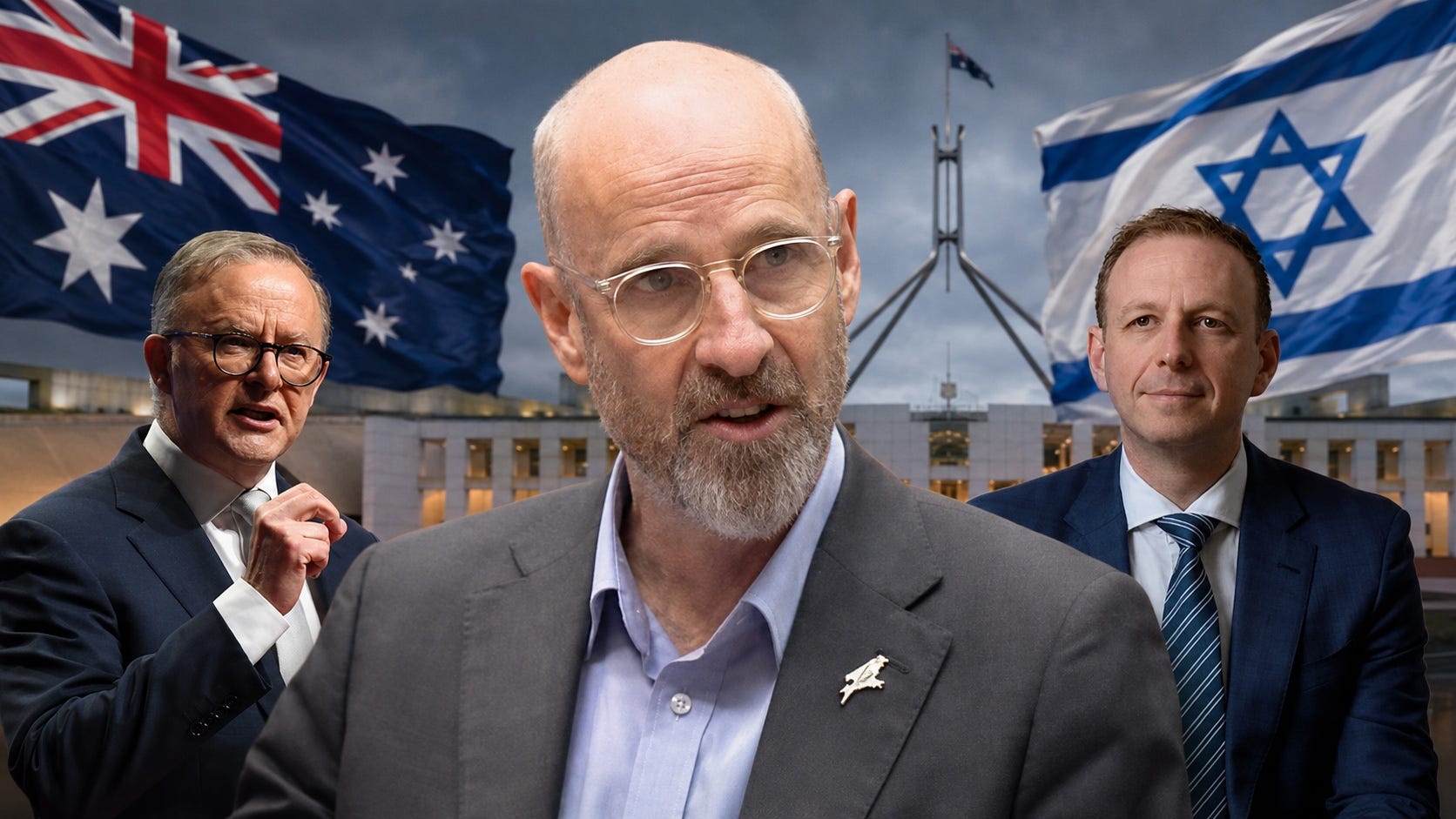
Senator Nick McKim is not the first Australian politician to challenge the pro-Israel or Zionist influence in Australian politics, and he probably won’t be the last, but his comments made in the Senate and subsequent refusal to apologise to a prominent member of a pro-Zionist organisation might be a crossing of the Rubicon that might be difficult to turn back from.
This began from a relatively innocuous exchange in the Senate last week, where McKim was questioning new powers being granted to ASIO – an organisation that has not covered itself in glory in recent years – which includes secret questioning of people who have not been accused of committing a crime. He continued to argue that these laws were coming from a Labor Party that had “completely lost its way, captured by fossil-fuel interests, captured by Zionist interests, captured by the Five Eyes security establishment”.
Predictably, the president of the Zionist Federation of Australia, Jeremy Leibler, turned this parliamentary debate into a public fight, where Leibler published an open letter demanding that McKim must withdraw the allegation and apologise unreservedly to the Australian Jewish community.
In his letter, Leibler argued that accusing a government of being “captured by Zionist interests” was an antisemitic trope of Jewish people secretly manipulating governments and public institutions, making a spurious link to The Protocols of the Elders of Zion, Nazi propaganda, the Holocaust, the Bondi attack and the growth of antisemitism in Australia.
In response, McKim condemned the Bondi attack and denounced antisemitism, but rejected Leibler’s argument that criticism of Zionism is inherently directed against Jewish people – which is the legally and morally correct position – going to say that “conflating ‘Zionist’ with ‘Jew’, as the Zionist Federation does, is fundamentally dishonest”.
As many other people also argue, McKim went on to say that Zionism is a political ideology and that the organisations that are pushing a pro-Israel agenda are legitimate subjects of political debate, in the same way as fossil-fuel companies, pharmaceuticals, or any other lobby group should be.
And these are important points. Opinions about Israel within the Jewish community are wide and disparate, and not all Jewish Australians identify as Zionists, and there some Jewish organisations who publicly oppose Israeli government policy, such as the Jewish Council of Australia. The AIJAC and Zionist Federation are obviously political advocates, but neither can claim to represent every Jewish person in Australia.
McKim has made these claims now, but he’s not the first. Former Labor MP Julia Irwin was one of the earliest federal politicians to speak about the Zionist influence within the Labor Party and in 2005, she criticised Israeli policies of “ethnic cleansing” and accused it of holding Gaza as a concentration camp, supported the rights of Palestinian people and suggested that debates about Israel within the Labor Party were restricted by organised pressure and funds coming in from the Zionist lobby in Australia.
Former NSW Premier and federal Senator Bob Carr is perhaps the most prominent politician to have spoken about this issue. After leaving Parliament in 2013, Carr said the pro-Israel lobby had exercised “extraordinary” and “unhealthy” influence over the prime minister at the time, Julia Gillard, outlining his frustration at the government’s reluctance to issue even a small amount of criticism of the illegal construction of Israeli settlements in the occupied West Bank, settlements that are continuing to grow today – illegally.
Current Australian Greens Senator Mehreen Faruqi has also provided similar critiques in the past – in 2022, she said the “Israel lobby is in overdrive” in response to the inordinate amount of federal parliamentarians who had received sponsored trips to Israel, as part of the so-called “study tours” which are primarily designed to remove criticism of the state of Israel within Australian politics.
So we can see that McKim is not the first parliamentarian to call this out, but he is the first to make the allegation of political capture, and then explicitly refuse to apologise when it was demanded by a Zionist organisation.
The political capture in full view
If McKim is alleging that much of Australian politics is captured by pro-Israel and Zionist interests, what does this actually look like? Of course, the most visible form of this is the access to politicians.
The AIJAC is a public-affairs organisation and is very open about its contact with politicians, journalists, officials, advisers, academics and a wide range of community leaders. Its signature program is the Rambam Israel Fellowship, which it uses to target specific current or aspiring leaders in a wide range of fields, and provides them with access to Israeli politicians, military and security officials, commentators and journalists. It’s not the riff-raff or the people who they believe don’t have the influence – that would be a waste of time and energy – it’s only the people within society that they feel have enough leverage for them to spread this information to a wider audience, or to enforce it upon the minions of the organisation that they lead.
This is then reinforced or “topped up” after they return from these “study tours” – follow up meetings with ministers and opposition leaders, private briefings, political functions, media commentary, submissions to inquiries and campaigns against the recognition of Palestine, influencing university policies, school curricula and monitoring the news coverage by the ABC or SBS.
The money flowing into political parties from pro-Israel and Zionist groups is difficult to trace and substantiate, and there’s no evidence to suggest that the AIJAC or the Zionist Federation are direct donors to the Labor Party or to the Coalition. But there is so much money flowing into politics that is unaccounted for that makes it difficult to rule it out.
Australian current donations laws provide a flood of anonymous funding from those groups who have the resources and coordination to keep it that way and maintain their political influence. The current federal disclosure threshold is $17,300 and a small group of well-funded individuals – for example, ten people – could easily create a coordinated campaign to fund a political party through nine federal, state and territory divisions, and there you have it – $1.5 million, no questions asked, but certainly a conversation that can be brought up at the next private meeting with the prime minister.
And that’s just through undisclosed donations – there’s fundraising dinners, there’s access to senior politicians and another anomaly which is classified as “other receipts” – whatever that might be – but the upshot is that the public has no way of knowing where this money is coming from, who’s behind it, and what type of political influence is gained through this.
In 2025, $138 million was made in undisclosed donations – “dark money” – and this is roughly a third of all political donations. Taking these large sums of money into account, it would be possible for political operatives – or a political advocacy group – to make considerable donations while flying completely under the radar of donations laws and remaining completely anonymous. That’s not to suggest that it would only be coming in from pro-Israel or Zionist interests but given human nature and the political structures and behaviours as they exist at the moment, it would not be surprising at all, if this was actually the case.
This funding then produces a circular process – acceptance of money influences preselection issues in both major parties, dependent on which faction is accepting the money; it affects the messages that political parties put out and, ultimately, politicians quickly learn which positions on Israel provide them with promotions – for example, NSW Premier Chris Minns and Foreign Minister Penny Wong – and which positions will make them languish on the backbench and never to be promoted again – for example, Labor Party backbencher and former minister, Ed Husic.
How the flow of dark money affects political parties
The Labor Party faces many internal problems over its parliamentary stance on Israel and Gaza. Most of its membership and voter base has become highly critical of Israel, while its senior leadership is all in with the US alliance, defence matters and the relationships with pro-Israel organisations which, is anathema to Labor’s membership and contradicts the national Labor Platform. And it’s very clear that any Labor MP who challenges any of these positions is not going to be promoted or heard from any time soon, and possibly facing a preselection challenge at the next election.
For the Liberal Party, the internal issues might be different but it ends up with the same result: a clear alignment with United States policy and pro-Israel influence through the politics of national security, conservative media and evangelical Christianity. Any unlikely challenging of this position coming from a backbencher is guaranteed to end in political isolation, although a bigger question would be how they ever became a member of the Liberal Party in the first place.
The Australian Greens are far less restricted in what they can say: their members and supporter based are far more critical of the state of Israel, far more supportive of Palestinian rights, and the hostility coming from the conservative mainstream media and pro-Israel groups is already to be expected.
And their perspectives are more closely aligned to mainstream opinions about Israel – the often quoted research from the Pew Research Center suggests that 79 per cent of Australian hold an unfavourable view of the state of Israel, and this is a consistent number in the 36 other countries that Pew included in their survey.
McKim has opened up a political debate that has existed for many years but has usually been conducted on the quiet in hushed whispering tones, in private, or when a politician has left office. It’s just a question of whether this represents a genuine turning point and others will muster up the courage to join him, or if he’s silenced in other ways and his colleagues decide that standing up to these powerful interests is just a bridge too far.
If they do find the courage, it could result in a long-overdue inquiry – perhaps another royal commission to compete with the farce of the current inquiry into Antisemitism and Social Cohesion – and find out who exactly it is that influences Australia’s foreign policy matters and how far up the chain it extends.
That’s why this exchange between McKim and Leibler could be a critical point where the Australian political system – and the rest of society – starts asking the questions about where everyone’s loyalties lay, the questions that should have been asked many years ago.


Finally an Australian politician with some courage.
The ALP, Coalition and One Nation with their press releases could have just copied verbatim the Israeli Foreign Ministry.
Senator McKim a consistently strong communicator along with Shoebridge.