


The Royal Commission into Antisemitism and Social Cohesion is – yet again – descending into a forum of “hurt feelings” from anonymous speakers, and advancing the political agendas of Zionist groups in Australia, at the expense of everyone else. The Commission was ostensibly created to address antisemitism in Australia and strengthen that favourite catchphrase of the Prime Minister – “social cohesion” – when, in fact, it seems to be working in the opposite direction, and fewer people understand what this social cohesion is meant to achieve.
As we suggested earlier this week, the latest evidence provided by Special Envoy Jillian Segal is a prime example. Segal has called for an independent body to scrutinise the ABC and SBS over their reporting of Israel and Palestine, arguing that the broadcasters should adopt the IHRA working definition of antisemitism and, by implication, substantially alter their editorial approach to the conflict. More troubling is the suggestion that Australia’s public broadcasters should report more of “the good things Israel does” because their coverage has been “too negative”, as if the media should only operate in an environment where human interest stories and the supposed goodness in the heart of Israel should be presented to the Australian public.
But why should the media go searching for the “positive news” from Israel – under the direction of a body created by Segal – when all it’s going to do is to support a colonial–settler enterprise that’s stolen the land of Palestinians and destroyed so many lives? A state which has killed at least 70,000 people in Gaza – figures which Segal has disputed, even though the state of Israel broadly agrees with the number – and, according to some epidemiological assessments, up to 680,000? Where can this “positive news” be found?
Ironically, Segal’s broader criticism of Australian media is difficult to reconcile with the coverage that has actually been provided. If anything, mainstream reporting has frequently reflected official Israeli perspectives while devoting relatively little attention to the humanitarian consequences of the war in Gaza. Yet even this level of reporting is now regarded as excessively “negative” of the state of Israel.
Segal’s term as Special Envoy to Combat Antisemitism expires in July next year, and it’s unfortunate that we’ll have to tolerate her misinformation and the promotion of an extremist ideology for the next 12 months. A better outcome for social cohesion would be achieved if her tenure was terminated immediately, but given the current state of affairs and the Prime Minister’s lack of backbone on anything to do with Israel–Palestine affairs, that’s unlikely to happen.
The other hearings at the Commission have also shown a similar imbalance. Of course, genuine incidents of antisemitism need to careful examined but what exactly are we hearing at the Commission? What legal checks and balances are being used to verify the evidence, given that most of is being revealed under the cloak of anonymity?
Among the evidence presented was the testimony of a UNSW academic, who described four students allegedly performing Nazi salutes towards him during a business class in 2024, before going on to suggest that it wasn’t clear if they knew he was Jewish, or not. How carefully was this evidence scrutinised by counsel assisting? Other students claimed that friendships dropped off when they revealed themselves as Zionists and supporters of the state of Israel – as if, somehow, we’re meant to try really hard to maintain the relationships with those who condone the actions of a state that’s been committing genocide, war crimes and apartheid since at least 1948. Life is not as easy as that.
Of course, if this is what people are feeling and experiencing, that is real and it can’t be denied. But these are feelings and this is a Royal Commission, not an intimate counselling session where the feelings of hurt can be listened to by a paid psychotherapist, remain unexplored and not interrogated in any way.
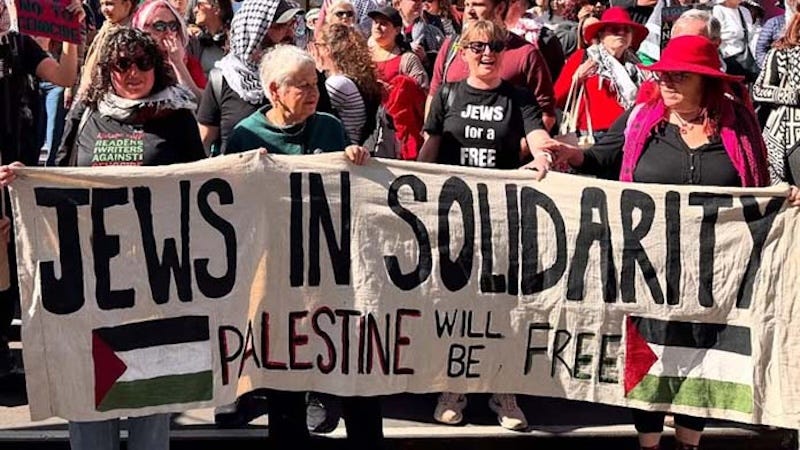
Compare this with the material presented by co-convener for Students for Palestine Yasmine Johnson, who was continually questioned by counsel assisting. Johnson said that Israel is a “political project”, and that Zionism is an “ideology which supports the existence of the state of Israel, and that is a racist project”, and every piece of evidence provided by Johnson – who is Jewish – was constantly stalled, interrupted and queried. Of course, this is what a Royal Commission should do, but why is it that the information that runs counter to the narratives supported by Zionist groups is always carefully scrutinised, but no such scrutiny for the endless hurt feelings of Zionists who feel that any opportunity to portray themselves as the victims in their quest for an exclusive supremacist greater Israel project always needs to be taken up?
Nobody should feel that they are being harassed in a university environment – or any environment at all – but we need to get real about this. Although the Royal Commission has tended to focus on evidence of “hurt feelings”, the presence of Johnson – and the testimony provided last week by Sarah Schwartz, human rights lawyer and executive officer at Jewish Council of Australia – shows that there is a broader understanding and different opinions of the Israel–Palestine question within the Jewish community in Australia, than the ones that we are being led to believe through this Royal Commission.
So why do we mainly hear from the extremist elements within the Jewish community? Soon after Schwartz provided her testimony, News Corporation predictably lead the attacks on her, and this follows on from criticism from Zionist lobby groups describing her as “a self-hating Jew”, a “traitor”, as well as distributing memes depicted her as a rat. Why is this behaviour never called out?
And while there’s been a big focus on the hurt feelings on campuses in Australia, not all campus experiences around the world are the same, and these have received very little attention during these proceedings.
Since October 2023, Gaza’s education system has been devastated on a scale without precedent in modern times. Many experts and international human rights organisations have described this destruction as “scholasticide” – the destruction of an entire education system through the killing of students, teachers and academics and the demolition of schools and universities.
During this time, more than 18,000 students, around 780 teachers and education staff, and at least 120 university academics have been killed. Around 97 per cent of school buildings have been damaged, more than 430 school buildings have suffered direct hits from the Israel Defense Forces, and around 92 per cent now require major reconstruction or a complete rebuild. Gaza’s higher education sector has effectively ceased to exist, with 22 of its 38 university campuses completely destroyed, another 14 seriously damaged, and 195 of 206 university buildings are now unusable.
UN experts have also suggested that these attacks will have a devastating long-term impact on the fundamental right to education, culture and freedom of expression for an entire generation of Palestinians, as well as creating long-term trauma. It’s a pattern of destruction that amounts to an intentional effort to erase Palestinian educational and intellectual life altogether, which is one of the clear and internationally recognised definitions of genocide.
But despite this scholasticide perpetrated by the state of Israel, can we still be friends? And please don’t call this out, because something that might have resembled a Nazi salute on campus – can’t be too sure, your honour – really hurt my feelings.
This catastrophe has barely been featured in a Royal Commission ostensibly concerned with social cohesion. The destruction of an entire education system, the deaths of thousands of students and hundreds of academics, and the elimination of Gaza’s universities raise profound questions about human rights and the application of international law. Yet, here in Australia, we have a public forum for some of the most privileged people in society, oblivious to the detrimental and genocidal actions of the state of Israel that they dearly love, complaining that nobody wants to be their friend anymore. It’s absolutely pathetic.
We also heard evidence – if that’s what it can be called – from Professor Josh Keller, representing the Australian Academic Alliance Against Antisemitism (5A), who claimed that using the word “anti-Zionism” with a hyphen is anti-semitic (oops, my mistake – that should be antisemitic) but then failed to explain how this could ever be detected in the spoken language, rather than text on a page.
Yes, we’ve reached the realm of the truly bizarre and insane, where even the innocuous hyphen that has endured without charge since the 1600s, is now apparently guilty of antisemitism. Let’s see what the good professor has in store for the en dash, em dash, and other forms of punctuation, for their alleged crimes against the state of Israel.
This is now extreme overreach – as well as foolish – and the danger is that social cohesion and the opinions that we are told that we need to listen to are gradually being redefined according to the political priorities of particular interest groups, rather than existing as a universal democratic principle. A Royal Commission established to reduce division is now moving towards a situation where criticism of the policies of a foreign government is itself becoming subject to official scrutiny.
Australia’s democratic institutions depend upon free and open independent journalism, open debate and the ability to criticise governments – whether Australian or foreign – without fear of political sanction. If those principles are weakened in the name of “social cohesion”, then the Commission will ultimately reach the opposite of what it was established to achieve.


That Albanese has handed so much power to the UNELECTED Jillian Segal and her fellow Zionist lobby groups and donors is an attack upon the very core of democracy , and a betrayal of all Australians who are appalled at the genocide being committed by
the Zionist Israeli government . Does this woman applaud , and find perfectly fine the wilful slaughter of Palestinians and
Lebanese civilians , and where is her defence of these crimes against humanity ? Legitimate polls have found that around 78% of
Australians are against the genocide , as any normal person would be . This leaves the question of why Albanese , Minns and other
Premiers are so eager to grovel to the Zionist agenda . How very dare they entertain any consideration of a special police force to protect
Zionist members of the community !! Not to mention the power given to Segal to dictate what schools and universities can teach or discuss . This is fascism on steroids , and will stain the legacy of these Australian governments in perpetuity .
The farcical imitation of a “Royal Commission into antisemitism “ is another disgrace , apparently planned and produced by the Zionist community and lobbyists . Shaming this nation and all Australians.
Pretty obvious that the RC was set up to achieve exactly what it's shitting out.