



The Royal Commission on Antisemitism and Social Cohesion commenced as an examination of prejudice and “social cohesion” – the Prime Minister’s most favourite phrase – but is now developing into an attempt to hijack Australian educational institutions and redefine acceptable political debate, according to the diktats of a very small, powerful and influence group.
The Special Envoy to Combat Antisemitism, Jillian Segal, is pushing for antisemitism educational curricular of a particular kind to be introduced into early childhood programs, all the way through to higher education. It’s an outrageous overreach and should be resisted at every opportunity.
In response to the Bondi Beach shootings in December 2025, Prime Minister Anthony Albanese announced the Antisemitism Education Taskforce to be chaired by David Gonski. It’s unclear how an education taskforce was meant to deter radicalised and potential shooters in the future, but it covers every level of the education sector: early childhood education and care, primary and secondary schools, universities and the wider higher-education sector.
This was the first part of access to the educational system, but the reach of this is extraordinary – curriculum, teacher training, school regulation and university policy within a national structure, essentially dedicating itself to one specific form of discrimination, and ignoring all the others.
Segal has also announced the establishment of the National Centre for Education Against Antisemitism, an organisation that will be independent of government, but able to influence government and education departments, and will deliver training and educational materials to governments, schools, businesses, law-enforcement agencies and not-for-profit organisations.
In quite an audacious statement, Segal told the Royal Commission that education needs to reach younger age groups because younger children are more open to changing their views, while university-aged students were more likely to be fixed in their opinions. This is really troubling, and sounds more like an adventure in proselytising: children’s willingness to absorb new ideas should be based on a balanced education and the ability to develop critical thinking, not force-fed with the ideas coming in from Zionist zealots, who are intolerant of any criticisms of the state of Israel.
While this curriculum hasn’t been developed and is yet to be implemented, the real question is why this is being allowed to proceed without any serious political or public scrutiny.
The problem of political advocacy within education
It could be argued that all state-based education and curriculum verges on propaganda, as it defines the acceptable behaviours and thinking for future generations, based on what our educational leaders believe is in their best interests and that of society. But at least in modern educational settings, critical thinking has replaced the style of old-fashioned rote learning, enabling students to acquire skills that will allow them to become more adaptable in an ever-changing world. Segal’s proposals would do the opposite.

Holocaust education already has a place in Australian schools, mainly within secondary history, particularly in Years 9 and 10, as part of the study of the Second World War, Nazism, racism and genocide, while some schools do include age-appropriate material in Years 5 and 6.
There’s no serious argument being put forward against the teaching of the Holocaust as a major historical event, and there’s no question that students should understand the rise of Nazism, the systematic persecution and murder of millions of Jewish people and the political and institutional conditions that made those crimes possible, to ensure that it never happens again.
But Segal’s proposals go far beyond the historical understandings of the Holocaust: it includes Jewish history and civilisation, the positive contributions of Jewish people to Australia, and what she describes as modern forms of Jew hatred, including anti-Zionism, online conspiracies, and political hostility directed towards Israel.
And it’s at this point where her proposals move from education about discrimination – and only the one form of discrimination – and into the field of propaganda and agitprop. Segal wants to include the International Holocaust Remembrance Alliance definition of antisemitism, which includes making statements that describe Israel as a racist project, comparing Israeli policies as fascist or Nazism, or denouncing Zionism.
The IHRA definition has been criticised by many legal scholars, human-rights organisations, Jewish academics and civil-liberties advocates, precisely because it includes anti-Zionism and criticism of Israel within its definition of antisemitism, and potentially criminalises the act of speaking out against the actions of Israel in Gaza and West Bank, which presumably would include accusing Israel of genocide, apartheid and war crimes.
If this type of framework is embedded in schools, universities and professional training, students and teachers – and even toddlers – could be placed in the position of having to interpret discussion of Israel and Palestine through the lens of educational bodies that are committed explicitly to Zionism and the defence of Israel. This is unacceptable, totally.
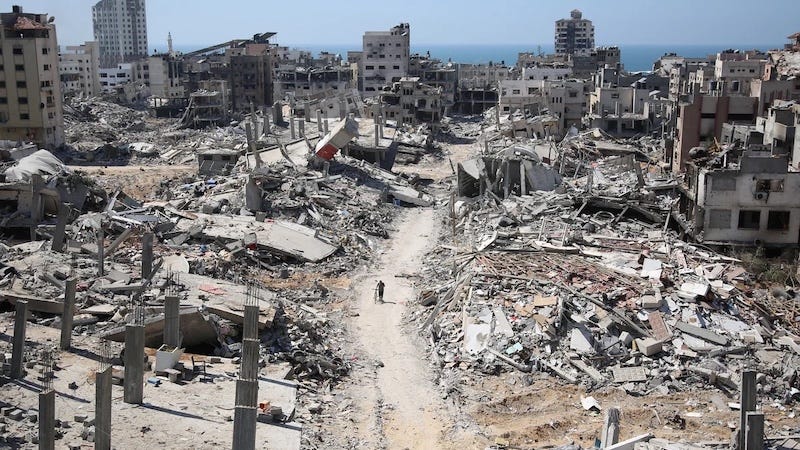
Israel is accused of severe breaches of international law in Gaza and the occupied Palestinian territories, and has been for some time. Its government has overseen the devastating genocide, ecocide and scholasticide of Gaza, the displacement of most of its population and restrictions on food, medicine and humanitarian assistance.
Israeli settlements continue to expand across the occupied West Bank – and this has been determined as an illegal act by the world community – while Palestinian communities are displaced, their homes demolished and their land absorbed. This didn’t commence on 7 October 2023: this has been the story of Israel’s behaviour ever since it was formed in 1948, if not before.
These are not just abstract disputes or religious disagreements that date back thousands of years: these are modern-day questions about military power, occupation, dispossession, human rights and American interference. Students and academics – and toddlers in early education settings – should be free to analyse these issues without having to demonstrate that their conclusions comply with a bizarre and ill-defined definition of antisemitism.
There’s also a question of proportionality to this debate. Australia had approximately 4.16 million students across all of its schools in 2025. Jewish students comprise around 0.4 per cent of the national school population, and a substantial proportion of Jewish school-aged children – around 53 per cent – attend Jewish day schools. In most Australian schools, Jewish students represent a very small part of the student population – around 0.2 per cent, or, on average, one student in a school enrolment of 600 students, which is the average size of a school population across Australia.
Before we are accused of antisemitism yet again, this does not mean Jewish children are undeserving of protection, far from it. Every student has the right to attend school without being abused because of their religion, ethnicity or identity, and that goes for all students. But it does raise legitimate questions about why one community’s history, civilisation, social contributions and contemporary political concerns should become the subject of a specialised national program going across every level of education, especially for such a small cohort.
Why should every Australian student be required to undertake dedicated education about Jewish history, civilisation and exceptionalism? If this is the principle we are going to accept, will there be equivalent programs be created for Islamic civilisation, Chinese history, Greek culture, Lebanese migration, Italian, Slavic, Indian history and the contributions of every other community to Australian society?
The curriculum would quickly become a collection of programs designed to satisfy the political and cultural demands of particular organisations, leaving less space for Australian history, Indigenous dispossession, democratic institutions, economics, science and the practical knowledge students already struggle to receive.
The issue is not whether Jewish history is worthy of study (see previous note about accusations of antisemitism) but why should every student across Australian preschools, primary schools and high schools be forced to know this history?
And what would this history involve? Harry Triguboff defacing many Australian cities with his Soviet-style apartment buildings over many decades? Frank Lowy creating the Westfield shopping centres that crippled so many business operators through high rents and unfair bargaining power? Or would it be antisemitic to balance the “positive contributions” with the more deleterious effects?
Would this history also point out that Sir Isaac Isaacs did indeed become one of Australia’s finest Governors–General but that he also warned about the dangers of political Zionism and that recognising Israel at the expense of Palestine would lead to ongoing war and destruction?
This is a real problem. Australia shouldn’t have a specialist organisation acting like a star chamber that decides – at the behest of a government-appointed right-wing envoy – how millions of students across the country will be taught about Jewish identity, Zionism, and the state of Israel.
Protecting a community or restricting political debate?
The latest analysis from the Pew Research Center suggests that 79 per cent of Australians have an “unfavourable view” of the state of Israel (49 per cent very unfavourable; 31 per cent somewhat unfavourable), and this has deteriorated remarkably since their last poll on this issue was performed in 2013, when the figure was 48 per cent unfavourable – still high, but nowhere near the levels of today.
Despite the desires of the Segals of this world to think otherwise, these results can’t just be dismissed as evidence that most Australians have become antisemitic. They haven’t. The figures indicate the widespread opposition to the behaviour of the state of Israel and the Israel Defense Forces, and growing public recognition of the humanitarian catastrophe that has been inflicted upon Palestinians by the state of Israel.
This presents the Albanese government with a big dilemma. At the same time public hostility towards Israel is increasing, his government is creating institutions that want to redefine that expression of hostility as antisemitism. Albanese could just say “no” and rule these outlandish educational proposals out right now, but we know that he won’t, because he wants the favour of everyone within the establishment class, even the extreme Zionists who come knocking on his door. And, as we’ve seen since October 2023, every political leader in Australia is only too happy to throw out the rule book for democracy and acquiesce to the will of these extremists, even if it comes with a high political cost.
When extreme definitions of antisemitism are catapulted into every part of society – schools, universities, workplaces, government agencies and professional bodies – we can see that it’s less about discrimination and more about regulating what people can say about Zionism, Israel and Palestine.
And we can see exactly what the outcome will be: teachers will avoid discussing Gaza because they fear complaints and reprisals. Universities will call in the police and remove protesters, rather than risk the accusation that they failed to provide a “safe environment”. Students will be expelled for using or saying political slogans the antisemitism envoy disapproves of. Employees will say nothing, rather than risk the allegation that their criticism of Israel has created an antisemitic workplace.
No appointed envoy or organisation should be placed in a position where they can determine the educational requirements of the entire country. That is totally unacceptable in a modern democracy, but it’s the path that we’re currently going down and it’s going to be very difficult to turn around.
Yes (and yes, we do have to point this out again and again), antisemitism should be confronted wherever it occurs. Jewish students should be safe at school, at university and be able to participate in public life without being blamed for the actions of a foreign government. But combating antisemitism doesn’t mean keeping the scrutiny away Israel, and treating Zionism as an unquestionable principle.
The danger isn’t just that these proposals will restrict the criticism of Israel: it will weaken the fight against genuine antisemitism, because when everything is antisemitic, then nothing is. Australia doesn’t need a curriculum that approves opinions about Israel. It needs an education system that teaches students to examine history, recognise propaganda, oppose racism and question power – whether it’s coming from our own government, or another one in a faraway location.
A real education teaches students how to think, but an ideological education tells them what they are allowed to think. There’s a key difference. If Segal’s proposals cross that line between the real and the ideological, they’re not going to strengthen Australian democracy or add to “social cohesion”. All it’s going to do is try to protect one community so it can regulate and restrict the political thoughts of everyone else.


The slope is becoming more slippery with each new anti semitism initiative and AA and Labor's seemingly willing support.
There are several unanswered questions if this were to proceed. Can I and my children opt out of the indoctrination? What are the penalties for opting out? Will the police arrive at my door to arrest me for resisting?
AA and state and federal Labor's positions on this remain inexplicable to me without descending to explanations such as state capture.
Brilliantly well said . The nursery rhyme , “Come into my parlour “ said the spider to the fly….” leaps to mind . Except in this case it is the fly (Albanese ) being invited , if not forced into the parlour of the spider , whom he is alleged to have selected as his “antisemitism envoy”, Segal . That any government would happily permit foreign agencies to dictate policy to them is tantamount to betrayal of the nation’s future . Why use bombs on a population when you can indoctrinate them from birth with the PERMISSION of a grovelling government ?? There are no words sufficient to describe the depths of grovelling submission by this excuse for a government to a foreign state now committing genocide in Palestine . Meanwhile Albanese gives a puff piece interview to The Saturday Paper in the grounds of The Lodge while playing with his dog and pleading for the public to “lower the temperature “. This is Leadership ??? Shame on him . 😡😡😡