


Labor conferences are carefully stage-managed affairs. The delegates will cheer, the leaders will deliver their polished speeches, and all the awkward debates are quietly buried behind procedural motions – except for a few orchestrated and tolerated tiffs – and everyone leaves declaring unity has been achieved. But there are far deeper issues that are bubbling beneath the surface.
The warning from Premier Chris Minns about the rise of One Nation wasn’t so much a piece of political commentary, but an admission that large sections of Labor’s traditional electoral base have become impatient. Cost-of-living pressures, housing affordability and declining faith in institutions have created fertile ground for political outsiders, while governments continue promising caution and stability instead of transformation.
The conference also exposed Labor’s increasingly difficult balancing act, where many delegates demanded stronger action on gambling reform, improvements in civil liberties, and housing reforms, while the leaders continued to highlight caution, discipline and incremental change. Truly inspirational stuff. Government has become an exercise in managing vested interests without disturbing the traditional centres of economic and political power, and conferences like this show that there’s unlikely to be any change in this position.
The challenge for Labor – both in NSW and federally – is that electorates rarely reward the slow careful management forever. Voters usually understand when governments are restricted in what they can do, but they also recognise when “caution” just becomes an excuse for avoiding difficult decisions and postponing this for another day. As Labor heads towards its national conference in late July, the bigger question isn’t about whether the party can maintain internal discipline and unity, but whether it can still convince Australians that it governs for something larger than just remaining in office for the sake of it.
The party of protest removes the protestors
The Labor Party was born out of strikes, picket lines and people making those in power deeply uncomfortable. These days, it calls in the police to remove the protestors.
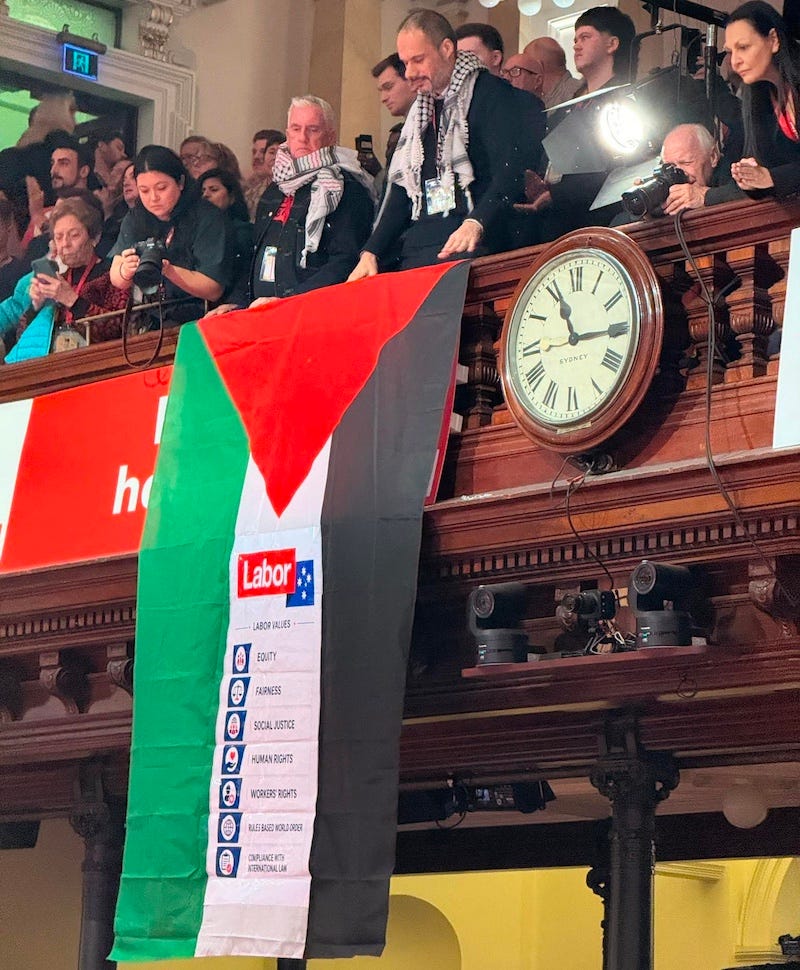
The defining image from the NSW Labor Conference wasn’t Anthony Albanese outlining the government’s agenda or Minns warning about One Nation: it was the spectacle of Labor members unfurling a Palestinian flag from the gallery within Sydney Town Hall, only to be escorted out by security and police while delegates applauded their removal. We’re still not sure why: Australia recognised the state of Palestine in 2025, so it can’t be because it’s an unofficial flag. Perhaps a certain group of privileged people who donate heavily to the Labor Party found it offensive?
Somewhere in the atmosphere at this moment, the ghosts of the labour movement probably looked on in astonishment and bewilderment, barely able to recognise what their party had become. It takes a special kind of political evolution – and an infiltration by Zionists – for a party built on organised dissent to applaud the removal of dissent from its own conference.
Palestine has become a lot more than just a foreign policy debate – it’s become a mirror reflecting Labor’s broader political identity, and it’s not a pretty sight. Outside the conference, thousands continued to demand an end to the slaughter in Gaza, and the application of foreign policy that’s guided by international law rather than the politics of convenience. Inside, the leadership offered the carefully constructed language of bullshit, more expressions of concern and another reminder that these matters are, naturally, “complex” and so so far away. And they always seem to become remarkably complex whenever powerful allies, donors or uncomfortable geopolitical realities are involved.
The real argument isn’t just about Israel and Palestine. It’s about whether principles can survive within the Labor government and broader labour movement, where the established leaders deflect and make excuses for Israel’s genocide in Gaza and war crimes in Lebanon, while the wannabe leaders within unions simply keep quiet about it. Can’t jeopardise those chances of preselection in a safe Labor seat, can we Sally.
We can predict it now: the National Conference later this month will undoubtedly feature passionate speeches about Palestine, a few procedural compromises and carefully negotiated wording designed to offend as few people as possible. Or perhaps the police will arrive to ensure that nothing is discussed at all.
That’s also the modern art of politics, especially within the modern Labor Party: silencing dissent and turning a moral issue into the language of the committee, just like Arendt’s banality of evil. But no amount of carefully massaged resolutions can disguise the growing divide between a leadership determined to downplay controversial issues, hoping they just go away, and a rank-and-file membership asking why a party that once prided itself on challenging power now seems so comfortable accommodating it.
Labor often reminds Australians of its proud history. But it’s not a history that’s being added to, and it’s unlikely that the photograph of the unfurling of the Palestinian flag at this conference is ever going to feature in the archives at Trades Hall.
When the centre of politics is empty, someone else moves in
The most revealing comment from the NSW Labor Conference wasn’t even about policy – it was Premier Minns describing the electoral challenge at the 2027 state election facing Labor is “Everest” and identifying One Nation as the party climbing the mountain, an admission that something far deeper is happening in Australian politics and political leaders have yet to work it out.
For years, especially since the onset of neoliberalism in early 1980s, both major parties have reassured voters that economic growth was necessary and would eventually solve everything. Everything. Instead, many Australians have watched housing drift out of reach, secure employment become far less secure, public services stretched thinner to the point where they’ve almost gone, and regional communities steadily hollowed out. The electorate was always told that globalisation would create winners, but what they’ve discovered instead is that someone else in the upper echelons usually collected the rewards.
The political establishment has spent years treating One Nation as an unfortunate outbreak of voter irrationality, rather than asking why so many people have concluded that the established parties are no longer speaking to them. The irony is that the Labor Party was a part of the process that created these frustrations in the first place, and continues to create policies that concentrate wealth.
The Coalition, meanwhile, offers familiar slogans dressed up as fresh thinking. Neither side appears especially enthusiastic about questioning the economic orthodoxy that has dominated Australian politics for the past four decades, and they are suffering. It’s the Liberal Party that’s suffering the most at the moment, but Labor’s turn will arrive at some point in the future.
This leaves a political vacuum, and politics has an iron law about this: vacuums never stay empty and are always going to filled with something else. If mainstream parties refuse to channel public anger towards concentrated wealth, corporate power and structural inequality, others will happily redirect that anger elsewhere – towards migrants, refugees, public institutions or whichever convenient target happens to be available that week.
One Nation’s rise is not the disease, it’s the fever. The disease is a political system that continues asking voters for patience while assuring them that the very economic model producing their insecurity just requires yet another minor adjustment, and everything will be okay.
Eventually, enough people will stop believing this and will be eager to look elsewhere. The fact that One Nation offers no solutions at all is an indictment on the current state of politics: it’s so far gone that the electorate is prepared to consider a party which is led by a dilettante, is incomprehensible, and unworkable. It will take a long to recover from this.
The house always wins, especially in politics
Every few years, Australian politics rediscovers poker machines. Politicians speak earnestly about the harm caused by gambling, the families devastated by addiction, and the billions quietly disappearing from household budgets into rows of brightly lit machines that go ka-ching. As usual, there are the speeches, the promises, and carefully-worded motions of commitments. But then the clubs industry reminds everyone who really holds the cards in this game.
The Labor Conference has at least shifted the conversation somewhat, or around 0.1 per cent. Delegates backed a moratorium on new poker machine licences, higher taxes on large club operators and a long-term reduction in machine numbers. On paper, it’s one of the strongest anti-gambling positions adopted by Labor in years. On paper. The question now is whether it becomes government policy, or glanced at by the relevance minister, a wry grin, before carefully disposing the recommendations in the bin.
That is where politics has become considerably less courageous. Clubs NSW has spent decades cultivating extraordinary political influence, wrapping one of Australia’s most profitable gambling industries in the language of community sport, local charities and family entertainment. Yes, we have families devasted from the effects of gambling, but have a look the local football team receiving that sponsorship cheque. Look at the RSL hosting Anzac Day, and wow, the junior netball club has just received their new uniforms. Meanwhile, billions of dollars continue to quietly disappear through poker machines in Western Sydney, with a disproportionate share coming from communities least able to afford the losses.
The remarkable achievement of the gambling industry has been convincing governments that regulating poker machines is somehow politically riskier than allowing the social consequences to continue. Few industries enjoy such a successful arrangement: private profits, public costs, and politicians forever searching for reasons why now isn’t quite the right time to act, because we can’t jeopardise those new uniforms for the netball juniors, can we?
If the Minns Government follows through on these reforms – and sorry to point this out, but it’s a hypothetical: this will never happen – it will inevitably be accused of attacking community clubs. Expect the familiar warnings about job losses, struggling sporting organisations and threats to local communities. It is a script that’s been final tuned over many decades. Yet conspicuously absent from the industry’s public campaigns are the people sitting alone in front of poker machines at midday, the families emptied by addiction, or the suburbs where gambling losses function as a silent tax on financial desperation.
This is how government operates in NSW: there’ll be retreat from these recommendations – if it even gets to that stage – and we’ll be reminded yet again that in politics, as in gambling, the house usually wins.
Brilliantly well said , thank you 🙏. Minns and Albanese have been shrivelling any concept of a “ a Labor Party “ since they
assumed office . How is it possible to have any trust in , or respect for a “Prime Minister “ who supported Palestine until he became
PM , and then changed tune abruptly to support his “valued friends “ the Zionists who are committing genocide ??
How is it possible to have any trust at all in a NSW Premier who took an all expenses paid trip to Israel for “information “
aka indoctrination , and who now sees fit to have his Police Force arrest any peaceful protester who dares to object to
genocide ? Ben Chifley , Gough Whitlam must be spinning in their graves . Paul Keating must be disgusted .
Shame on both the PM and the NSW Premier , who are opening the door wide to the insanity , racism to the max , and ignorance of One Nation . THIS is the consequence of their spineless grovelling .
Labor is the new Liberal party in all but party colour.