



The political fallout from the treatment of Gaza flotilla activists by Israeli authorities is becoming a much bigger issue than the actions of one extremist minister posting humiliating videos on social media. What occurred on the Global Sumud flotilla – where civilians were illegally detained in international waters, kneeling with zip ties around their wrists, while Israel’s extremist national security minister Itamar Ben-Gvir mocked them publicly – has exposed more openly what Western governments have spent nearly two years defending, or carefully avoiding confrontation with Israel over the destruction of Gaza and the broader collapse of international law.
For leaders such as Prime Minister Anthony Albanese and Foreign Minister Penny Wong, the problem isn’t just about Ben-Gvir, it’s what he represents. Ben-Gvir is no longer the maverick outlier who can conveniently be dismissed as an embarrassing extremist operating on the fringes of Israeli politics. Whenever Albanese and Wong claim Israel does have a right to defend itself, this is the Israel that they’re also expecting us to defend as well.
What is frequently ignored is that he is a part of the Israeli government and holds enormous influence over Prime Minister Netanyahu’s splintered coalition and represents a growing concern within Israeli politics that’s becoming harder for Western leaders to explain away while still pretending Israel remains a beacon of democracy – the only one in the region, apparently – and supposedly operates within the boundaries of international laws and protocols.
Ben-Gvir’s behaviour is grotesque, but it’s not new: this is who this guy is. Public humiliation, dehumanisation and his theatrical display of dominance have long formed the main part of his political identity, and he humiliates Palestinians in the same way each and every day. Recently, he celebrated his birthday with a cake decorated with a golden noose, after he mandated the death penalty by hanging for Palestinians deemed to be engaged in “acts of terrorism”. And we know that in Israel, “terrorism” could mean anything, even a Palestinian child throwing a stick at a police officer after being arrested for an unknown and concocted criminal charge.
Ben-Gvir is heavily influenced by the banned fascist movement, the Kahanists, who openly advocate Jewish fascism and supremacy, violent nationalism and the expulsion of Palestinians. In 1994, one such Kahanist – Baruch Goldstein – murdered 29 Palestinians at the Cave of the Patriarchs in Hebron. Ben-Gvir also displays Goldstein’s portrait in a prominent position in his home – an illegal settlement near Hebron – and has constantly lauded and admired him throughout his political career, claiming that “he is my hero”. These are the values Albanese and Wong want Australians to defend when they say Israel does have a right to defend itself.
What makes this difficult for Western governments to continue to ignore is that Ben-Gvir is not irrelevant within Israel, or some kind of fringe activist. Polling over recent years has shown significant levels of support for his rhetoric and actions among the Israeli public – according to Pew Research, 36 per cent of Israelis support his actions – and his party, Otzma Yehudit – Jewish Power (of course) – remains influential because Netanyahu’s government depends upon figures like him to survive. This destroys that convenient fiction frequently used by Western governments that Israel’s maniacal behaviour can simply be blamed on a handful of rogue extremists detached from broader Israeli political culture, when they are actually a central part of it.
Of course, Ben-Gvir has behaved in this way for many years, but the recent incident on the Sumud flotilla has placed a greater focus on his outrageous and unhinged behaviour. The Australians who were a part of the flotilla were stripped naked, assaulted, denied legal access and subjected to psychological humiliation. They were also held at gunpoint, hidden and beaten inside shipping containers, and terrorised after Israeli forces illegally intercepted the flotilla in international waters, just outside of Cyprus.
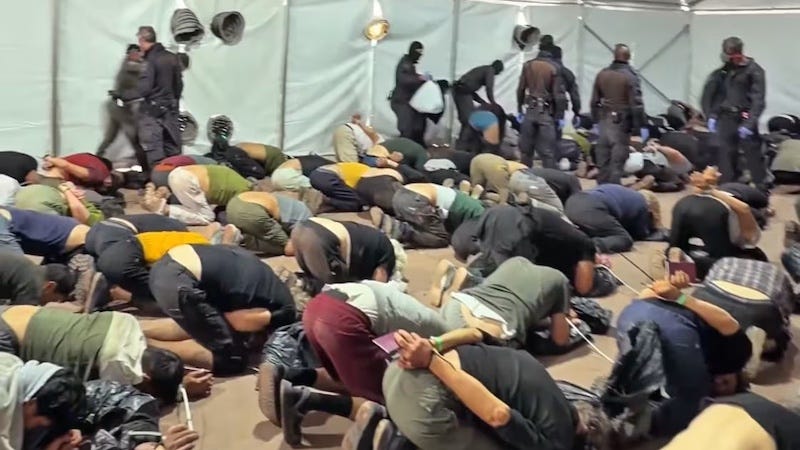
Israel – as it always does – has denied all allegations and insisted detainees were treated lawfully, while Israel’s ambassador to Australia – Israel’s propagandist-in-chief Hillel Newman, has dismissed all accusations of violence and abuse. Yet these denials are increasingly at odds with the reality of what people can now see directly through videos, the testimonies and the vast volume of independent reporting emerging from the region itself.
Why is it that we are expected to believe every single unsubstantiated word that’s uttered at the Royal Commission into Antisemitism and Social Cohesion – yet dismiss all the documented evidence and statements from over 400 people on the flotilla who were simply trying to bring much-needed aid to the people of Gaza?
We’re not expecting things to change that much – after all, the Australian government, like many others around the world, seems to have an infinite level of tolerance for the many crimes and misdeeds of Israel – but this could develop into a deeper crisis that all governments will need to face up to.
For decades, almost every Western leader has managed the domestic perceptions of conflicts within Israel–Palestine through lugubrious and slippery diplomatic language, massaging the media messaging and deliberately making it all seem too ambiguous for anyone to understand. And haven’t Albanese and Wong – along with so many others in Australia – been the masters of this, with different messages flying out from each side of the mouth on every occasion, with the key words filtering through to the leaders of Zionist lobby groups, because they are the ones who all of this language is directed towards.
Public outrage is softened through carefully crafted talking points about “both sides”, “security concerns”, “complex regional dynamics”, “difficult to judge”, and the classic go-to talking point: “Israel does have a right to defend itself”, a concept that isn’t afforded to many other countries in the region, and certainly not for the state of Palestine.
But as much as they will continue to show their weaknesses with these tactics, Israel’s actions Gaza and now in southern Lebanon have shattered that strategy and makes it more difficult to sustain. Social media, independent journalism and the unprecedented scale of destruction in the region have made that method of influencing public perception far more difficult, particularly among younger audiences who increasingly distrust mainstream political institutions and corporate media narratives. And because of this, the Albanese government now finds itself trapped inside this political balancing act that is becoming more unstable with each and every week.
Australia’s strategic alliance with the United States and longstanding diplomatic support for Israel sits on one side, but that’s becoming increasingly unpopular. On the other is the mounting public anger over the actions of the United States and Israel, a public that increasingly sees Western responses to the conflict, including Australia’s, as morally bankrupt and hypocritical.
This is why the situation in Gaza, southern Lebanon and now Iran has evolved into something far larger than a foreign policy issue, even if most people can’t fully comprehend these conflicts. It’s now cutting directly through to Australia’s domestic politics: universities, the media, arts organisations, sporting bodies, councils and workplaces are increasingly being drawn into a battleground over Palestine, protest rights, censorship, with the usual accusations of antisemitism and political intimidation.
That erosion of Australia’s legitimacy on these matters also carries enormous long-term consequences for the body politic, which seems to be so easily discarded by many countries around the world, in their quest to support the rouge and out-of-control state of Israel which, essentially is being governed by the likes of Ben-Gvir and Bezalel Smotrich, who are the modern day versions of Himmler, Rosenberg and the brownshirts from the Nazi era.
Once domestic populations begin to realise that governments are applying human rights, democracy and international law selectively rather than universally – bearing in mind that all politics involves a certain level of duplicity and double-speak – the damage to the body politic doesn’t end up being restricted just to the field of foreign affairs. That collapse of trust then begins to permeate through to other areas – if this hasn’t already been breached – the media, political parties, universities, courts and democracy itself.
That’s what makes the flotilla incident so significant in Australia. It wasn’t just about a few hundred activists who were illegally intercepted at sea, it’s a symbolic representation of the clash between two versions of events, and only one of those is being believed. In one version, Albanese and Wong – and others – will continue speaking the concocted language of diplomacy, alliances and restraint (i.e. the outrageous lies) primarily because they’re close to hopeless and know nothing better.
In the other version, millions of ordinary people are watching graphic evidence of war, occupation, starvation and humiliation – not just of Palestinians and Lebanese people, but of their own citizens – in real time while political leaders insist the situation remains too “complex” and “far away” for them to offer any kind of meaningful and moral position.
The danger for Western governments is that the old language of diplomacy that’s been in use since the 1800s no longer works. It’s all high-level bullshit and people can see this for themselves. Every new image from the region, every viral video of humiliation by extremists such as Ben-Gvir, every allegation of abuse followed up with even more evasive statements and denials just keeps chipping away at the credibility of the political establishment, if there’s any left at all.
The issue is no longer about whether governments support Israel: they obviously do, and will continue do so, despite everyone’s protestations. There must be some serious-level kompromat being held on all these political leaders – or threats being made to their family members or other types of blackmail – because no leader in their right mind would support the actions and activities of the state of Israel, especially taking into account the actions of Ben-Gvir and Smotrich, unless these types of threats against them are being made.
And it’s also obvious that large sections of the public no longer support the state of Israel, and its behaviours in the region. For the Australian government, that’s the real political crisis that it’s facing – not just the collapse of faith in Israel, but the slow collapse of faith in the entire Western political and moral framework that protected it for so long. The real question is why it has come to this.


Why has it come to this? Because Israel should have been called to account in 1948 for its genocidal, sadistic, terroristic, blood-drenched foundation and it was not.
It has continued to terrorise, brutalise, rape, torture, murder, steal, destroy, occupy, colonise and the world has let it get away with it. Why would they not become more and more depraved and debased, believing as they do in their own victimhood, supremacism and ability to commit any crime and for it to be accepted, indeed, funded, by the world at large.
Israel is a monster the world supported in conception, foundation and function and now the world must dismantle it completely.
Any time spent in what is called Israel and with Israelis makes it very clear that the State, society and culture are a Cult and one sourced in psychopathic, narcissistic, increasingly psychotic beliefs and behaviour.