


What was meant to be a Royal Commission to examine antisemitism and social cohesion in Australia has quickly become much broader and far more politically dangerous: the attempt to recreate the boundaries of acceptable political debate and dissent surrounding Israel, Zionism and the destruction of Palestine.
While it was established to address allegations of rising antisemitic abuse following the October 7 attacks in Israel and Israel’s subsequent war on Gaza, the inquiry was initially framed as an effort to protect vulnerable communities after the Bondi terror attacks in December 2025. However, it’s now morphed into an attempt to blur that distinction between antisemitism, and criticism of Israel and Zionism.
Much of the testimony presented at the Commission is basically suggesting that any form of solidarity with Palestine is inherently antisemitic. The presence of Palestinian flags, watermelon symbols, university encampments, fundraising drives for children injured by the barbaric actions of the state of Israel, artistic exhibitions and slogans such as “from the river to the sea” are all now being claimed as acts of antisemitism. In this kind of environment, even describing the actions of the Israeli state as “barbaric” risks being interpreted as antisemitism, and the overall effect of this is to create a climate where legitimate critique of a specific nation–state will result in the criminalisation of those making the criticisms.
Much of this is arising from the application of the International Holocaust Remembrance Alliance definition of antisemitism, which too easily combines opposition to Israeli government policy or Zionism, with antisemitism. This Royal Commission has adopted the IHRA definition rather than more sensible alternatives such as the Jerusalem Declaration on Antisemitism, which clearly distinguishes between antisemitism and criticism of Israel as a political entity. This is an enormous distinction in a democratic society such as Australia, if that’s what we claim to be. If opposition to nationalism, occupation, military and state violence or extremist ideology can be twisted and re-presented as racial hatred just because Israel is involved, then we may as well give up on that claim and just let legitimate political debate disappear for good.
The inconsistencies are more obvious once we compare the acceptance of the actions of Israel with the treatment of other communities during similar international actions. Following Russia’s invasion of Ukraine in 2022, many Australians of Russian background experienced hostility and social stigma, yet few political leaders or media outlets warned against conflating ordinary Russian people with the actions of the Vladimir Putin; in fact, the social stigma seemed to be encouraged. Yet criticism of Israel’s conduct in Gaza and now in southern Lebanon – despite the massive amount of civilian casualties, widespread destruction and mounting international condemnation – is increasingly treated as a unique political situation or brushed off as “Israel’s right to defend itself”, and protected from the scrutiny that’s directed at every other country in similar circumstances.
The bigger danger here is that the Commission risks transforming legitimate concerns about the actions of the state of Israel – which includes war crimes and genocide – and the extremist ideology of Zionism, into a state-sanctioned process for regulating speech, and delegitimising protest and political activism. Democracies ultimately become unstable when institutions decide to protect one group from legitimate criticism of a state they support – or even criticism of their own actions, such as fundraising for the Israel Defense Forces, or supporting Shevet Onnot, a scout’s group in Melbourne that actively recruits and prepares young people to serve in the IDF.
This is something that has already shaped the media commentary surrounding the Commission. Former editor of The Age Michael Gawenda argued in his testimony that many journalists within the mainstream media have become activists who are hostile to Israel and Zionism, and that the incidents of antisemitism have been too easily dismissed by them.
There’s very little evidence to support this. Yes, over 600 journalists signed a letter of solidarity in November 2023 for the many Palestinians journalists who had been killed by the IDF and to condemn Israel for the killing of so many civilians, but almost none of these sentiments – which were registered in their capacity as journalists outraged by so many of their peers being killed – have filtered through to the coverage provided by the mainstream media.
Major outlets such as the ABC, SBS, Seven West, Nine Media and News Corporation have, with very few exceptions, generally framed events that are broadly sympathetic to Israel’s political narratives, almost to the point of regurgitating Israeli propaganda verbatim. In comparison, coverage of Palestinian suffering has often been neutered by more cautious editorial language and suspicion, while pro-Palestinian activists have routinely been portrayed as being socially disruptive or politically suspect – and on occasions, beaten by police or arrested for holding up a “river to the sea” sign at a protest rally.
Yes, there are any many Jewish Australians who have experienced fear and trauma since October 7, and those emotions – whatever they might be – need to be heard and recognised. But what are we actually hearing at this Royal Commission? Complaints about watermelons; feelings of being unsafe after seeing the flag of Palestine – as if seeing the Israeli flag doesn’t cause any discomfort at all for Palestinian communities – complaints of bullying over a Minecraft exchange online; concerns about seeing fundraising activities for victims (which are usually accompanied with the aforementioned offending Palestinian flag); objections to children’s drawings in public spaces (with flag, again).
Many of the testimonies provided at the Royal Commission, such as Gawenda’s, rely heavily on personal commentary and subjective interpretation rather than verifiable evidence, or blanket statements that appear to be at odds with reality. Also, there’s been almost no reference at all to the existence of Palestine, or reference to the brutal actions of Israel, including the occupation of West Bank, genocide in Gaza, the illegal expansion of settlements, or the practice of apartheid.
Of course, these issues will never be mentioned because it undermines the narrative that Israel wants to present of itself at the perfect and “most moral” state, and cover over the extreme ethno-nationalism that is subjugating and attempting to remove an entire group of people from their homes. Best to limit the conversations to Minecraft, or offensive comments that might have been made at a netball game in the eastern suburbs of Sydney.
The musician Deborah Conway also complained to the Commission about being excluded and “cancelled” from performances and venues, but failed to mention that it’s the result of extreme Zionist views and callously suggesting in an ABC interview in 2024 that the Palestinian children killed by the state of Israel were not even children, and “depends on what you call kids”.
The Commission has become – at this stage at least – a one-sided receptacle for every perceived slight against Zionists and supporters of Israel in Australia, with the ultimate intention of making these slights – real or perceived – punishable in the court of law. The Royal Commission was created as a result of the Bondi terror attacks – and to explore the issues of antisemitism – but the victims of these attacks seem to have been forgotten about, and the social cohesion that it was meant create, is as far away as it has ever been.
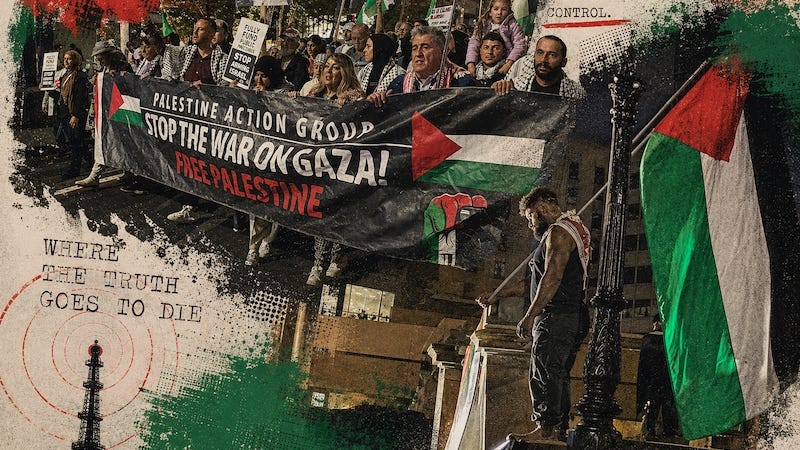
While the Royal Commission continues to hear the one-sided evidence and perspectives, others who have been left out are using other ways to have their voices heard. At Sydney Town Hall last Friday night, pro-Palestine supporters gathered to mark 78 years after the Nakba – the other holocaust that never gets mentioned and Israel doesn’t like to talk about, where over 700,000 Palestinians were violently removed and displaced by the infamous and brutal Zionist paramilitary group, the Stern Gang – an event that is a key cause of the generational trauma that exists until today.
One of speakers was 87-year-old Fouad Shriedy, displaced from northern Palestine as a child during the 1948 Nakba, and he provided a lived historical memory that rarely fits within Australia’s discussions about “social cohesion”. “The Palestinian dream will never die… my heart is still in Palestine,” he said. “The Nakba did not end in 1948, it is still happening today, and the genocide is still going on in Gaza. We will never forget Palestine and one day, Palestine will be free.” Palestine will be free. Is that now deemed to be antisemitic as well?
Voices such as Shriedy’s are entirely absent from mainstream discussions surrounding the Royal Commission. The Australia Palestine Advocacy Network requested leave to appear, but was refused on the grounds that it didn’t have a “direct and substantial” interest in the public hearings, even though the Commission is ostensibly about social cohesion.
Why can’t we recognise the perspectives of Fouad Shriedy or from the representatives of the Australia Palestine Advocacy Network? If the goal is to achieve “social cohesion”, we should be hearing from as many people as possible, even if it is to give the Commission a veneer of credibility – and to avoid the accusations of just being another avenue to entrench the viewpoints of a privileged group of people who already have strong connections to the existing power structures in society.
So, what will become of this Royal Commission? Perhaps it has already done its work through the release of its interim report, and its activities from this point onwards are to allow people to vent their frustrations, experiences and perceptions about how they feel the rest of the world is against them, while the incidents of real antisemitism will slip by.
None of this is to deny the existence of antisemitism in Australia. As a child growing up in a working class migrant family in a dysfunctional, predominantly white-Anglo lower socio-economic and angry outer suburb in Perth, I’m not going to deny whatever people might be feeling, because I’ve felt it myself, and so many times.
It’s not just the fuck off and go back to where you came from – so much of racism and discrimination doesn’t always reveal itself in obvious ways, and even when it is overt and obvious, if there’s no one there to record it or report it, it’s as though it never occurred in the first place.
These testimonies should be heard, even if we’re not quite sure what we’re listening to. Jewish Australians, like all all other minority communities, deserve safety, dignity and protection from abuse, harassment and violence. And when an event such as the Bondi terror attack occurs, we need to work out ways of reducing the chances of this ever happening again, and improve protections for all peoples.
Australia does face challenges in addressing these concerns at a time when the nationalistic far right is gaining a foothold in many parts of the community. But if the solutions end up suppressing hard-fought political rights and are used to protect the state of Israel from criticisms of its war crimes and genocidal actions, then Australia will be trashing the same democratic freedoms that it claims to be defending.
“Your experiences as a child had more to do with kids can be cruel as most of us experienced for being poor, rich, fat, thin, freckled, redhaired, bad at school, good at school, bad at sport, good at sport etc.”
No, these are grown adults hurling abuse as I played in the front yard with siblings, including a daily offering from old racist Mr Robinson. Best not to tell other people what their experiences were, based on your own, because there’s a chance the wrong assumptions will be made.
It appears that the Antisemitism Envoy essentially demonizes, defunds, and criminalizes dissent to Israel's g3n0c1de. It appears that the Royal Commission on antisemitism is essentially a kangaroo court constituted to frame everything as the Envoy and her fellow Israel g3n0c1de lobbyists want it. What Hasbara McCarthyism will Labor governments (and their complicit Libs, Nats, and OneNats) gift Aussies next, and will they drop it before or after the NSW election?
(Neo)'Liberal' Party? I haven't seen any fight to preserve Civil Liberty from them this century.
ALP the 'Party of Workers'? Maybe 10%, but the other 90% is more like Another (Neo)Liberal Party.
OneNation? Of & by the duped racist imperialists, for the fossil fuel investors (like the Nationals).
At least we have Greens NSW, which have actively resisted this McCarthyism.
Judaist Aussies also have the JCA batting for justice, even if the match is fixed to oppose them: https://www.jewishcouncil.com.au/2026/05/jewish-council-to-appear-at-royal-commission-hearings-this-week-on-definitions-and-drivers-of-antisemitism