


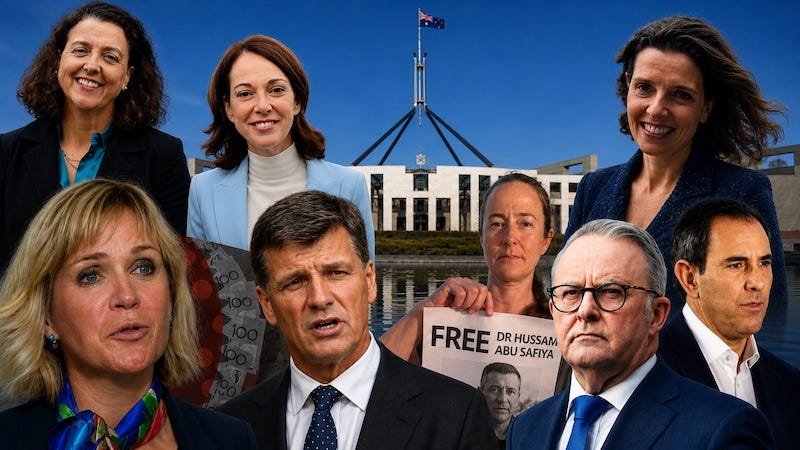
This week’s briefing outlines the big issues to look out for: the growing housing and inequality crisis, the continuing collapse of the Liberal Party and rise of populist politics, the emergence of independents and teals as a new political force, and the widening political fallout from Israel’s actions in Gaza and the debate surrounding Australians serving in the IDF.
The Parliament of property owners
Federal Parliament returns this week facing the political reality that neither the government nor the opposition particularly wants to address: the old economic “compact” between the current and former major parties is falling apart, and younger people now understand that the system no longer works in their favour and, perhaps, it never has.
After decades of the bipartisan worship and genuflection at the altar of property speculation, privatisation and “market efficiency”, the Albanese government now finds itself managing the consequences of a housing system that has transformed that basic human value – shelter – into a money-making machine and an extortion racket for the banks.
Treasurer Jim Chalmers uses the words of “intergenerational inequality”, but the deeper problem is that Australia’s political class spent well over 30 years creating an economy designed to protect asset holders at almost any social cost. Now that millions of younger Australians are locked out of housing altogether – even renting is becoming difficult – the same political and media establishment suddenly wants to sound concerned – really concerned – even though, in reality, they’re only pandering to vested interests – while mainly avoiding the serious reforms that will genuinely threaten entrenched wealth.
Predictably – as we’ve seen over the past two weeks – even the modest discussions about tax concessions, negative gearing, capital gains or housing investment will continue to trigger all of these hysterical warnings from lobby groups, property investors and conservative commentators claiming Labor is launching an “attack on aspiration”. But in reality, their panic is based on something that’s far easier to see: the Australian economy has become dangerously dependent on permanently rising property prices.
It won’t happen this week, but the real question facing Parliament in the long term is whether the government is actually prepared to challenge any of this in a meaningful way – or whether it just wants to give the appearance of being “reformist”, while actually protecting the structures that created all the problems in the first place.
The continuing collapse of the Liberal Party
Something which is a lot more serious than a temporary protest vote is now developing in Australian politics. The rise of One Nation is no longer just about culture wars, anti-immigration rhetoric or discontent on the fringes – although that’s a big part of it – it’s reflecting a much deeper malaise within mainstream politics across large parts of the country – particularly the voters who feel like they’ve been left behind economically, and are socially insecure and culturally ignored by both major-ish parties.
For years, Australia’s political and media establishment comforted itself with the belief that unbridled populism was something that happened elsewhere: Brexit in the UK, Trumpism in America, Europe’s nationalist right, and assorted “convenient idiots” in South America, who pave the way for vested corporate interests to take up the role that’s usually provided by government.
But after decades of wage stagnation, collapsing housing affordability, privatised public services and widening inequality, the social conditions that produced those movements now exist here too. As much as we might detest the prevailing attitudes of Pauline Hanson and One Nation, the real surprise isn’t so much that it’s a fringe party on the rise – at least in the opinion polls – it’s that the major parties still seem shocked and confused by it.
The Liberal Party’s crisis is especially profound because it no longer appears to know what it actually stands for. It spent years fluctuating between corporate neoliberalism for donors and culture-war populism for voters, eventually satisfying neither of these groups. One Nation is now starting to grab the same territory the Liberal Party once occupied: railing against the elite and “woke”, fearful nationalism, distrust and resentment toward institutions.
Meanwhile, the Labor government risks making the same mistake many centre-left parties overseas have been making for some time: making that assumption that voters experiencing economic anxiety will automatically reject right-wing populism because it seems to be too unhinged. And wearing the clothing of conservatives – the same Tories Anthony Albanese claimed to fight against, because “that’s what I do” – means that the Labor Party will also one day suffer the same fate the Liberal Party is currently experiencing, and then wonder how it got to that point.
The Teal machine and the hole in the centre
Australian politics might be entering a strange phase where the structures that supported the traditional major parties are falling apart, but not sure what’s to replace them. We can see how One Nation is currently filling that gap on the centre-right side of politics, but what about the centre-left?
There’ a growing discussion about independents forming a stronger parliamentary force – either as a party or a far stronger alliance – as a counter to the rise of One Nation. Representatives such as Senator David Pocock represent a broader shift among affluent, highly educated urban voters who have become politically homeless inside a Liberal Party consumed by culture wars and increasingly disconnected from metropolitan Australia.
The “teal” movement started off as a revolt against the dysfunction, climate denialism and political corruption of the Liberal Party, but it also reflected a mood within the electorate that they wanted to see politics built around competence, moderation and stability – those same areas that the Liberal Party were ignoring.
Of course, there are going to be inherent problems – independents often present themselves as “post-political” figures who stand above party-based ideology, yet they also operate within the same economic framework that produced many of the frustrations now fuelling populist anger in the first place. Already, several teal independents have ruled out forming a party, but what will happen if the rise of One Nation becomes unstoppable?
The Labor Party might be in the ascendency at the moment – and there’s no space for a new progressive party to occupy right now – but that can always change. In the middle of 2021, with the Liberal Party already in government for eight years, the Labor government was told to just forget about the 2022 election, and prepare for campaign after that, with a new leader in either Jim Chalmers or Tanya Plibersek: that’s how confident the establishment was about the continuing dominance of the Liberal Party. That was 2021: have a good look at the current stocks of the Liberal Party, less than five years later. They are totally dysfunctional.
The independents should have a good look and assess that history, before it becomes too late to take up the opportunity when it presents itself.
The flotilla and a small crack in the Western consensus
The political fallout from Itamar Ben-Gvir’s treatment of the Gaza flotilla activists is becoming far more than just about the actions of a demonic and provocative Israeli minister going viral on social media. For many years, governments all around the world – including the first-class denialists, the Australian Labor government (a special mention to Anthony Albanese and Penny Wong) – have spent more than two years defending, rationalising or carefully avoiding confronting Israel over its war crimes in Gaza and southern Lebanon, and kidding themselves that the international “rules-based order” still means something, when it obviously doesn’t.
It’s not a new style of imagery: detained civilians kneeling with zip ties aboard a seized aid flotilla in international waters, while one of Israel’s most violent, vile and extreme ministers publicly mocked them online. This is Ben-Gvir’s modus operandi – he’s been doing this for years and, along with Bezalel Smotrich, is among Israel’s most despicable parliamentarians, in a field of many.
That creates an increasingly dangerous political problem for governments all around the world. Official statements continue to express “concern” or “shock”, but it’s not really new material from Israel that we’re seeing, and the broader diplomatic and strategic relationship with Israel remains fundamentally intact. The contradiction is becoming harder to sustain though, particularly among younger Australians who consume international news outside traditional media frameworks and increasingly distrust establishment narratives surrounding the conflict.
The Foreign Minister Penny Wong infamously said that it’s hard to “judge from afar” when Israel cut food and water to starving Palestinians. Although Senator Wong did condemn Ben-Gvir – not the government of Israel, but only Ben-Gvir – she needs to start making more judgements about Israel’s war crimes, genocide, illegal actions and occupations in Palestine and southern Lebanon, and stop treating the public as fools. We can all see what’s happening and what Israel is doing and, yes, we are also afar and standing at the same distance from Gaza as Senator Wong is.
The IDF fighters amongst us
More people are now asking the question: if Australians who have travelled to fight in conflicts linked to Islamist groups, separatist militias or hostile foreign causes are subjected to intense national security scrutiny – as they should be – why is the involvement of people who have served in the Israeli Defense Forces never subjected to the same scrutiny?
The growing debate surrounding Australians serving in the IDF is exposing that glaring inconsistency at the heart of Western foreign policy and counterterrorism rhetoric. Federal governments have spent years expanding foreign fighter laws, surveillance powers and national security frameworks in the name of upholding international law – the so-called “rules-based order” – and preventing Australians from participating in overseas conflicts. Yet now, amid mounting allegations of war crimes and ongoing investigations by the International Criminal Court into Gaza, the question is being totally ignored by the government.
One of these people – IDF volunteer Russell Campbell – was freely roaming the streets of Sydney, violently disrupting and attacking people who showed any evidence at all of supporting Palestine. Even though his actions were well-documented through social media, police officers were “unable to identify any offences”, doing nothing about it until he was arrested six months later. Would an Australian citizen with a Palestinian background returning from the region be afforded the same leniency?
Officially, the Albanese government insists serving in a recognised foreign military is not automatically illegal, and legally, that is correct. Politically, however, the issue is becoming harder to ignore as evidence and imagery from Palestine and southern Lebanon continue to shock international audiences.
Once the criticism transcends the scope of activists and legal groups and moves into the mainstream electorate – and especially the younger members of the electorate, the cowardice that has always been there, just becomes more obvious and more difficult to sustain.


Maybe I’m being naive but I’m convinced that although One Nation will lead to the destruction of the Liberal and National Parties at the next election and will become the official opposition. One Nation’s lack of discipline and Pauline Hanson’s dictatorial style will cause the party to collapse during the next parliament. What rises from the ashes is anyone guess.
Maybe a reconstitution of the right as Menzies created the Liberal Party after the collapse of the United Australia Party?
The Australian Labor Party gives me no joy. In my mind they have become a managerialist neoliberal economic party that sort of remembers they were a party for workers and sprinkles breadcrumbs to suggest to the masses they care whilst leaving the structure of the neoliberal in place.
I have a relative that volunteers for Kate Cheney who was asking my thoughts about a possible merger among the Teal independents. My off-the-cuff reaction was to question the utility of it, considering the major part of their appeal is, well, being independent. So far, they have succeeded in spite of the electoral system being geared towards favouring the major parties, which has worsened under Labor's recent reforms regarding electoral donations. Rather than creating a party, I think a coalition agreement would be more apt. The Teals, having won re-election, have cemented their place in the parliament, and there is no way that One Nation could possibly erode their hold on the electorates they represent. Moreover, with recent polling indicating that Labor may only just win a majority if an election were held today, there is a strong likelihood that independents will hold the balance of power (this is something I think will galvanise Australian democracy and be a catalyst for greater reform). Thinking purely from an electorate standpoint for the Teals, they would be in a much better position to deliver key initiatives for them. This all said, if the Teals were to form a party, it would be the final nail in the coffin for the Liberals. Malcolm Turnbull already seems to be a high-profile convert. The Liberals seem to be wanting to be more like One Nation, and have doubled down by giving Tony Abbott the party presidency. I'm surprised he actually hasn't joined One Nation, but I suspect that's because he doesn't want to play second fiddle to Pauline and Barnaby.