


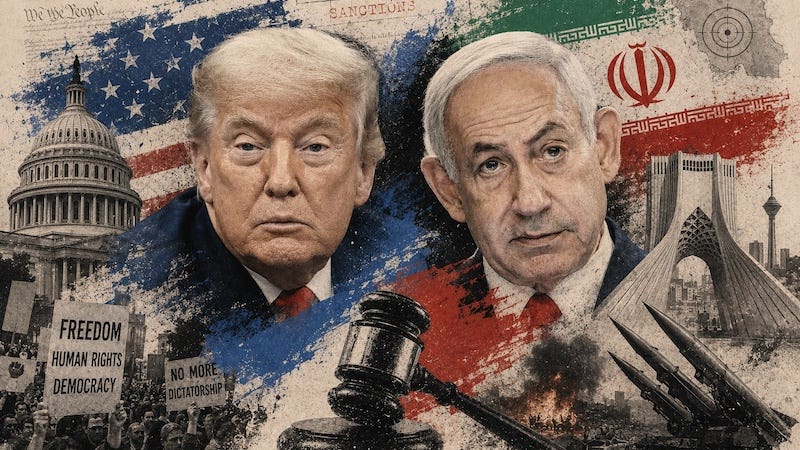
For months, if not years, the world was told – mainly by the United States and Israel – that a confrontation with Iran was totally necessary and inevitable. When the attacks on Iran commenced in late February, the markets reacted accordingly, oil prices surged and the shipping routes through the Strait of Hormuz were thrown into total chaos. At the time, there was a possibility of a wider regional conflict within the West Asia region and dragging the entire world economy into a catastrophe – and while there were several attacks on US bases in the region, the conflict has been limited to Israel’s unwarranted and illegal aggression in southern Lebanon and attacks on Beirut.
There is now a memorandum of understanding between the United States and Iran – and of course, we’ll have to wait until the conflict fully ends before we can believe that this MOU will actually end this war – but there’s an even bigger question that needs to be answered: what exactly was the point of this war?
Neither Washington nor Tehran has publicly released the full text of the agreement, which is due to be finalised in coming days and, as a result, much of this is speculation. However, there seems to be a broad outline from various diplomatic sources that frozen Iranian assets will be released, there’ll be less restrictions on Iranian oil exports, and new security arrangements over the management of the Strait of Hormuz will be implemented. The Iranian government is also pursuing compensation for damages from the United States, although it’s unclear how this would be achieved, or even if the US would be willing to proceed with such a reparation deal.
The US, of course, sees things differently – with a focus on reopening of the Strait of Hormuz (even though Iran did open it up, only for the US to close it down again for unknown reasons), stabilisation of global energy markets (even though it was their actions that created the instability in the first place), and guarantees from Iran that it won’t obtain or develop nuclear weapons.
On the evidence before us – and as been suspected for some time – this appears to be a massive loss for the United States (and Israel) and a major victory for Iran. And neither the United States or Israel have gone through the usual bravado of claiming a strategic victory – and certainly nothing like George W. Bush prematurely announcing “mission accomplished” in 2003 after the invasion of Iraq – and this comes after months of idle threats of escalating tensions and military confrontation.
US President Donald Trump has pushed the memorandum on Truth Social as a “diplomatic success”, but has wanted to move on from Iran very quickly, shifting attention back to domestic issues such as border security, infrastructure and economic policy. Yet the speed with which he appears to be “moving on” and eager to close off this saga raises a few uncomfortable questions for him.
If the outcome is a negotiated arrangement that allows Iran to continue exporting oil, gain access to frozen assets, avoid direct military action and remains a major regional power – and if anything, its power and stature in the region has increased – then it’s difficult to see what precisely the United States has gained through a confrontation, where the end result could have been achieved through diplomacy in the first place.
It’s even more difficult to understand the purpose of this war, when compared to the Iran nuclear agreement that Trump abandoned in 2018. At the time, Trump argued that the Joint Comprehensive Plan of Action – agreed to in 2015 by the five permanent Security Council members of the United Nations, and the European Union – was fundamentally flawed, and promised a tougher approach on Iran. Yet this new agreement – if it comes to that – will delivers a deal that is significantly better for Iran than any previous deal. Once again: what was the point of it all, aside from acquiescing completely to the unrealistic and maniacal demands of Israel, the one country that might end up being the biggest loser out of this?
For years, successive Israeli governments have argued that Iran represents an existential threat requiring constant pressure, isolation and, when necessary, military action – a pissant country of 9 million people, demanding action from a country of 350 million, ultimately to be used against a country of 93 million people, and destabilising an entire region in the process. The assumption here is that Iran could be deterred, weakened and eventually forced into concessions, which of course, didn’t happen – and anyone with basic understandings of geopolitics and military strategy, could have easily predicted this outcome.
Instead, Iran has shown that it retains substantial military capabilities, significant regional influence – which has now been boosted – and enough leverage to force major powers back to the negotiating table. Whatever the effectiveness of Iran’s missile operations, the broader political outcome has reinforced Iran’s position as an important regional player, rather than an isolated pariah the United States has been telling the entire world for over 47 years.
Israel now also faces a deeper strategic problem. This conflict has drawn more international attention to the instability of the region, including the ongoing genocide and humanitarian crisis in Gaza, longstanding questions about the rights of Palestinian, and Israel’s current illegal invasions and military actions in southern Lebanon.
Increasingly, for global audiences, including those in Australia, the more the military escalation dominates the headlines, the more difficult it becomes for Western governments to maintain that deception about Israel’s “right to defend itself”, when the public can see for themselves which countries are causing this conflict. And for those in the electorate who are prepared to tolerate or overlook Israel’s assorted war crimes and invasions of neighbouring countries, they can certainly feel the effects of their actions at the petrol bowser or at the supermarket check-outs
The United States is also now finding itself on the outer in international circles, although for the current Trump administration, they’re possible not overly concerned about this. Most major European powers failed to support the US and showed little enthusiasm for a prolonged military confrontation with Iran. Of course, their lack of enthusiasm for conflict would have been based around self-interest, rather than any humanitarian concerns about Iranians or Palestinians – they understood that a major war in the region would threaten global energy supplies and have a significant economic impact – but the fact that they didn’t support the US at all, is quite telling.
These economic consequences also raise another uncomfortable issue that deserves far greater scrutiny, an issue that we previously explored in “The kings of chaos: Who really profits from war”. Major geopolitical crises such as this create enormous opportunities for speculation and profits, where significant movements in oil futures, defence stocks and shipping markets create winners and losers – mainly winners among the captains of industry – long before any diplomatic settlement is reached. Was this war all based around creating these winners in the United States? When will the important questions start being asked by the US regulators?
Perhaps the most extraordinary aspect of the entire episode is how little appears to have changed despite the enormous risks involved. We’ve long argued that there was a distinct lack of a strategy in this attack on Iran. Many military commentators and experts were bemused by the direction of US action in the region, and could not quite follow the tactics, because it seemed to defy the history of successful military campaigns. There were some suggestions that Trump was utilising Richard Nixon’s madman theory of bizarre and unorthodox strategies to bamboozle and confuse the opponent, but in the end, it was the sign of a madman who simply didn’t know what he was doing.
Just look at the results: Iran remains governed by the same political system, and while the regime change that Trump openly espoused resulted in the assassination of Iran’s spiritual leader Ali Khamenei, the government remains the same. The US is deeply entangled in the Middle East and can’t pull out, even if it wanted to. Israel is despised even further, not just in the region, but not all around the world, and remains locked in an even deeper competition with its neighbours. There’s still a wide range of disputes concerning sanctions, regional influence, nuclear technology and security issues that remain unresolved, and will continue to do so for the foreseeable future.
Nothing has changed. The rest of the world, however, has paid the price for this foolish intervention, through destabilised fuel and energy supplies, shipping and supply chains disrupted, and yet another period of global fear and uncertainty, as if the world hasn’t had enough to deal with over the past decade. And for what reason?
Of course, history will be the final arbiter of the merits – or otherwise – of Trump’s foolish war, but it proves that a show of strength and injecting a large dose of testosterone rarely wins the war, unless it’s supported by strong diplomacy. But this in itself, is an inherent contradiction: strong diplomacy in the first place would have avoided this conflict, but the likes of Trump, Peter Hegseth and Marco Rubio had other ambitions, which were not clear to anyone else, and perhaps not even to themselves.
The real losers here are those who occupy the White House and the Knesset, and the war mongers who were too stupid to save themselves from their own ignominy. And they will continue to convince themselves, and their supporters, that they really did win the war, even when all the evidence suggests the opposite. For all the talk of imaginary victories, the final verdict is very easy to make: a massive amount of damage was done to the global community and economy, a great deal of unwanted risk was created, and in the end, America’s idiot king has arrived back to the point where he started. That really is a special skill.

Thanks Eddy and David.
And look at how the Australian establishment has reacted with ‘relief’ at the outcome.
Albanese, Wong and Marles the first in the world to endorse the illegal attacks and war on Iran, likely thought that Iran would fold within days. Iran has (at present) against all odds survived the Epstein Coalition’s attacks. The triumvirate in Canberra showing they know zero about the history of Iran and it’s long civilisation. The mayor of Marrickville and his councillors will continue to distract us with second hand submarines and shiny objects.