



Migration policy from the One Nation magic wand of racism
Labor is doing its best to imitate Pauline Hanson’s racist magic-wand politics, sending out the message that migration numbers will fall dramatically, without causing any pain at all, without damaging universities, without making skill shortages worse or weakening an economy that has been calibrated to sustain itself through a certain level of population growth.
Hanson, though, wants to cut net migration much further and has singled out international students as her latest scapegoat of choice. The Coalition seems to have also decided to join this nihilistic race to the bottom, hoping that the voters out there will forget that governments of both persuasions built the migration and university-funding systems that they’re now denouncing.
These arguments over migration are always presented as a dispute over the net numbers, but there are much larger policy failures that lie behind the scenes. Housing shortages are now being blamed on migrants, rather than decades of government underinvestment, and the favourable tax concessions that gave rise to speculation in property in the first place.
Pressure on infrastructure is blamed on population growth, rather than incompetent governments who have failed to build the infrastructure that was needed to support this demand. Falling wages are blamed on foreign workers instead of the environment that was created to weaken unions, more insecure employment and a deliberate suppression of wages. Universities were starved of public funding and encouraged to seek fee-paying international students, and are now being condemned for relying on these students.
The most bizarre part of this how One Nation has spooked the major parties and now – led by a political dilettante who bellows uninformed opinions through a megaphone but offers no solutions – is dictating policy for both the government and the opposition. Labor holds 94 seats and the Coalition holds 42 – and this makes up around 90 per cent of the seats in the lower house – yet a party that holds just two seats in Parliament, in conjunction with the News Corporation machine of outrage, is determining migration policy. It’s a sad indication of what politics in Australia has become.
Buying back guns is meaningless without major reform of gun laws
The new NSW gun buyback scheme that was created as a result of the Bondi terror attacks in December last year, will become a major federal and state political issue after Prime Minister Albanese and Premier Chris Minns announced that up to 274,000 firearms could be removed from the community when the scheme commences later this year. The Commonwealth will partially fund this, but there’s already resistance from Queensland, Victoria and Western Australia, which has started to undermine a comprehensive national response to gun ownership.
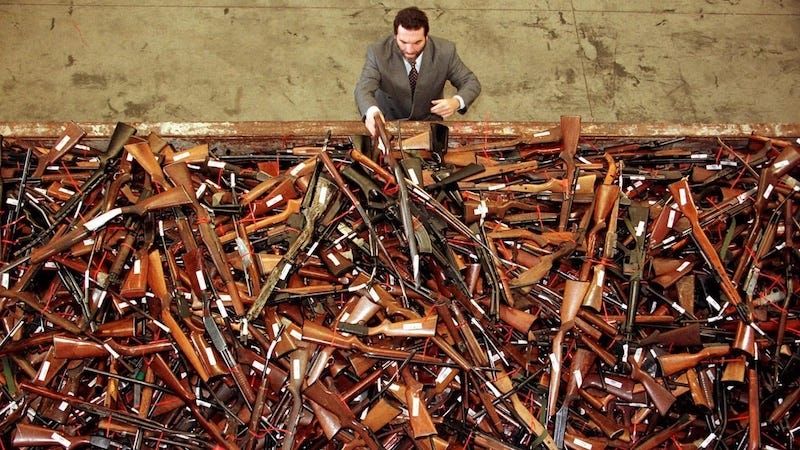
And this exposes that age-old problem of Australia’s federation: political leaders will declare a national emergency on a particular issue, create national principles, which then produce eight different systems.
One Nation and the Nationals – who are travelling down the same hysterical path as the American gun lobby – are now claiming that the lawful owners of guns are being punished for a terrorist attack they had no role in, conveniently overlooking the fact that the perpetrators of the Bondi terror attacks owned six legally-obtained guns.
The real test will be whether this buyback actually removes high-risk weapons, rather than generating a number that Minns can try and impress the public with, in the lead up to the 2027 NSW state election. That’s great if 274,000 guns are removed from the community, but we have to remember that it was just three guns that were used to kill 15 people in the Bondi massacre.
Without consistent national gun laws, NSW risks buying back all of these firearms while other states enable the conditions that allow their numbers to grow. And that, is not a great example of national leadership.
Stealing from disabled kids to pay for AUKUS
The government’s Securing the NDIS for Future Generations legislation will this week place disability policy in the spotlight. The government has argued that there needs to be tighter eligibility and assessment criteria to control expenditure and preserve the NDIS scheme – an argument that they have never put forward for the outrageous $368 billion AUKUS program – but why bother supporting the people that genuinely need support, when we can pay for submarines that we’ll never receive in 20 years’ time.

Disability organisations have already suggested that current NDIS recipients, particularly those children with autism or developmental delays, will lose their individualised support through the so-called Thriving Kids program that’s due to commence in October. There’s many questions remain about the program’s design, workforce requirements, funding and consistency across the states and territories, and these have yet to be answered.
Of course, governments never use the brutal language that’s associated with cutting essential services – this round of cuts to these desperately needed funds preach the language of “sustainability”, better “pathways”, “preservation” and “appropriate supports”.
But the key word here is exclusion, because that’s what Labor’s new legislation will do. Using weasel words doesn’t create the speech therapists, the occupational therapists, early-childhood specialists or provide accessible community programs that are needed to sustain this program.
The government is attempting to remove children from the NDIS, but we have no idea what happens to them afterwards. Thriving Kids might end up repairing some of the gaps in the existing system, but it seems to be more of an austerity measure that’s couched in feel-good language of bureaucracy.
Let them eat tents: The Coalition’s housing policy for low-income people
Housing is still a big talking point within the community and it seems to be that political connecting point between migration, inequality and the cost-of-living. The shadow housing minister Andrew Bragg’s answer is the typical free-market libertarian approach to everything, believing that every social issue can be solved by removing regulations, in this case, reducing the National Construction Code and making energy-efficiency and accessibility standards optional, rather than mandatory.
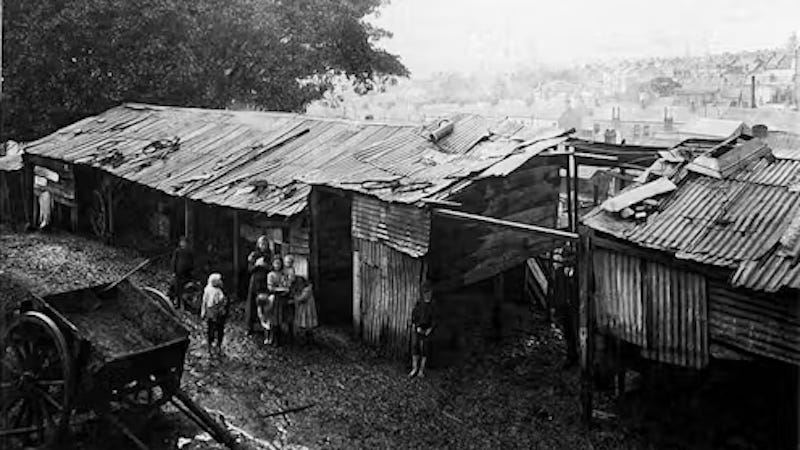
And if this wasn’t enough, Bragg suggested that lower-income people just have to accept “substandard homes”. It’s the Coalition’s housing vision built for the dystopia: one standard for the privileged people who can afford the comfort and easily manage their energy bills and cost of living, and another standard for everyone else in the chaff class, who may as well live in tents.
What Bragg is proposing is clearly a false economy. A cheaper building with inadequate insulation will cost more to heat and cool; any fool will be able to tell you this. A home constructed without taking accessibility into account will need expensive modifications later on in life – usually at a cost to government – especially if an older person develops a disability or suffer an injury. Once again, it’s the Coalition’s short-termism on display: developers will receive the immediate saving; but residents are the ones who will inherit the long-term costs.
Bragg’s rhetoric during the week also replicated that of the US Republicans, veering into the language of the mad uncle or the ravings of the drunken man at the local bar, where he described Labor’s economic interventions as “communism” and “neo-Marxism”, while he described compulsory superannuation as a “repressive system” controlled by unions.
And this would be a surprise to the superannuation sector, because there are no superannuation funds that are legally controlled or owned by trade unions in Australia, and even more of a surprise to all of those retail and self-managed super funds that are so far removed from the presence of “communist” or “neo-Marxist” unions that they wouldn’t be able to spot one in a McCarthy-ist era show trial.
Bragg is supposedly a moderate within the Liberal Party, but this isn’t serious housing policy at all, it’s just an ideological demolition job that very few people are going to take notice of.
Australia does needs cheaper and faster construction in the housing sector, but affordability doesn’t mean building inferior housing for people on lower incomes.
The Liberal Party’s holy war at ICAC
The NSW ICAC investigation into the conservative Christian “Reformers” faction is increasing the pressure on Angus Taylor, although we do have to point out that he is not accused of any wrongdoing – yet.

ICAC has heard evidence that some of these associates wanted to “shake down Angus for 10k”, and had secured an initial $15,000 contribution followed by monthly payments. Taylor has categorically denied paying anything at all, while other evidence has suggested that these associates might have been boasting or lying about gaining the commitment.
While this issue has the potential to end Taylor’s leadership – not that too many people would notice – that bigger issue is the attempts of this Reformers faction to recruit thousands of conservative Christians to the Liberal Party, take over Liberal branches, and drag the party backwards on abortion, euthanasia, transgender rights and same-sex marriage. As if the Liberal Party doesn’t already have enough problems trying to regain electoral credibility, and this will damage the party even further.
Taylor’s problem – at the moment – is more of a political problem than a legal one, but he needs to come clean about what he knows about the Reformers, what sort of involvement he’s had with the organisers of this faction, and if he supports their objectives. This group is a maniacal and zealous subgroup that has very little mainstream support and is trying to fight the culture-war battles that were lost some time ago. Why does the Liberal Party keep wanting to fight these losing battles over and over and again?
Melon-gate: The enshittification of mainstream journalism continues
Fear not: we’re not trying to keep kicking this story down the road, but focussing on how the mighty – if that’s what they ever were – have fallen.
The continuing media fixation on Albanese’s hand gestures while discussing melons on the obscure Bush Deep podcast has become less about the Prime Minister and more of an indictment of Australian political journalism.
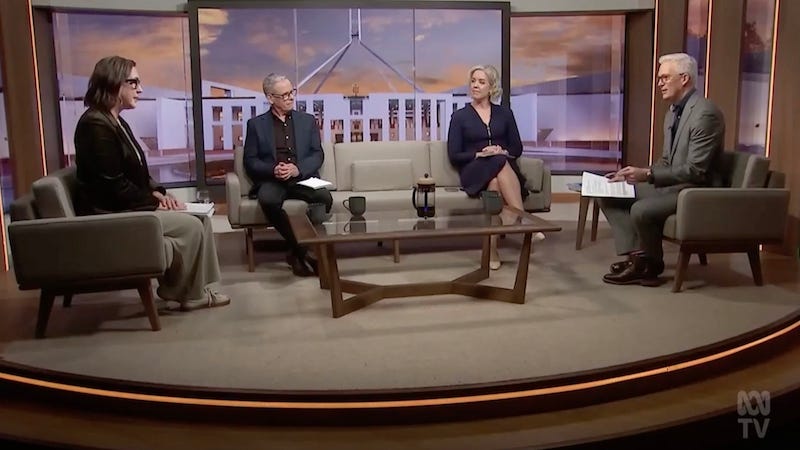
The increasingly irrelevant Insiders program – supposedly the pinnacle of political analysis at the ABC – spent more than a quarter of its program discussing this issue (sorry folks, we just ran of time to discuss migration, housing, gun laws, NDIS cutbacks, the disaster of AUKUS, but OMG, will you just have a look at those melons!), in a clear indication of the paucity of intellect on display from Australia’s mainstream journalists.
The melons were presented by Japanese Prime Minister Sanae Takaichi in May, and Albanese appeared on Bush Deep more than a month ago, and Japan has clearly stated that it does not regard the incident as a diplomatic problem. Yet the Coalition has encouraged the pantomime – and supported by the mainstream media – by suggest the Australian Federal Police need to investigate the leaking of confidential Japanese material, making sure that this manufactured scandal that doesn’t have any legs at all, will be able to walk into another week of Parliament.
Albanese deserves criticism for appearing on a podcast that’s based around smutty humour and sexual innuendo – it’s the same podcast where he made the “shagging Kylie Minogue” comments recently – and if this is Labor’s idea of connecting with younger Australians, it needs to go back to the drawing board and stop this patronising view of young people as unsophisticated and obsessed with smutty sex and useless double-entendres.
Of course, if he decided to appear on the New Politics podcast, he would never have arrived at this point, and we’d be able to discuss all the important things within the realm of politics. But it’s his choice.
The media’s response to this has been far worse. Parliament is dealing with gambling reform, a war in Iran and Australia’s response to it, cutbacks to the most vulnerable people in society, immigration policy and housing deregulation, while ICAC is examining attempts of a Christian conservative group to take over the Liberal Party. And the list goes on. Instead, journalists keep wasting everyone’s time by re-analysing a hand gesture and a piece of fruit.
Australia’s political journalism keeps going down the path of “infotainment” and presents the garbage they should be discussing at their dinner parties in Canberra – and keeping it there – as serious analysis to a national audience. It’s an absolute disgrace. The media is the main joke in politics, and it’s now become the punchline too.


Main stream media - same old, same old. The standard of journalism will never change whilst we have such concentration of media ownership plus religious and lobbyist interference.
The problem with Insiders is that it spends too much time on the game of politics rather than analysing policies and programs.