


This week’s briefing outlines the big issues to look out for: the truths being withheld in the antisemitism inquiry… a US strategy unravelling in the Middle East… a federal Budget shaped by fear rather than reform… and a Liberal Party victory that masks the deepening fractures on the right.
The blind spots and closed doors: What the antisemitism inquiry isn’t telling us
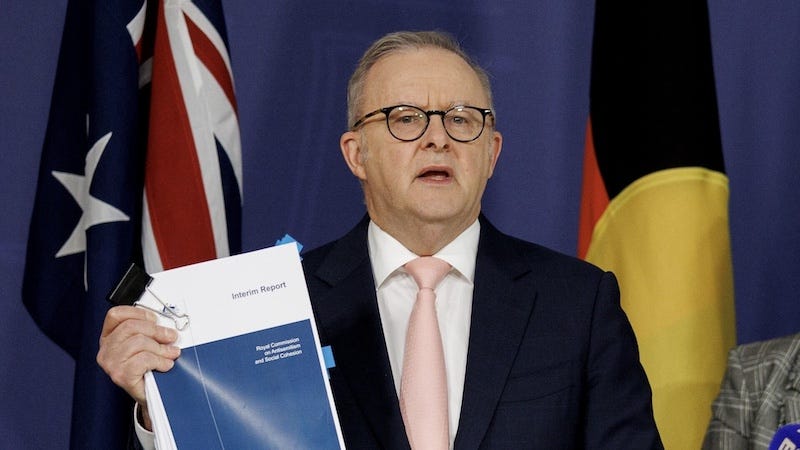
The interim findings of the Royal Commission into Antisemitism and Social Cohesion were announced at the end of last week – and while most of it at this stage seems to be uncontroversial, the actions of the NSW Police seems to have been underplayed, and the information that ASIO and the Australian Federal Police may have held on the two Bondi shooters, and how their inactions may have contributed to the tragedy in December 2025, has been withheld.
The nine recommendations that have been released seem to be unremarkable, and have suggested a tighter co-ordination of security and police resources, modest reforms to firearms control and a gun buy-back scheme, and the suggestion that existing legal frameworks are adequate, albeit with some strengthening of laws in certain areas. Yet there’s an uncomfortable reality that’s sitting under the surface: if the legal framework is already adequate, then why did these failures occurs? What exactly did ASIO know, and will we ever find out?
Just like in the Lindt Café attack in 2014, the Bondi attacks have become another example of failures within our security systems. The Lindt Café attacker – Man Haron Monis – was an ASIO “asset”, where he was useful in creating the links to other miscreants and possible terrorists, and was tolerated while he served this purpose. It’s quite possible that the two Bondi attackers also served a similar role – their weapons were legally obtained, intelligence agencies had been aware for some time of the risks they posed to the community, and warnings about these vulnerabilities seem to have been identified but not acted upon.
That, of course, leads to a bigger question: what exactly is the point of ASIO and the Australian Federal Police if it can’t transform the information they hold on these people that are a danger to society, into prevention and protections for the community?
The five unreleased recommendations have been withheld because of national security and ongoing criminal proceedings – in the case against Naveed Akram, that is certainly justified, but national security grounds? It could be a secrecy that’s been used to protect security agencies institutions from embarrassment and cover over their ongoing incompetence, rather than about protecting the public from harm.
There needs to be accountability here, and the Royal Commission should look at leadership within these security agencies, what their priorities are, and what’s happening to all the massive increases in funding that both ASIO and the Australian Federal Police always receive when they agitate about security threats, the same threats that they never seem to be able to stop. The hearings in Sydney will continue and keep the pressure on, but the central issue remains: how much of the truth is being withheld, and when will the public will ever be allowed to see it?
A war without the endgame: Australia watches as the US strategy collapses
The expanding conflict involving Iran, Israel, Lebanon and the United States is placing more pressure on the fragile global order that Australia has long relied upon. Israel implemented a genocide and humanitarian crisis in Gaza, and they’ve exported this campaign into southern Lebanon, with a growing sense that Israel is totally out of control and more humanitarian disasters are going to be created, certainly in the lead up to the next Israeli general election.
The stated objectives from the United States – deterrence, containment and increased influence in the region – is now looking less like a coherent plan and more like a set of unrealistic ambitions and foolish overreach. Sixty days into this war against Iran, and none of the US objectives have materialised. Instead, oil prices have risen sharply, allies are unclear about what their relationship with the United States is – or even if there still is one – and adversaries such as Iran and Hezbollah have adapted during this war through the use of asymmetric warfare tactics.
And this is no longer a projection of American power; it’s been an exercise in the limitations of its power. Perhaps some time ago – or under a different President – the United States could have shaped these events in its favour. But this time around, it’s wallowing like a weakened and diminishing power, with an incompetent buffoon as a President, who’s only too happy to talk about his exceptionalism, while the authority of the United States burns in the background. At least Nero fiddled on his cithara during the Great Fire of Rome; Donald Trump waxes lyrical like a stand-up comedian, hoping no one will notice the calamity that’s swallowing up his Presidency.
A budget on the brink? An international crisis, a domestic compromise
The coming federal budget has promised much, but is becoming less of an economic blueprint for change, and more like an outline of the Albanese government’s political priorities. Of course, there are many pressures on the federal government due to weakening economic circumstances, and an increase in global instability created by the unstable Trump regime.
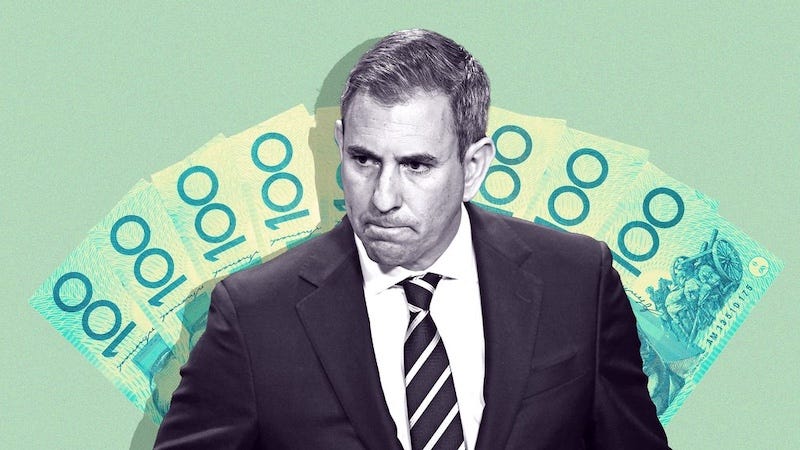
There’s issues related to cost-of-living relief, healthcare, housing, and national security spending all competing for attention, but the bigger question is whether the upcoming Budget will result in a coherent plan for much-needed economic reform.
Rising oil prices and disruptions to many supply chains are already filtering through to household budgets, and while federal Budgets can’t create immediate change, this one has to be more than the window dressing and the “abundance of caution” that the Prime Minister has become well-known for. Temporary fixes like extending fuel excise cuts may ease short-term pain, but they will do little to address the structural problems that exist in the Australian economy.
However, there might some unexpected announcements by the Treasurer, Jim Chalmers. Speculation about winding back negative gearing and capital gains concessions has dragged on for many years, and it appears that the federal government might make some reforms here. But why now? As we know, Anthony Albanese is not one to risk any of his political capital, even when he holds a massive amount of it, but there’s a clear political incentive: younger voters now outnumber the older propertied classes that built their exorbitant wealth through the outrageous policies implemented by the Howard government.
Changing these policies to make them fairer for younger voters now might make also them forget that Albanese failed to stand up to vested interests by blocking a 25 per cent gas export tax. But it could also end up being a case of trying to satisfy everyone, but convincing no one – and making the Budget look like the usual game of politics, rather than doing anything economically meaningful.
Despite the win, there’s still a weakness in the Liberal vote
The win in the Nepean by-election in Victoria has been celebrated by the Liberal Party as a major victory, but underneath all the theatre is still an uncomfortable reality. The prominence in this campaign of the Victoria leader of the opposition, Jess Wilson – effectively treated as the main act in what should have been a routine by-election – suggests a party stretching itself to manufacture a new-found momentum when it actually doesn’t exist. Declaring herself to be the “next premier of Victoria” after a single by-election win might energise the Liberal Party faithful, but it’s also a sign of hubris when a lower-key reaction would have been more useful.
While the result was relatively meaningless – Nepean is a traditionally safe Liberal Party seat, and Labor didn’t run a candidate in this by-election – it did reinforce a longer-term trend: the fragmentation of the conservative vote. Increasing reliance on preference flows from far-right parties like One Nation seems to be becoming a necessity for the Liberal Party, but all it’s going to do is drag both the Liberal Party and One Nation from the seat numbers that are needed to form government.
With another electoral test coming up in the federal seat of Farrer – the by-election there will be held on 9 May – the broader picture is becoming clearer: the control of the two-party system by the major parties is still breaking at the seams, and it’s just a question of who picks up the pieces. For conservatives, the challenge is not just about winning seats – it’s about holding together a coalition of interests that increasingly looks like it doesn’t agree with itself.


