


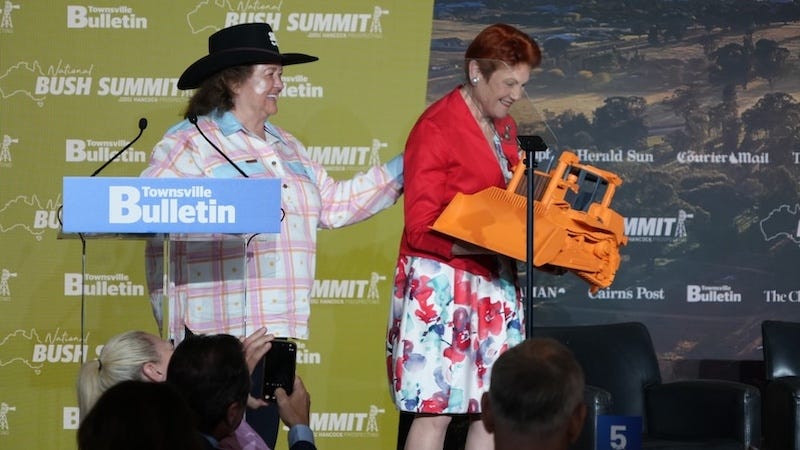
One of the big developments in Australian politics has been the growing influence of mining billionaire Gina Rinehart and a small circle of ultra-wealthy political donors. As we all know, very little in life is free, and that’s certainly the case when it comes to politics; it’s always a question of what the trade-off is. While political influence has always followed the money, the relationship is becoming increasingly more obvious. What was once conducted through clandestine and private meetings, industry associations and backroom lobbying, is now taking place in full public view through media ownership, political donations, advocacy campaigns and direct intervention in national debates.
Rinehart’s growing support for figures such as Pauline Hanson raises a broader question about the health of Australian democracy. If ordinary voters are increasingly struggling with housing costs, lower living standards and a reduction in economic security, why do some of the loudest voices in politics belong to those who have benefited most from the existing neoliberalist environment? The language they use is often one of freedom, the so-called “common sense” and standing up to elites, even though these campaigns themselves are funded and amplified by some of the wealthiest people in the country.
Australia has liked this idea of being more resistant to the excesses of American-style politics. Yet the arrival of billionaire wealth, media influence, the endless culture-wars and increasingly personalised political movements suggests that this assumption is starting to fray at the edges. As public trust in institutions weakens and traditional parties struggle to inspire voters – the Liberal Party, and Labor too, even with their massive majority – the wealth class is finding new opportunities to direct the national conversation towards their line of thinking, which seems to be based around a hard-right style of extremism.
The question isn’t about whether money influences politics – that has always been the case, despite the desire from the public to remove it completely. The question is whether politics is gradually becoming another asset class for the wealthy, and only available to them, because they’re the only ones who can afford the price of entry.
Missing in action: Where have the Greens gone?
If money coming in more obviously from the wealth class is one development within politics, another one is the party which spent years positioning itself as the conscience of Parliament has become remarkably difficult to find within the current national conversation. The Australia Greens still have significant influence in the Senate and, according to national opinion polls, still attract a significant level of support – yet while One Nation continues to dominate the headlines with their inane outrage and culture-war narratives, the Greens seem to be missing in action, just a time when they should be finding their place in the sun.
Of course, part of the problem is structural, where the Albanese government has successfully occupied much of the centrist political territory, leaving the Greens struggling to distinguish themselves without appearing either obstructive or irrelevant. At the same time, the mainstream media remains far more attracted to outrage, conflict and political spectacle than detailed policy debates, where a fight about immigration, national identity and transgender issues – where the debate has been reduced to a man is going to steal a women’s Olympic gold medal – will always get more coverage than a discussion about public housing construction or tax reform.
Many of the economic anxieties that are driving politics at the moment – housing affordability, insecure work, declining living standards and rising inequality – are tailor-made for a party advocating a major overhaul of the political system and seeking positive social reform. Yet public frustration is increasingly being channelled towards far-right populist movements rather than the progressive alternatives that are out there, even though the likes of Pauline Hanson offer no solutions and essentially represent a culture of complaint. Whether this is a failure of messaging, poor leadership, a weak political strategy or just because of the mainstream media is going to be a matter of debate. But whatever the case is, the Greens need to work it out, and work it out now.
The danger for the Greens isn’t so much that they’ll disappear – they’ve had a strong and consistent vote over the past 15–20 years, with a strong representation in the Senate – but they seem to be silent, just at a time when the conditions would seem to be favourable to them.
A party can hold seats – or lose them, as the Greens found out in the lower house during the 2025 federal election – win votes and exercise parliamentary influence, but if it no longer defines the national conversation, its capacity to influence the future begins to fade. In a political environment that’s becoming increasingly dominated by anger, grievance and political personalities, the question is whether the Greens have been sidelined by the circumstances that politics is currently in – or whether they’ve lost the ability to tell a compelling story about what kind of country they would like to build.
Letters from Britain: Is Albanese sleep-walking towards oblivion?
One of the most important political questions might not be about the Liberal Party, the Greens or even One Nation. It’s about whether the Prime Minister, Anthony Albanese, is following in the same path as his British counterpart, Keir Starmer. Starmer is widely expected to resign as Prime Minister, and the parallels with these two leaders is remarkably similar.
Both leaders won enormous parliamentary majorities that looks impressive on paper – Labor won 94 seats of 150 on offer; British Labour won 411 from 650 – but these results hide a far more complicated reality. In both instances, voters were not necessarily enamoured by the choices on offer, but were far more repulsed by what was being presented by the conservative alternatives. Of course, it can’t be denied that the Labor/Labour results were incredible, but there was very little public enthusiasm for either Albanese or Starmer.
Some of this is because political parties from the centre-left find themselves trapped, once they win elections. They spend years in opposition arguing that government should be there to improve people’s lives, but once they get there, they govern in the interests of the status quo. Decisions end up being deferred, everything that was promised gets watered down, and issues are managed rather than resolved. Or in the case of Australia’s National Anti-Corruption Commission, things turn to shyte.
In Britain, this is producing a political revolt. The soon-to-be-gone Starmer government seems like they won an election for no good reason, except to kick the Tories out – which, of course, is usually the good enough reason, but it’s only the first part of the equation. Public frustration is no longer directed only at the Conservatives; it’s increasingly directed at Labour itself.
Australia might be heading towards a similar moment. The danger for Albanese is not an immediate leadership challenge, in the way that newly-elected Labour MP Andy Burnham has presented himself against Starmer in the UK – but that continuing public perception that his government is presiding over a decline rather than stopping it, and avoiding the better future that they promised to build.
Meanwhile, protest politics continues to gather momentum. Just like the Reform party in the UK, the rise of One Nation is not necessarily an endorsement of its policies, it’s mainly a symptom of a broader belief that established institutions are currently incapable of delivering meaningful change. When voters understand that mainstream politics has become just a choice between different managers of the same system, they begin looking elsewhere.
The lesson from Britain isn’t that Albanese will suffer Starmer’s fate: while they’re respective circumstances are similar – Albanese doesn’t have Jim Chalmers lurking in the background creating havoc for him, although that could change. The lesson is that governments elected to deliver change, have to deliver it. And if they don’t, the electorate will turn towards the people who will deliver that desperately needed change.


Now palmer is out spruiking he can save Australia? This tells this Nemo that the alp must be doing something correctly? palmer only cares for his bank account, same as rhinehart.
But the media is hating on Albanese so here we go with another "kill bill"
Thanks Eddy and David.
When the capitalists abandon the pretence of the respectable think tanks and junk thought leadership, they just acquire a political party like they do a yacht.
Rinehart doing her bulldozer stunt as a homage to Javier Milei but with none of the convincing bravado.