


Democracy, nationalism and the unfinished question of Palestine
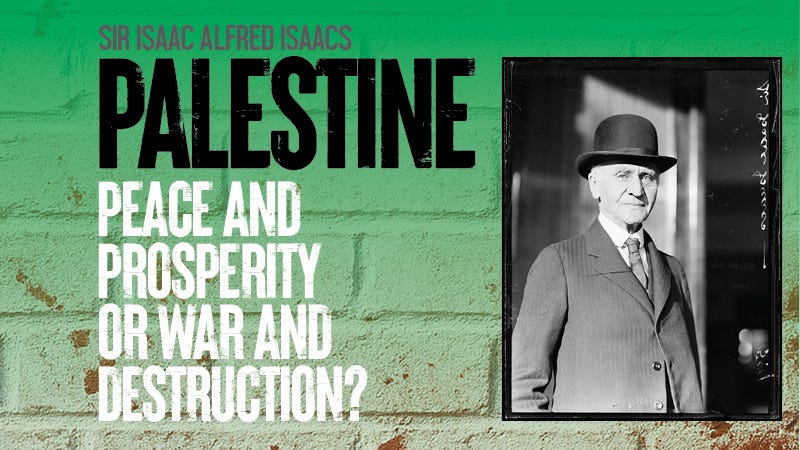
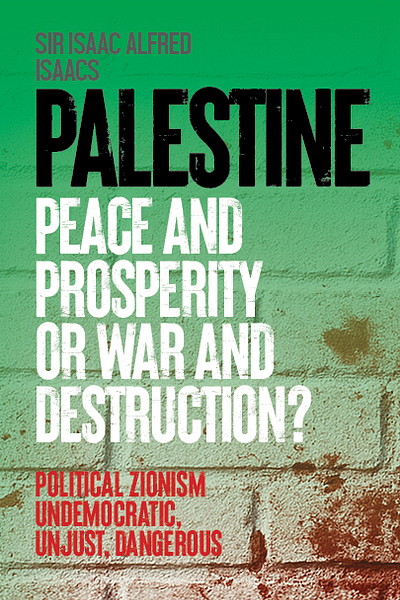
In 1946, when Sir Isaac Isaacs published Palestine: Peace and Prosperity or War and Destruction?, the modern Middle East had not yet been born, but the parts that make up this central tragedy were already fully formed.
The state of Israel didn’t exist at this point: that arrived two years later, in 1948. The Nakba hadn’t occurred, the catastrophe where well over 700,000 Palestinians were displaced, concurrent with the ongoing destruction of Palestinian society, land and identity by the newly-created Israel. The United Nations was just one year old. And yet Isaacs, the former Governor–General of Australia, Chief Justice of the High Court, and one of the most eminent Jewish jurists in the English-speaking world at the time, believed that the most consequential moral and political failure of the coming era was already visible, even before the state of Israel had been created.
He wrote this publication during a time of extraordinary tension and global vulnerability, soon after World War II. The Jewish people of European had just endured a genocide committed on an industrial scale by Nazi Germany, and hundreds of thousands of survivors were displaced, stateless and traumatised. Sympathy for Zionism was widespread and, in many parts of the world, this was a natural instinct after the horrors of the war.
At the same time, Palestine—which was still under the British Mandate—was experiencing escalating violence between Jewish paramilitary groups, Arab nationalists and imperialists who were still keen to keep marking out their territorial boundaries and influence. Isaacs wrote this book not as a neutral observer, but as a deeply committed Jew, a democrat, and a constitutional thinker who believed that the path being pursued in Palestine would lead not to refuge and reconciliation, but to perpetual conflict. Eighty years later, Isaacs predictions have, more or less, come to fruition.
What makes this book remarkable is not just its historical position on the eve of Israel’s creation, but the nature of Isaacs’ dissent. Isaacs was not opposing Jewish immigration, humanitarian refuge or Jewish cultural life in Palestine; he was opposing something far more specific and, in his view, far more dangerous and sinister: the adaptation of Zionism into a project of political sovereignty defined by religion and ethnicity, and the attempt to create a state whose identity would inevitably subordinate one people to another.
In 1946, the arguments pushed forward by people such as Isaacs went against the flow of international opinion at the time. In 2026, however, it reads like a warning that was ignored and should have been listened to more closely.
Isaacs’ position has often been misunderstood, mischaracterised and, over the years, marginalised. He was not an anti-Zionist in the way that contemporary supporters of Israel and Zionism like to derogatorily point out. He was actually a supporter of what he referred to as religious and cultural Zionism, especially the development of Jewish life, learning and community in Palestine, and as a refuge for Jewish people fleeing persecution. What he solidly rejected was the ideological pursuits of Political Zionism, which sought to entrench Jewish dominance, implement demographic and social engineering, and place their constitutional rights above all other people.
His critique rests on three key principles.
The first principle is democracy, where Isaacs believed that a modern state could not be defined by a single religion or people, without betraying the democratic ideal that citizenship should rely on civic equality, rather than identity. To create a “Jewish state,” he argued, was to revive a form of church–state nationalism that Europe itself was trying to escape from and eradicate forever.
The second principle is justice to existing inhabitants, and the insistence that the Arab population of Palestine—Muslims and Christians alike—possessed moral and political rights that could not be rejected and removed by historical claims, religious texts or the historical crimes of Europe, especially those of Nazi Germany. A solution that required permanent subordination, demographic “swamping,” or coercion was, in his view, unjust by definition.
The third principle is the moral standing of Judaism. Perhaps most controversially, Isaacs argued that Political Zionism, by abandoning universalist ethics in favour of ethno-national power, risked damaging the honour and value of Judaism. He feared that a state built on exclusion and dominance of another group of people would not end anti-Semitism, but provoke new forms of it, while placing Jews everywhere in a position of moral and political vulnerability.
The arguments put forward by Isaacs weren’t marginal in 1946, and many prominent Jewish scholars, intellectuals, rabbis, jurists and organisations across Britain, the United States and Australia shared these views. What is remarkable about this book is the clarity with which he foresaw the long-term and disastrous consequences of rejecting compromise and equality.
Reading Isaacs after 1948—and after 2023
History didn’t follow Isaacs’ advice. Within two years—and several months before Isaacs died—Israel was declared a state, war quickly followed and hundreds of thousands of Palestinians were displaced. In the following decades, Israel consolidated itself as a powerful nation–state, while Palestinians remained stateless, occupied in Gaza and West Bank, or exiled. Over time, the conflict has hardened into a permanent feature of global politics—especially for the United States—which seems to be difficult to breakdown and resolve.
For many years, Isaacs’ warnings were treated as obsolete old-school thinking that had been superseded by the facts on the ground and realpolitik of the twentieth century. Yet the events of the early twenty-first century—a new realpolitik, especially since October 2023—are forcing us to re-assess all the assumptions that have been made historically about the Middle East. The Oslo process, commenced by Yitzhak Rabin and Yasser Arafat at the White House in 1993, has collapsed completely. The continuation of the occupation of Gaza and West Bank by Israel, the continuous expansion of illegal settlements and the endless cycle of violence, primarily committed by Israel, have raised many questions about democracy, equality and international law in Israel–Palestine.
The events of 2023–25, particularly the war in Gaza and the ensuing legal, moral and diplomatic crisis, have made it difficult to avoid those questions. Allegations of war crimes, debates over genocide—which, incidentally, are accusations that have been made by the United Nations—and unprecedented proceedings before international courts have brought Israel’s founding contradictions into the spotlight. At the same time, the many states that once proudly supported a “rules-based order” have struggled to reconcile their stated commitments to human rights, with their political alliances.
In this context, Isaacs’ book shouldn’t read just as a relic of something prehistoric that was written before the creation of the state of Israel—a state that he never actually got to see—but as an early and clear articulation of the dilemmas that remain unresolved to this day. His insistence that security cannot be built on permanent inequality, the suggestion that messianic nationalism rooted in exclusion corrodes democracy, and that moral authority matters as much as military power, speaks directly to the chaotic world of 2026.
Why this book still matters in 2026
This book is not offered as a definitive answer to the Israel–Palestine conflict—it sits at just over 17,000 words—nor is it an argument against Jewish self-determination per se. It’s a clear reminder that right from the very beginning, there were many principled and highly informed Jewish voices—as there are today—who warned that the choices that were about to be made by the international community in 1946 would lead to tragedy for both the Jewish people and Palestinians.
Isaacs believed that an alternative world for Israel and Palestine was possible, a future based on equality, equal citizenship and ideological restraint. Whether such a future remains within reach is an open question, as the voices that echo the sentiments of Isaacs are far softer in the global politics of today, and are far more difficult to find. What is no longer credible is the claim that no alternative was ever imagined, or that dissent was solely external, hostile or anti-Semitic.
To read Isaacs today is to confront an uncomfortable truth: many of the arguments now voiced in international forums, human rights reports and legal case were articulated clearly—by a Jewish former head of state—all the way back in 1946. That they were ignored, as they are today, doesn’t diminish the force of their arguments.
This edition is published not to settle the arguments of the past, but to shine a light on the events of the present day. In an era when unchecked nationalism is resurgent and fuelled by irresponsible and incompetent leaders who see themselves as demigods rather than keepers of the public good, when democracy is fragile and seemingly falling apart and international law is openly questioned, Isaacs’ voice invites readers to ask a question that remains painfully unresolved:
Can peace be built where equality is denied—and can a state founded in trauma afford to abandon justice?
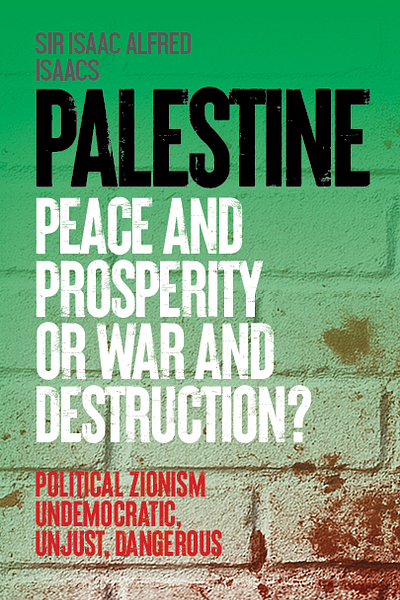
Palestine: Peace and Prosperity or War and Destruction?
84 pages
Originally published in 1946. Released January 2026.
Download “Palestine: Peace and Prosperity or War and Destruction?”
All Substack subscribers can download Palestine: Peace and Prosperity or War and Destruction? for free from the links below – in PDF, Kindle, Apple, Google, Kobo, Nook and generic formats.
This is a brilliant essay. It's more than a book review: you have written a coherent, objective analysis of the most divisive issue today without resorting to emotive, sensational language. You have brought to our attention a work that provides a critical framework that we can use in our discussions about these issues. Nowhere else have I read this type of clear-eyed dissection of how we can argue respectfully and maturely about a highly sensitive issue. And we have a former Governor-General to thank for giving us words of wisdom.
For some reason all of your posts are not showing up In my substack “all feeds” or “paid” since the beginning of January. I need to go to New Politics to see your 4 new posts after 31/12. Thought you were on deserved a break.