


It we are to fully understand the current wars and tensions in the Middle East region, we really need to look beyond the immediate headlines, which are more about the mainstream media defending the interests of the United States, Israel and the rest of the Western world, and trying to neatly divide this conflict into “winners” (us – a.k.a. US-Israel-Australia), and “losers” (them – a.k.a. Iran-Islam).
There’s a deeper dynamic that’s been played out, and it is that struggle of the United States trying to maintain its regional influence, and trying arrest its slide on the international stage – which is slowly but surely happening – and seems to be spluttering with short-term military actions and behaving as though today’s world is where it might have been in 1956, and trying to apply this type of thinking in a different and more dynamic world of 2026. The world is changing, but not in the way the United States wants it to change.
Of course, it might be considered ridiculous to suggest the United States is a waning power – it’s still number one economically and militarily – but its actions over recent weeks have been a mixture of bizarre strategy and an arrogant belief that it can do whatever it wants in a region where it’s been able to maintain strong political influence, secure all the energy requirements that it needs, and prevent the emergence of other regional powers that might be hostile to its interests. Those days might be coming to an end.
That system was built on several core pillars: military bases installed across the region, security arrangements and economic blackmail with corrupt governments – such as Egypt and Saudi Arabia – control of major shipping routes, and the projection of American might through both soft power and hard power. Within this structure, Israel has long functioned as America’s most reliable partner, and now possesses one of the most technologically advanced armed forces in the region. But how effective has it been in recent times? Israel can easily defeat defenceless or weakened political entities, and kill thousands of people – for example, in Gaza and southern Lebanon – but it’s more than meeting its match against Iran, and along with the United States, has probably overestimated what can be achieved against what essentially is the most powerful country in the region.
For the United States, maintaining its influence in the Middle East – and using Israel as its proxy – has been a key part of its foreign policy for many years, and the possibility of losing strategic ground in this area would be one of its greatest concerns. And Iran’s growing diplomatic and economic engagement with Russia and China feeds directly into these concerns. Iran has also become more actively involved in groups such as BRICS and the Shanghai Cooperation Organisation, groups that have the great potential to create alternative centres of global economic influence outside the systems dominated by America. And that’s exactly what the United States does not want.
From this perspective, the attacks on Iran are a part of a broader American struggle of keeping itself at the top of pecking order in international politics. Last year, it was Venezuela, with the US President Donald Trump trying to remind the world that the Monroe Doctrine still exists, and a belief that the United States can still do whatever it wants within its own domain. But it was almost a show-pony act: just like Israel, America can only bully the far weaker countries, and it’s evident that it won’t be able to get its own way against Iran: it’s far too powerful for that.
The fear for the United States – and for Israel – is that if Iran is able withstand these attacks and consolidate its influence across Iraq, Syria, Lebanon and other countries within the Gulf, it could form a solid regional bloc that operates with far greater independence. And that could also end up creating many problems for Israel too.
Over the past few decades, many of Israel’s historic rivals have been weakened or removed as a threat – both to Israel, and to Western (US) interests. Iraq was severely downgraded after the 1991 Gulf War and the 2003 US-led invasion; Syria has been heavily weakened after their prolonged civil war and the sudden withdrawal of Russia at its key benefactor. Libya essentially collapsed after the NATO-backed uprising in 2011, and has still not recovered – all of these were classic imperialist divide and rule tactics, and Iran effectively is the only regional power still standing and now capable challenging Israel – and America – in the region.
So there’s a wide range of issues that offer explanations about these attacks on Iran – big power rivalry, regional security issues, economic interests, war profiteering, domestic political pressures and some highly conservative and religious-based fanatics working behind the scenes within the US military to bring on the maniacal “end times”.
This isn’t the last stand for the United States, far from it – the outcome might not result in a military defeat, but it will suggest that it’s not as powerful as it thinks it might be, and will also confirm its slow downward trajectory as the world’s sole superpower, soon to be overtaken by China.
The evangelical road ahead and the risk for Australia
If the current trajectory continues, the next phase of the conflict with Iran – or with other players in the region – is likely to be less about clear and coherent long-term military plans, and more about a theological war influenced by all of those evangelical Christians who have infiltrated Trump’s White House, and the upper ranks of the US military. This influence was clearly the case under the presidency of George W. Bush in the early 2000s, but it’s been fast-tracked and radicalised, first of all during Trump I, and much further under Trump II since early 2025.
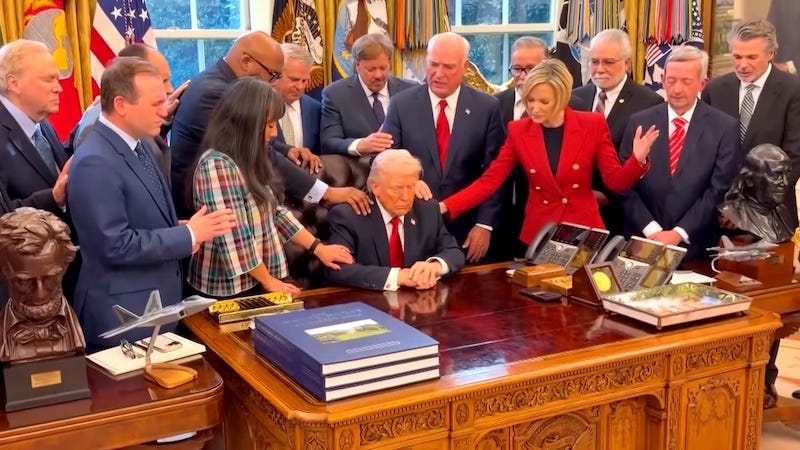
And a belief in having “God on our side” and a blind and obscene obsequiousness to Israel probably explains why the US attacks on Iran have been fragmented and inconsistent. Although the build-up in the Persian Gulf had been happening for some time, and it was clear that the United States was going to act sooner rather than later, the military actions when they occurred did escalate rapidly and unpredictably, the political messaging from the White House seemed to be shifting from day to day, and the broader military objectives remained unclear even to the more experienced analysts of the region.
Under these circumstances – a conflict governed by the rules of theology and not by a clear military strategy – could end in a long drawn-out war of attrition, and as we have seen historically in places like Vietnam and Afghanistan, these are not the types of wars that the United States has traditionally been able to win. Sure, the United States and its Israeli proxy have overwhelming conventional military power, but Iran’s geography, population and regional networks make it an exceptionally difficult to defeat outright, and this is in addition to being underprepared through that belief of “God on our side”.
This is the greatest risk for the United States, where a prolonged war with Iran could ultimately weaken its power, just at the time when it’s in a broader international contest with China and Russia. And if the conflict disrupts global energy markets or triggers a broader economic downturn – as it has already started to do – the political consequences inside the United States could be severe.
This is where the implications for Australia become concerning. Australia has been drawn into conflicts created by the United States in the past, and while it’s not as clearly defined as Robert Menzies announcing in 1939 that Great Britain was at war and “as a result, Australia is also at war”, it’s close. And while the Prime Minister Anthony Albanese might not be showing the same enthusiasm the Howard government showed during the invasion of Iraq in 2003, he’s only too happy to continue with that pattern where Australia’s involvement starts off at a modest level – in this case, deploying 85 ADF personnel, surveillance planes, and air-to-surface missiles to support the United Arab Emirates – and then increases it to a level where if the United States is at war, then Australia is too.
This week, Albanese emphasised the importance of maintaining strong relationships with the United States for the sake of international stability, but he should have exercised greater caution. Becoming too closely aligned with an ally whose strategic and military objectives are unclear – as well as being determined by theological “end times” buffoonery – is a big risk and it’s not clear why the caution that Albanese is famous for, seems to have abandoned him at this time.
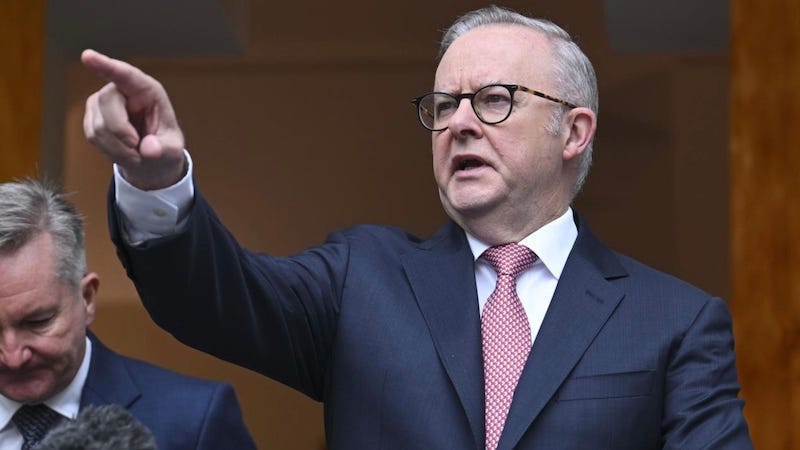
A wiser course of action for Albanese would have been to go through the quieter circles of diplomacy, rather than giving a ringing political endorsement of the actions of the United States and subsequent military support. If the conflict does deepen into a prolonged crisis in the region, not confined just to Iran, then Australia’s ability to moderate or hold a constructive diplomatic role will be reduced, because it’s held itself too tightly to the failing ambitions of the United States.
The world is a far more complex place than it was 70 or 80 years ago in the immediate post-war period. That’s not to diminish the complexity of yesteryear, but the international politics of today has so many economic, ideological, military factors – and now, needing to contend with the theological undercurrents of Christo-fascism within the White House – that need to be balanced out and taken into consideration.
And that’s why this conflict in Iran is taking on a greater significance: it’s not just a skirmish to remove a Supreme Leader and implement the famed “regime change”, it’s to maintain that so called “rules-based international order” which, of course, is just a more palatable term for Western imperialism and the United States wanting to remain as the world hegemon.
Whether we like it or not, the United States is a central part of Australia’s defence structures, and there might not too much space for independent thought or strategy when conflicts like this arise. But surely there should be enough space for Australia to make careful and strategic judgements.
Where’s the cautious Albanese when he’s needed the most? Blindly following the United States into war and throwing caution to the wind – yet again – will have ramifications for Australia. And we continue to make that mistake of assuming that when smaller states such as Australia wage a war on behalf of someone else, it will never become their own war and a problem that they’ll have to deal with at some point down the track.
Thanks Eddy and David
As we have also discovered, the Albanese regime and its Triumvirate of Albanese, Wong and Marles never cared about international law, and endorse illegal warfare, bombing and murder of Iranian civilians and sovereign heads of state.
They can’t tell you if it is legal or whether a crime has been committed, but they can tell you that they stand for the ‘liberation’ of Iran by carpet bombing their homes. They are America first, not Australia first.
This ALP regime elected on 34.6% of the vote is one of the most dangerous in history because they actually believe their own AUKUS propaganda that they are ‘good’ and anyone else that is independent is ‘bad’.
Deputy dog Albanese is less 'cautious', and more 'complicit' with war criminal leaders of the US and Israel. 4/5ths of Labor, Liberals, Nationals, and One Nation appear little more than different propaganda flavors of the same problematic imperialist Neoliberalism. The most likely solution is joining up (BEFORE the election campaign) to actively organize to replace the LibLabNatON enshittification next Federal and State elections. I suggest with The Greens, or any genuinely proactive and ethical independents (maybe 1/3 of them?), and any likely new entrants which can demonstrate a (previous career) sufficient track record of giving a damn about what matters to us. Let's kick these deadbeats to the political curb, before they consolidate their knees on our necks!