


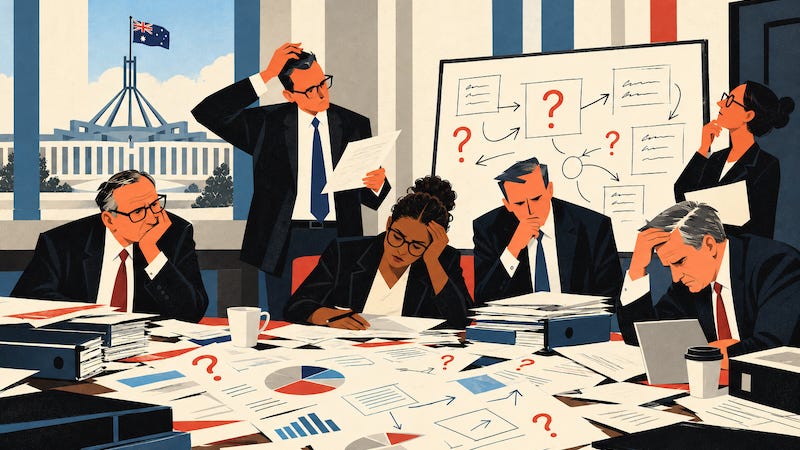
There is a particular type of person who does very well in large institutions. They are usually well qualified, understand the procedures and know precisely what constitutes an acceptable answer to an acceptable question. They are rarely considered to be fools in the conventional sense but their weakness is that they have spent so long learning how the institution thinks that they have stopped noticing that it’s become the only way to think. They can be called “gronks”, and Australia appears increasingly comfortable allowing them to run things.
A gronk is a dullard bureaucrat, but dullard is more important here than bureaucrat. The defining characteristic is not low intelligence but a lack of intellectual curiosity. Gronks are unimaginative, rarely seriously challenged and suspicious of ideas from outside the recognised process. They can be diligent, decent and technically competent people, which is precisely why they become influential. Put enough of these people together, allow them to appoint people who broadly resemble themselves, give them considerable authority and protect them from the consequences of being wrong, and eventually you have what we can call a gronkocracy.
The Reserve Bank of Australia has become a useful case study of this phenomenon. Just last week, its Monetary Policy Board unanimously increased the cash rate by another 25 basis points to 4.60 per cent, and in the same announcement, the Bank acknowledged that consumer spending was easing, housing prices had fallen in most capital cities, new housing loans had declined and labour-market conditions had eased.
It also identified inflationary pressure created by conflicts in the Middle East, disrupted oil supplies, higher energy prices, rapidly increasing technology prices and weak productivity growth, alongside related domestic capacity pressures. Having described several different economic problems, the Board arrived at the familiar conclusion: aggregate demand had to remain subdued, so Australians required another dose of higher interest rates.
Perhaps it’s right to make this decision. Perhaps. Inflation remains above the target band, constraints on domestic capacity are a real thing, expectations matter and higher interest rates will eventually reduce demand. But that does not answer the more interesting question: is suppressing aggregate demand the best response to this particular mixture of inflationary pressures? To a person with a hammer, every problem has the unfortunate tendency to look like a nail, and needs to be hammered away.
Interest rates are an extremely powerful tool – that cannot be denied – which is exactly why we should be careful about using them. Raise the rates and households with mortgages have less disposable income, borrowing then becomes less attractive, investment is cancelled and economic activity will eventually slow down. Monetary tightening doesn’t arrive in some utopian model household developed by the Bureau of Statistics: it lands on real household finances that vary enormously.
When the hammer doesn’t fit the problem
It’s reasonable to use Australian monetary policy to control the flow of money in within the economy. But there are things that domestic monetary policy cannot affect. If petrol is expensive because Middle Eastern oil supplies have been disrupted, increasing a mortgage repayment in Frankston doesn’t produce another barrel of oil. Making an apartment development harder to finance does absolutely nothing to relieve the current housing shortage.
Interest rates can make consumers sufficiently poorer or cautious that they reduce spending elsewhere, offsetting price rises imposed upon them through energy, housing or imported goods. Eventually the aggregate inflation number can improve but this is not the same as repairing the source of the price rise.
The delay seems to make the problem worse. The RBA itself says monetary policy can take between one and two years to have its maximum effect on GDP and inflation. A decision made in September 2026 is partially in consideration for the economy that Australia might have in late 2027 or 2028, while imposing some costs immediately on people living in the economy that we actually have, right now. Given that timeline, the cuts earlier this year barely had the time to consolidate their effects before policy changed direction yet again.
A great deal can happen during this time frame. The Middle East could change dramatically, although with Donald Trump at the helm in the United States, that might be unlikely. Oil supply could recover, shipping costs can change, computer chip supply can catch up with demand and governments can change their energy, housing and infrastructure policy. External inflationary shocks can weaken for many reasons that have nothing to do with the Australian cash rate.
This doesn’t mean the RBA can or should predict every external geopolitical event. But what it does mean is there is something very weird about responding to volatile external shocks with a domestic instrument whose most powerful effects might end up arriving way after those shocks have disappeared.
Imagine if the international energy prices fall sharply next year and Australian inflation goes down with them. At roughly the same time, accumulated interest-rate increases will have suppressed construction, consumption and investment and pushed unemployment higher. In this situation, it would be too easy – and dangerously so – for the RBA point to the lower inflation rate and declare the tightening a raging success. Unless we establish how much was caused by lower Australian demand and how much resulted from the external shock unwinding, all we have done is demonstrated the sequence of events, rather than the cause of it. In this case, we have the hammer belting the wrong material.
When Australia used a wider range of tools
Australia has recent experience of using a far broader economic toolbox, than just the blunt instrument of interest rates. During the global financial crisis, interest rates were cut aggressively, but there was other fiscal policy that was also used directly. Cash was transferred to households who likely to spend it – and they did – and public investment was brought forward to support employment as private demand collapsed. Treasury subsequently concluded that the cash payments boosted consumption and estimated that without that discretionary fiscal stimulus, the economy would have contracted for three consecutive quarters which, of course, is the definition of a recession.
Even two of the most derided elements of that stimulus package need a far more serious analysis. The Home Insulation Program was poorly administered: safety and compliance risks were underestimated, quality control was inadequate, with four deaths that were attributed to the program. Yet the Auditor–General estimated it created between 6,000 and 10,000 jobs, insulated more than a million roofs and produced substantial energy-efficiency benefits. These worthwhile policy objectives were undermined by poor implementation, but that doesn’t mean that the objectives achieved nothing.
The Building the Education Revolution is a similar situation. Some schools received facilities they might not have chosen if that sole purpose had been a part of long-term educational planning. But that wasn’t the sole purpose: the spending was designed to put construction activity into communities at a time when private investment was collapsing, and the Auditor–General found that it contributed significantly to reversing the decline in non-residential construction. A school hall was both a school hall and an economic intervention.
The lesson is not that cash payments, insulation batts or school halls are the universal answers to every economic problem: the issue is that governments were confronted by an unusual set of economic problems, and were prepared to ask what response fitted that problem, rather than treating the one macroeconomic instrument – interest rates – as sacred. Fiscal policy, monetary policy, regulation, public investment and the banking system were all part of the government’s response, operating over different periods and through different processes. And it’s very instructive that by using this method, Australia was one of a handful of countries that avoided the worst effects of the GFC.
That ability to improvise is what gronkocracies gradually lose and, over time, it’s a skill that completely disappears. They don’t necessarily make absurd decisions, and their decisions can usually be defended according to the methods and models that they fully understand. But they become dangerous because the range of possibilities that can be seriously discussed thins out, long before anyone formally rules anything out.
This is how an institution can contain a room filled with very clever people vigorously debating each other, while remaining remarkably resistant to the ideas that could provide a ready-made solution to the problems they are analysing.
This is not to say that the RBA needs to replace their economists with non-economists, or employ the mavericks who can shake up the institution with the our-there theories and thinking outside the box, just for the sake of it.
The RBA needs very good economists who understand monetary theory, financial markets and inflation. What it also needs is enough broad intellectual rigour to make those economists defend the premises of their arguments, rather than just the recalibration of their existing models. Someone should understand housing as housing, not primarily as a component of inflation; understand what financing costs actually do to construction; somebody should understand household budgets from something other than an aggregate set of statistics; and, of course, there should be somebody there who remembers the previous economic episodes well enough to recognise when an apparently new problem has an old solution, rather than going through the process of reinventing the wheel every time an issue arises.
How smart institutions become stupid
Perhaps this lack of memory is the difference between expertise and gronkocracy. Expertise carries knowledge but should also carry experience, doubt and judgement, because genuine expertise includes some understanding of how often sophisticated people have been wrong. Gronkocracy carries knowledge without enough doubt and then mistakes institutional consensus for independent confirmation.
This problem goes far beyond the Reserve Bank: governments, regulators, universities, corporations and consulting firms all reward people who master institutional expectations while filtering out people who keep asking the awkward questions. This isn’t a conspiracy or about ideological agreement; it happens naturally when successful insiders choose successors who appear sensible to them, the unconventional proposals carry greater career risk than conventional failures, and following an accepted process that provides protection when outcomes turn bad. The person who followed the procedure can explain the failure; the person who challenged procedure becomes the owner of the experiment.
The gronk’s problem is not a lack of intelligence but a narrowing of intelligence. Intelligence works best when it’s accompanied by curiosity, critical thinking and a willingness to discover that an assumption was wrong. An institution may contain some of the cleverest people in the country while becoming intellectually narrow, which is harder to detect because the sophisticated protective coat remains, long after the curiosity has gone.
That is how smart institutions become intellectually stupid. They accumulate enormous technical knowledge while gradually losing the capacity to imagine that their problem might require a different approach. Their failures are investigated and incorporated into improved procedures and technical manuals, after which those procedures are applied with still greater confidence. Everybody is professional, the papers are excellent, the modelling is sophisticated and the meeting minutes are impeccable, but the institution only becomes better and better at answering the questions that somebody should have challenged in the first place.
The solution is not to fill governments up with gifted amateurs or reflexive contrarians; expertise still remains indispensable. What institutions need is organised intellectual friction: people with enough knowledge to understand the prevailing argument and enough independence not to be impressed just because everybody important accepts it. The most valuable person in the room is sometimes the one who is prepared to ask whether the beautifully modelled answer relates to the problem outside, in the real world where the solutions have to be applied.
That is ultimately what I mean by the gronkocracy. It’s not a rule by idiots; it’s a rule by intelligent, credentialled and often conscientious people who have become too comfortable with the intellectual world in which they operate. The result is narrow, unimaginative and rigid decision-making, with compassion, reasonable rule-bending and imagination suppressed or simply forgotten about.
The opposite of the gronk is not the genius but somebody who remains curious, can still be surprised and is prepared to be proved wrong, because being proved wrong means there might be a better answer. Curiosity and critical thinking should not be irritants that institutions occasionally tolerate; they should be among the main qualifications for running them.


"...Someone should understand housing as housing, not primarily as a component of inflation; understand what financing costs actually do to construction; somebody should understand household budgets from something other than an aggregate set of statistics;..."
They bow to the sacrosanct computer models and data feeds developed by the clever people and in their ivory tower they are too far removed from the common man and so have no understanding of their problems or even a touch of empathy.