


A reader contacted New Politics recently about the condition of infrastructure in New South Wales and the Fifteenth Avenue upgrade in South Western Sydney, and his e-mail set me off thinking, if not exactly in the direction he intended.
There’s no shortage of infrastructure spending in NSW: Sydney has been dug up, tunnelled under and rebuilt at an extraordinary scale, yet its supporting systems don’t make all of this work any better. Travel is still slow and expensive, hospitals struggle with staffing while governments spend billions on buildings – the Powerhouse Parramatta will open in November but only after years of arguments about what had been built, why Ultimo had been sacrificed and how it needs to be governed.
We are very good at building the thing, but we are less good at deciding what the thing is for, what surrounds it and what will happen after the thing is built.
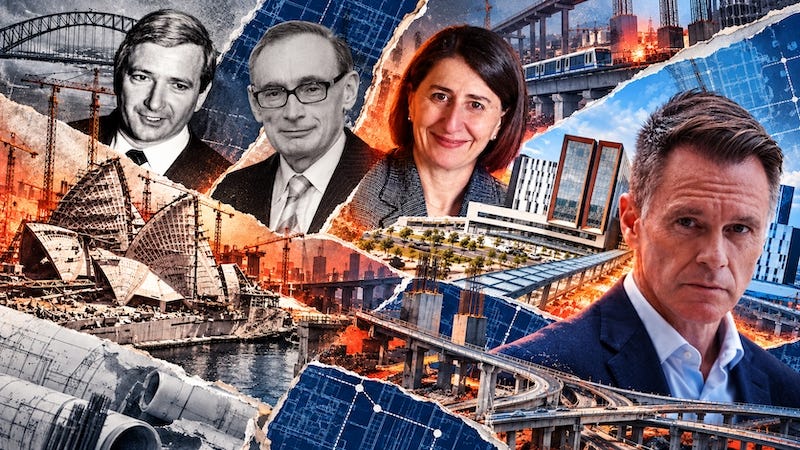
NSW governments have always wasted money and made bad planning decisions, the more important change began under Nick Greiner after 1988, where his economic rationalism brought privatisation, corporatisation and private-sector management principles further into the public service. His achievement – if that is the word – was larger than the assets sold: he changed what government believed it needed to do itself.
There was plenty to reform, the old public sector had inefficiencies and protected monopolies, and public ownership wasn’t a guarantee competence: the problem was believing government could shed their functions and responsibilities without shedding the knowledge attached to them. If outsiders could design, finance, build or operate a project, retaining that capacity inside government was considered to be a duplication. Eventually, the people capable of judging the quality of the outsourced work also disappeared.
Labor had 16 years after it was elected 1995 to change direction, but it chose not to. The Carr government was less doctrinaire, and electricity privatisation came across barriers from within the party and union movement, but private financing and operation became normal. The Eastern Distributor, Cross City Tunnel and Westlink M7 were Labor decisions that were made within much of the framework that Greiner established.
The Cross City Tunnel is a prime example, where treasurer Michael Egan rejected a state-owned toll-road company partly because private finance could transfer the construction and patronage risk away from the government. Motorists then avoided the tunnel and the operator collapsed. Investors had carried the financial risk, but government still had a tunnel in central Sydney and a transport problem around it.
Morris Iemma’s fight in 2008 with Labor over electricity privatisation showed how deeply this thinking had moved inside the party. Coalition governments after 2011 went much further through asset recycling, electricity transactions, WestConnex and long infrastructure concessions, but they were not starting on bare ground. Thirty years of policy had made private provision not something that was used occasionally, but increasingly the place from which government began.
That’s a more important question than whether privatisation is inherently good or bad. Private companies seek profits because that’s exactly what their purpose is. The failures occur when government creates a public system based around commercial arrangements and discovers that nobody except the government itself is obliged to make the system work as a complete entity.
Building projects without building a system
The poor state of Sydney’s roads show the consequences, where decades of enormous spending have produced an overpriced, poorly integrated system. New motorways feed roads that are unable to absorb their traffic. Drivers choose routes according to which tolls they need to avoid, as well as geography, sometimes accepting longer journeys to avoid yet another hefty charge. Western Sydney, where distances are greater and public transport usually poorer, holds a particularly heavy burden.
It’s not a transport network designed by somebody asking how people should best move around the city, it’s the accumulation of projects and concessions made at different times, with different prices and political purposes to take into account. And it’s a total mess, primarily because governments have worshipped the gods of privatisation, rather than the people who elected them in the first place.
The Independent Toll Review called it a “poorly-functioning patchwork”, finding inefficiency and unfairness, particularly for Western Sydney, where it has estimated that motorists have paid out $195 billion in nominal toll payments over three and a half decades. Governments in New South Wales encouraged private road investment, then introduced toll relief when the costs became politically unpalatable, now becoming a favoured election campaign strategy. The Minns government reforms might improve matters somewhat, but the biggest problem has been that in recent times, there had been no overarching plan for Sydney’s transport system.
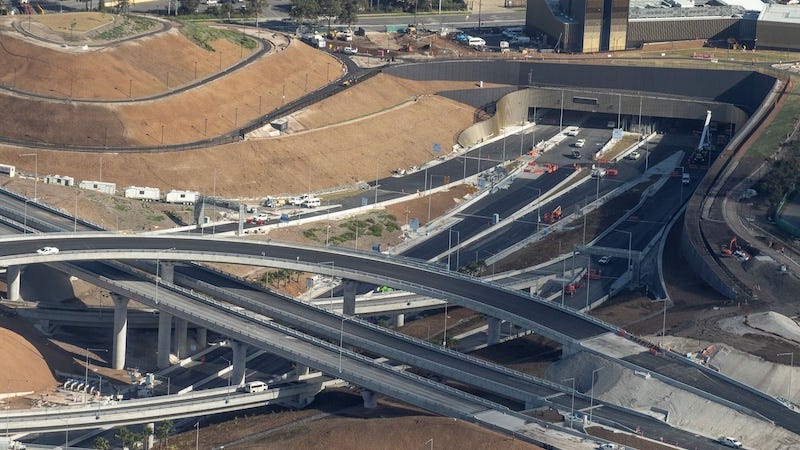
The WestConnex project is a clear example of this, where once it was divided into component projects, there was no requirement for continuing whole-of-program quality assurance – each part could pass through the development process, while nobody was examining the whole picture.
The visionary engineer, John Bradfield – considered to be the “father of modern Sydney”, thought in almost the opposite direction. What distinguished him from most was the levels to which he understand the problem and resolve it. The Sydney Harbour Bridge, suburban railway electrification and the city underground were all parts of the transport system. The bridge carried also trains because he was not designing an isolated harbour crossing and later wondering how rail might fit into to: he imagined the city as a whole and determined the engineering it required.
New South Wales in Bradfield’s era retained enough engineering and planning knowledge to develop a sustainable metropolitan idea. Contractors could build parts and politicians could alter others, but the idea wasn’t based around the corporate needs of a temporary private consortium: the state controlled every part of the process and acted in the interests of the public because, essentially, they were the ones paying for it.
The Powerhouse is more complicated because the case for major cultural investment in Western Sydney was overwhelming. The city of Parramatta deserves to have a great museum, yet the NSW government turned an argument for creating something new into a debate about moving something.
Instead of asking what type of museum Western Sydney should have, the project became bound up with removing the Powerhouse from Ultimo and transferring the institution elsewhere. There was no reason why Sydney could not have had both: a museum on the edge of the city, and one in the west, and a government spending $915 million on Parramatta could have thought more ambitiously than culturally robbing Peter to pay Paul.
The Northern Beaches Hospital opened with another version of this muddle-headed thinking. The new 488-bed facility brought serious complaints about staffing, equipment and transition; its chief executive resigned two days after it officially opened in 2018. A public-private model project the hospital was littered with problems, including an incident where a two-year-old boy died after he was left in an emergency department chair for two hours, despite showing life-threatening symptoms.
After an audit by the NSW government that showed that private ownership had resulted in numerous failings and safety issues, the hospital was transitioned into the NSW Health system, with a subsequent ban on future public–private partnerships at acute hospitals.
The temptation is to say NSW simply needs better project management, but it’s not only a recent issue. The Sydney Opera House was a project where the estimates were hopeless, construction began before technical problems were resolved, costs exploded and the main architect – Jørn Utzon – left. By modern standards, it was a fiasco, despite it being one of the most consequential things that New South Wales has ever built.
But at least the NSW Premier at the time, Joe Cahill, wanted an opera house because he believed Sydney should have one, otherwise that space left behind would have become an extension of the opulent nearby apartment buildings that are occupied by Sydney’s wealth class. Bradfield understood infrastructure as a system; Cahill understood this in a different way, but both shared the assumption that a government must know what it wants before deciding how.
Business cases created by external consultants now occupy the space that was left behind by that loss of confidence – and creativity – by our political leaders. Of course, governments always need to examine the costs, benefits and risks, but problems always arise when politicians leave the decisions for others to essentially make on behalf of the public, and have little skill or understanding of their civic duties an responsibilities.
No business case can really define the cultural infrastructure that Western Sydney deserves, the transport system Sydney desperately needs, or a hospital’s relationship to public health. Politicians are meant to be in tune with the requirements of their electorate but, over the past forty years or so, they’ve been too happy to hire somebody else to define the “problem” – the consultant – someone else to test the solution and, in an almost Kafkaesque scenario, then hire another consultant to ensures the first two are doing their job correctly. It’s a symptom of the disease of public–private partnerships: the decision-making is spread out, so no one ultimately takes responsibility.
Rebuilding the capacity to govern
Premier Chris Minns has inherited much of this and deserves at least some credit for recognising it and trying to do something about, albeit slowly. But Labor cannot treat forty years of history as something done by the previous government. Former Labor Premiers Bob Carr and Morris Iemma are part of it, as much as Nick Griener was, if not more. If both parties have hollowed out the state of New South Wales, just changing the government won’t fill it in again.
Rebuilding New South Wales, both literally and confidence in the infrastructure program, doesn’t mean recreating the Department of Public Works of 1955 or returning everything to public ownership. Governments will still need to use contractors, but they need engineers to recognise weak advice, planners to see way beyond the one development, commercial expertise to understand contracts and the continuous and permanent knowledge of past decisions made. This capacity looks expensive because its value cannot be assigned neatly to one project, but that’s essentially the reason why it needs to fully belong to the state.
New South Wales is a state that needs more infrastructure, not less, and the growing city of Sydney will always need new railway lines, hospitals, schools, roads, cultural institutions and public spaces. That makes the quality of government behind the spending even more important. A weak state with a huge capital budget does not become strong in itself, it just becomes a very large customer who’s happy to go for the most convenient trader of goods and services.
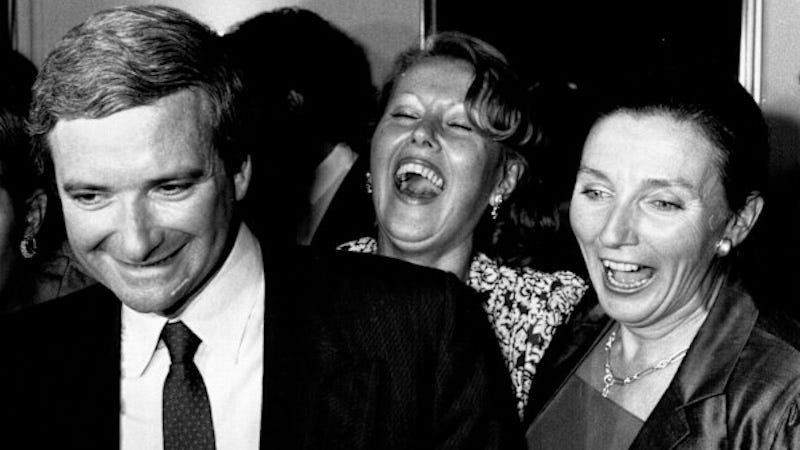
That’s the empty shell: NSW retains the money, statutory powers and ability to commission enormous works, but has progressively weakened the institutions that once connected them to the larger concept of the state. Although we can blame Greiner, it didn’t happen under the one premier. It accumulated through decisions that made sense superficially and individually – sell this asset, outsource this function, transfer the risk, finance this road privately, commission advice, assess this proposal separately – but, collective, it made no sense at all.
The more important question is asked less often: after nearly forty years of public–private partnerships, how much capacity does the NSW government have to think for itself? The state does not need to pour the concrete, but it needs to understand the city into which the concrete is poured into. It needs to know which institutions it wants, which systems they belong to, how they will operate and what public purpose justifies them.
Bradfield began with the transport system and arrived at the Sydney Harbour Bridge. Cahill began with the cultural institution and arrived at the building, the Sydney Opera House. Too much of contemporary NSW government begins with the project and hopes that, somewhere along the way, it will discover what the project was supposed to achieve.
Outsourcing government is Freidman economics. Read Shock by Naomi Klein or Disaster Capitalism by Antony Loewenstein
Waddá yá know…..Governments are useless and corporates take the money and run.
~The New Dark Ages~
The less the sweat the more the pelf
The public service serves itself
The bourgeois belt blames someone else
The prols in cotton-pickin hell:
Down at the base of the fiscal cliff
The poor are more than a little stiff
They slowly grow to get the gist
Then Scrooge McDuck prints more of it
Behind four pillars policy
There lies more pure Geometry
So obscure its clearly hid
Inside a one-eyed pyramid: