


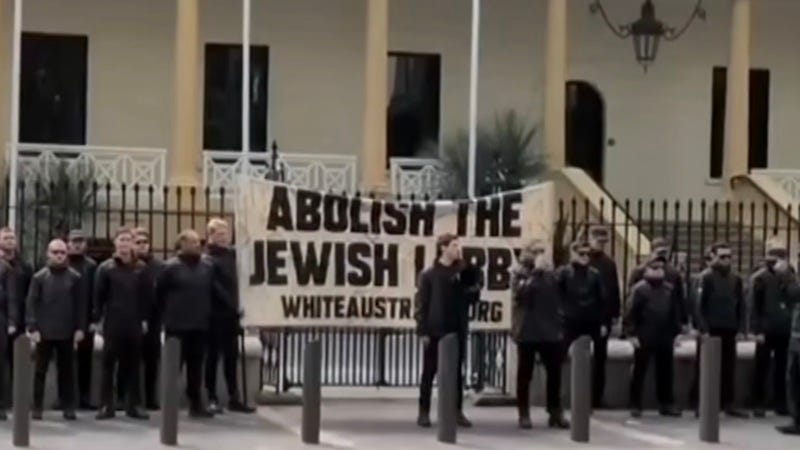
Outside the New South Wales Parliament last week, almost 70 members of an openly neo-Nazi group assembled in black uniforms, carrying a large banner that read “Abolish the Jewish Lobby”. They were also pushing their usual far-right agenda: white supremacy, anti-immigration, hostility to LGBTQI+ people, Islamophobia and explicit anti-Semitism. It’s not as though this was a surreptitious and spontaneous gathering: the organisers of the rally lodged their application with NSW Police well in advance, clearly stating that the rally was directed against what they called “the Jewish lobby”, and were granted approval around 10 days before the event.
On the day, police didn’t move in to disperse the group; they didn’t agitate and provoke them, pepper-spray them, punch or haul them off into police wagons. Instead, officers stood by while the rally went ahead directly in front of NSW Parliament House – a precinct that sits within easy walking distance of several major places of worship: a Presbyterian church across the road, an Anglican church in the same parliamentary square, St Mary’s Cathedral a short distance away, and a synagogue not far from the parliamentary precinct. Under the “vicinity” provisions the government had recently tried to use to restrict protests near sensitive sites – although these provisions were recently ruled invalid by the Supreme Court – this should at least have triggered some serious concerns from police and ministers.
NSW Premier Chris Minns publicly described the rally as “shameful”, condemning “despicable, hateful” demonstrations that spread division and racism on the streets of Sydney. Yet his outrage came after the fact, when it became clear the event had been approved and managed by his own police force. Both the NSW Police Commissioner and the Premier claimed to have been unaware of the authorisation – as is if it were some fun run event raising funds for charity and approved by a lower-level minion – despite senior police previously stating that these far-right networks were under active surveillance and “capable of extreme violence”. So, why was this rally allowed to proceed?
The actions and objectives of the rally were not only ugly, but deliberately provocative. On any reasonable reading of the state’s own hate-speech and public-order frameworks, this was exactly the type of gathering that should have attracted the attention of the NSW Police and the Premier. The group involved has been publicly identified by police and media as violent, extremist and committed to white supremacist politics, yet when these same activists assembled outside Parliament to denounce “the Jewish lobby” within sight of churches and a synagogue, the police approach was effectively hands-off. There were no arrests, no aggressive crowd control tactics, no sudden reinterpretation of “safety” or “security” that would justify shutting the event down.
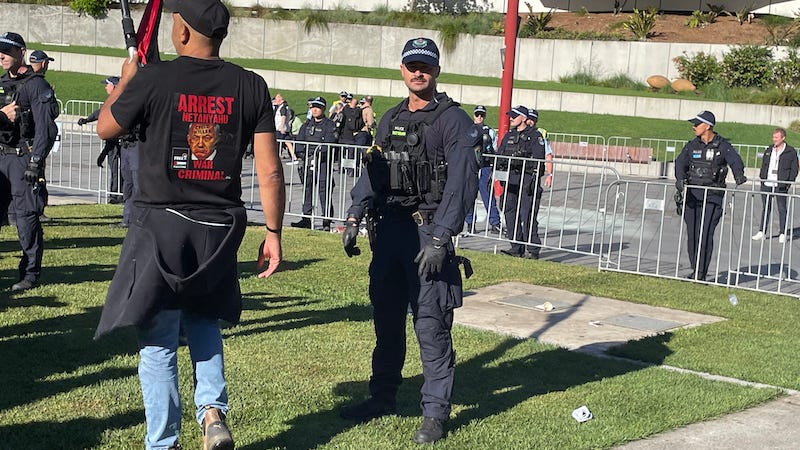
Compare this with the treatment of pro-Palestine and climate activists over the past two years: supporters of the state of Palestine in Sydney have had their applications to protest frequently rejected by the NSW Police, usually ending up in the Supreme Court to essentially beg for their democratic right to protest. And then, when their protests have gone ahead, they’ve been meet with brute-force tactics and public denunciations by the Premier and senior police. Protesters at a recent pro-Palestine rally in Darling Harbour were also pepper-sprayed, shoved, beaten and arrested; climate activists have been targeted with new “anti-protest” laws designed specifically to make their actions as risky and punitive as possible.
It’s an obvious contrast: neo-Nazis with their anti-immigration, anti-LGBTQI+, Islamophobic, anti-Semitic and explicitly white nationalist rhetoric are given the approval to protest right in front of the NSW Parliament. Meanwhile, the people protesting against war crimes, the genocide in Gaza, or against the government’s refusal to act on climate change are regarded as a threat to public order, and subjected to aggressive policing.
It’s a clear double standard and sends a message about whose actions are acceptable, and whose actions are not. The message to Muslim and Palestinian communities is that their grief and anger over mass killing in Gaza will be met not with empathy, but with riot squad brutality and legal roadblocks. And it tells the broader public that when it comes to protest in New South Wales, the real defining points aren’t based around violence versus non-violence, or lawful versus unlawful assembly; it’s a political choice made at the whim of the NSW Police: which side you are on, and whether your cause aligns with the interests and sensitivities of those in power.
How the NSW Police turn a blind eye to the far right
The issue here is that the law is not being applied equally. It’s a simple principle: the police shouldn’t favour one political group over another. Yet when it comes to support for Palestine or demands for more action on climate change, the police response is quick, aggressive and usually brutal: riot squads are always ready for the senior order to pounce after even the slightest provocation, and ministers take to the airwaves of the shock-jocks to denounce the protesters even before they arrive at their destination.
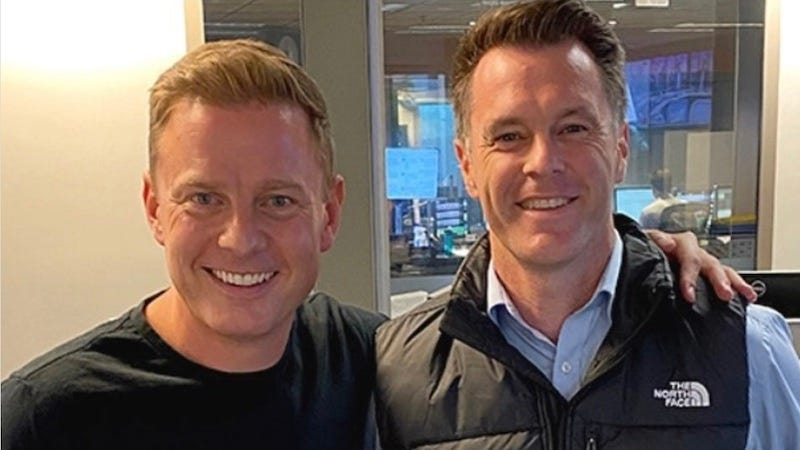
The behaviour is now so predictable that it’s a well-rehearsed script. A rally is organised; the application is rejected by the police; the right-wing media stir up the outrage; Premier Minns appears on talkback radio – usually with Ben Fordham at 2GB – to reassure conservative listeners that the government is in control; and police then prepare for the confrontation, as though they’re preparing for a weekend football game. Over and over and again, peaceful demonstrators are met not with dialogue but with provocations. The former Australian Greens candidate, Hannah Thomas, was left seriously injured at a Palestine rally at the SEC Plating workshop in Belmore – at least the officer responsible is now facing prosecution, but the police response should never have happened at all. These heavy-handed tactics are used so often now that they’ve come to define the policing of progressive action in the state.
Compare this with the treatment of neo-Nazis marching through Sydney with white supremacist banners. There’s never a riot squad lurking in the shadows; there’s no pepper spray and no tactical operations unit waiting to “circle the area”. Nothing resembling the state’s typical response to peaceful gatherings calling for an end to genocide or urgent action on climate change. If NSW Police can justify their aggressive approach to Palestine activists on the grounds of “safety” and “public order,” they need to explain why none of that logic applies to a group whose ideology is rooted in violence and exclusion, which the police themselves have previously described as capable of extremist harm.
One explanation is the presence of far-right sympathies within influential parts of the police force. Not universally though – there are many honest, hardworking officers who perform their duties ethically and without prejudice (surely there’d be at least some) – but the institution has repeatedly demonstrated selective tolerance for the political issues that it disagrees with.
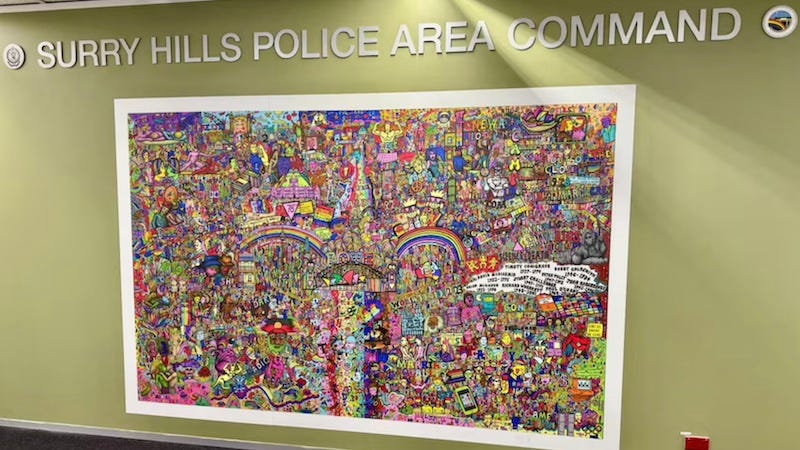
For example, the removal of Jeremy Smith’s Queer Sydney mural outside the Surry Hills Police Station: the artwork, celebrating LGBTQIA+ history, was taken down after complaints from officers stationed there, and we can assume that it wasn’t just about aesthetic preferences. This act suggests a police culture in which some forms of identity and protest are treated as illegitimate or unwelcome, while others – such as neo-Nazi rhetoric – are quietly accommodated. Officers shouldn’t be allowed to choose whose rights they defend based on personal beliefs or cultural biases: once the law is applied unequally, it ceases to be law, and becomes a selective tool based on political preferences.
Minns doesn’t need to be reminded of this but if he is willing to intervene against Palestine marches, to call for bridges to be cleared, or to support legislation designed to restrict climate activists, then he must also show the same approach when dealing with far-right extremism. Yet in this case, his government’s reactions were muted, confused and defensive – there’s a radical difference: neo-Nazis can march freely and are welcome here, while those opposing war, racism and environmental collapse are treated as enemies of the state.
Minns is out of his depth
Minns insists he was “outraged” by the neo-Nazi rally outside NSW Parliament, yet the explanation he offered for why his office failed to act – that it occurred on a weekend – doesn’t hold any weight at all.
Every major pro-Palestine and climate protest he has condemned, attempted to stop, or used as political theatre has also occurred on a weekend. The idea that the Premier wasn’t aware of the neo-Nazi rally because it was held on a Sunday just doesn’t add up, and it’s even more bizarre that he offered up such a ridiculous excuse in the first place.
What is happening, in reality, is that Minns is using the neo-Nazi rally as political cover to argue for even more police powers, including a re-draft of the hastily introduced “places of worship” protest restrictions that were recently ruled unconstitutional by the Supreme Court. He is pushing for expanded law-and-order powers not because existing legislation is inadequate – in fact, NSW already has some of the toughest hate-speech provisions in Australia – but because the government and the police chose not to enforce those laws against the far right. You don’t need new laws when you refuse to use the ones you already have. Demanding broader, more extreme powers in response to your own inaction isn’t leadership; it’s mini-dictator opportunism that covers over insecurity.
And insecurity might be the key issue here. Minns is only 46, politically young and naïve, and still untested in the pressure cooker of a minority government. It’s entirely plausible that he’s deferring to the most senior and most conservative elements of NSW Police – people who have spent decades shaping the internal culture of the organisation and who are, in practice, far more experienced in wielding state power than he is. If he feels uncertain about his standing within the Labor Party or his ability to control the Caucus, deferring to the police hierarchy would be a political shortcut. But it’s a shortcut that has a big price: Minns looks like a weak Premier bossed around by the police, and not like a strong Premier who should be the one telling the police what to do.
And there’s a sense within the NSW Labor Caucus that Minns is a reactive, law-and-order conservate more reminiscent of the Coalition years than anything that could be found within a Labor tradition, even though there have been some very right-wing Labor leaders in New South Wales.
It’s telling that comparisons are now being made not with NSW Labor heroes such as Neville Wran or Bob Carr, but to the Liberal Party’s former Premier, Dominic Perrottet. Perrottet’s affiliation with the hardline Catholic right made him an ideologue of sorts, but at least he was a recognisable one. Minns is also a staunch Catholic but appears more like a political middle manager – one who avoids ideological clarity, masks uncertainty with calls for “stronger powers,” and seems strangely comfortable enabling police overreach while claiming to stand for fairness. Where Wran kept his eye firmly on the needs of the working class, and where Carr – despite displaying the usual conservatism of the NSW Labor Right – maintained a coherent sense of what he stood for; Minns is drifting into something more erratic: law-and-order escalation without a clear Labor purpose behind it.
The result is a Premier who has now presided over the free passage of an anti-Semitic, white-supremacist rally in the parliamentary precinct while cracking down on those protesting genocide or climate collapse. Minns doesn’t need to morph into a radical left-wing firebrand, but he needs to apply the law consistently.
Even the Special Envoy to Combat Antisemitism, Jillian Segal, has been silent. The rally wasn’t too far from her residence in Darling Point, and while she would have been too far away to hear all the commotion, one would think that as soon as she knew about the appearance of nearly 70 neo-Nazis waving an anti-Semitic banner and hurling insults outside NSW Parliament, that would have been exactly the moment for her to speak out. Yet there’s been a silence, mainly because raising a concern might be politically inconvenient when she’s more focused on managing pro-Palestine criticism than confronting the far right.
Premier Minns has allowed a situation to develop where a neo-Nazi rally can take place on the steps of NSW Parliament without challenge – while progressive protesters face suppression, brutalisation, arrest and demonisation. In the process, he has alienated parts of his Caucus, emboldened the police hierarchy, and diminished Labor’s identity in the state that he leads.
It’s not the behaviour of a confident Premier, certainly not of a Premier from the Labor Party: it’s the behaviour of a government losing its moral and political direction – and of a leader who may soon find that the strongest threats to his position are not coming from the streets, but from within his own party.
The article is about Minns and the different treatment when it comes to pro-Palestine and climate action – beatings, pepper spray, arrests, media outrage – and the far quieter treatment of neo-Nazis and using these events to justify stronger police powers. That’s what the article is about. BTW, they’re not so-called neo-Nazis, they’re the real deal.
This is who Chris Minns is. Nobody believes the weak excuse he provided about “the weekend”. Now he has a reason to go back to Parliament with the places of worship legislation. This is how we end up with bad laws in NSW.