


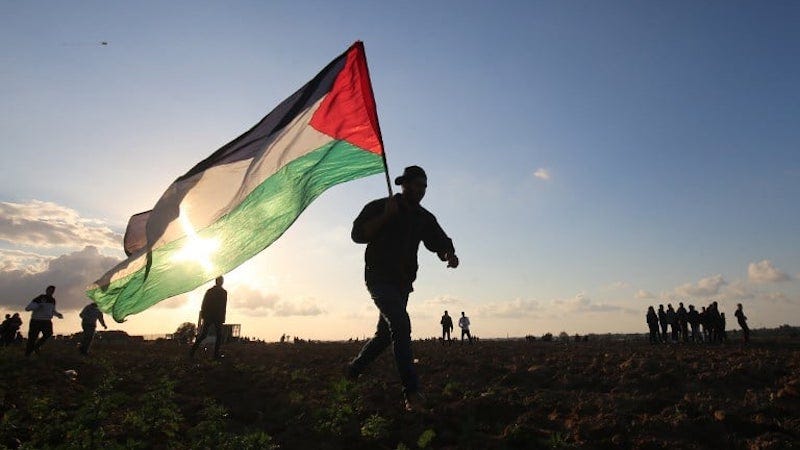
The Prime Minister Anthony Albanese has announced that Australia will formally recognise the state of Palestine at the upcoming United Nations General Assembly in September, framing the decision as an overdue and humane step toward advancing a two‑state solution – “humanity’s best hope to break the cycle of violence in the Middle East” as he put it – alleviating the humanitarian catastrophe and ending the genocide in Gaza.
However, his announcement wasn’t without conditions: Albanese made it clear that Australia’s recognition is “predicated on commitments Australia has received from the Palestinian Authority” – specifically, that Hamas is excluded from any future role in government, a demilitarised Gaza, and holding democratic elections as soon as practically possible, as well as implementing a range of other reforms.
Foreign Minister Penny Wong also suggested that recognition is dependent on pledges made in the past by the Palestinian Authority and other Arab nations in the region, and stated that it’s Australia’s intention to work with other international partners to hold them to account. It’s important to acknowledge that within this “two-state” solution, there are no conditions being placed upon Israel to accept a state of Palestine, or to demilitarise, or any other reforms: as usual, everyone else is asked to accommodate the desires of the international community, but Israel isn’t required to do anything at all.
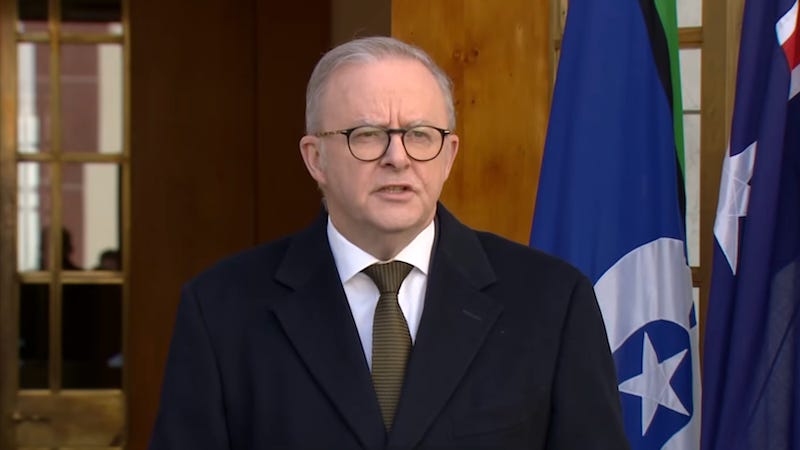
And, as if to provide himself with cover, Albanese stressed that although Australia’s decision is an independent act of a country acting in its own national interest, the decision also aligns with similar moves by other countries such as France, the UK, and Canada, also adding that Australia wouldn’t be dictated to by its allies – including the United States – although he did recognise the influential role of the US in Middle East diplomacy.
This recognition, albeit long overdue, marks a significant shift in Australia’s foreign policy in the Middle East, leaving behind the decades of delay on this issue and placing Australia alongside the 148 UN member states that have already acknowledged Palestinian statehood, despite the fact that full UN membership remains blocked due to the US vetoing these decisions at the Security Council.
Of course, domestic and international reactions have been divided. Critics – including Israel’s Prime Minister Benjamin Netanyahu and influential US figures such as the Secretary of State, Marco Rubio – denounced the move as premature, claiming it rewards Hamas and undermines peace efforts. Right-wing Jewish groups within Australia such as the Executive Council of Australian Jewry and the extremist Australian Jewish Association have warned of potential ramifications for the Jewish community within Australia, while sections of the Liberal Party have already promised to reverse this recognition if re-elected at future elections, although based on their current electoral standing, this is unlikely to happen for some time to come.
Conversely, the progressive Jewish Council of Australia, human rights advocates and Palestinian solidarity organisations have applauded the decision, although many have suggested that it’s only a symbolic gesture unless followed up with stronger action – including sanctions, arms embargoes, and accountability for war crimes and human rights abuses committed by the state of Israel and the Israel Defence Forces.
Australia to recognise Palestine but will statehood finally happen?
Australia is now scheduled to recognise the state of Palestinian but this is the latest turn in a decades‑long saga that can be traced back to the unfulfilled promise when the United Nations was first created. In 1947, the UN General Assembly adopted Resolution 181 – commonly known as the “Partition Plan” – specifically proposing the creation of two independent Arab and Jewish states in the British Mandate territory, with Jerusalem placed under international administration.
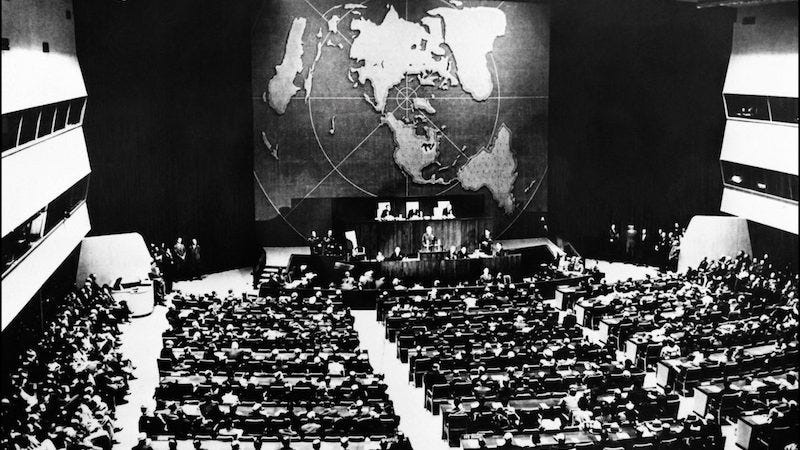
This is the international fact that many in the Western world – and within Israel – choose to ignore. Yet, despite the adoption of this resolution, the plan – as unjust as it was for Palestinian interests anyway – was never realised: Palestinian statehood of any kind has remained elusive since 1947, replaced with conflict and Israel’s forever wars, and blocking the two-state structure that was envisioned by the international community.
Australia, as a UN member and active participant during those deliberations, supported the Partition resolution and, in doing this, played a big role in the establishment of Israel while backing the idea of a Palestinian state at the same time. Why did this plan never materialise? Why did the international community deliver the promised lands for Israel – which now far exceeds what was decided in 1947 – but not for Palestine?
Albanese’s announcement, historically, isn’t an anomaly, but a continuation of what commenced in 1947. Certainly, even implementing what was agreed to by the international community almost 80 years ago isn’t a just solution for Palestine, but it has to be a start in resolving this ongoing conflict and crimes against humanity perpetrated by Israel – as well as the many unresolved structural and political challenges that were initially created by the British empire, going back all the way to the Balfour Declaration of 1917.
Of course, there must be an accountable government – free elections in Palestine, remembering that the last free election in Palestine in 2006 resulted in a victory for Hamas – there also needs to be the reconstruction of Gaza, the removal of settlers from the West Bank, and meaningful international mechanisms that can be enforced by the United Nations. Israel, along with the leadership of Benjamin Netanyahu, must face accountability – whether through reparations, criminal courts, sanctions, or other means to force a shift in behaviour, because Israel is going to be the biggest road blockage in the pathway to a permanent peace.
Is it a case of being careful for what we wish for? Recent international history suggests that recognition alone won’t stop this conflict – in fact, it could escalate it. For instance, the recognition of Croatia in 1991 didn’t end hostilities immediately; war persisted for many months. Similarly, international moves toward the recognition of Bosnia–Herzegovina in 1992 resulted in a brutal three-year conflict and genocide. As was the case in Cyprus in the 1960s and in East Timor in the late 1990s, the recognition of peoples or a state needs to be supported with strong international support, otherwise there’s no point.
Looking beyond this step by Albanese, it also provides Australia with an opportunity to play a more active role within international diplomacy, and influence the next phase through a commitment to peacekeeping solutions. Despite what the electorate might think about our political leaders, Australia has one of the best democratic systems of government in the world, and it’s only right that it attempts to export this to other parts of the globe. One plausible model would be the sustained deployment of UN peacekeepers in the territories, as suggested by Senator Jacqui Lambie – similar to the long-term missions in Cyprus and Kosovo – to maintain security, monitor borders, and support civil administrations.
Whatever the case is, Israel’s system of apartheid has to be dismantled. The civilian casualty rates are appalling: since the creation of Israel in 1948, the ratio of Palestinians killed through political and military action is around 10:1, and since October 2023, the ratio might now be as high as 500:1, perhaps even higher, when taking into account the unknown number of people in Gaza who have never been found, and are probably covered under rubble.
While acknowledging Hamas’s October 7 attack (and yes, we do have to keep acknowledging this to avoid being accused of ignoring the pain of Israel) there is absolutely no justification that exists for Israel’s actions to apply a disproportionate force and continued civilian suffering that many around the world have correctly labelled as a genocide. None whatsoever.
The Coalition keeps digging a deep hole for itself
As to be expected, the recognition of Palestine has quickly become political theatre and an issue there to be exploited by the Liberal Party for base political purposes. As demonstrated by Peter Dutton in the lead up to the 2025 federal election, this is what the Liberal Party do, and have not much else to offer. Division and chaos, that’s about it: the wallflowers of Australian politics that the electorate no longer wants to engage with.

Opposition Leader Sussan Ley and her colleagues in the Liberal Party – including Angus Taylor, Michaelia Cash and Dave Sharma – have launched vocal opposition to the government’s decision to recognise Palestine. Ley has gone so far to pledge that, if elected, the Coalition would revoke this recognition – rhetoric that’s been relayed straight from the mouths of the Israel and Zionist lobby in Australia, and is more about political posturing rather than credible policy, given the complexities around reversing such a decision.
It’s important to note that Ley was once a co‑convenor of the bipartisan Parliamentary Friends of Palestine group – a position she shared with Albanese over two decades ago – but she has now reversed her opinions, aligning herself with a pro‑Israel stance and, based on current political opinions within the electorate, will continue the downward spiral of the Liberal Party towards political oblivion.
The March for Humanity across Sydney Harbour Bridge a few weeks ago attracted up to 300,000 pro‑humanity supporters, a powerful signal that suggests that the issue of Palestine has broken free from the levels of fringe activism and entered the mainstream, despite the attempts by the media to still portray this as a marginal issue that not too many people care about.
And this suggestion isn’t hearsay; it’s backed up by polling. A recent Demos survey conducted in July found that 45 per cent of Australians now support formal recognition of Palestinian statehood, and that’s twice as many as those opposed (just 23 per cent). YouGov polling has found similar levels of support and, even among Liberal voters, support for Israel is waning.
While Albanese’s latest diplomatic announcement might be too late in this process – by about 78 years – at least it aligns with a strong and shifting sentiment within the Australian public increasingly sympathetic to Palestinian statehood. Meanwhile, the Liberal Party, led by Sussan Ley, wants to remain firmly stuck to their positions of the past, even as the electorate – and history – moves ahead at a rapid pace. It’s their loss.
It’s a foolish opposition leader who habitually opposes, simply because that’s what opposition leaders are supposed to do. It’s an even more foolish leader, whose party has lost its way, to oppose formal recognition of Palestinian statehood, when 45 per cent of Australians now support the move, twice as many as who oppose it.
A suggestion for Sussan Ley:
How about some humanitarian bipartisanship for a refreshing change? That could lift the standing of your marginalised Liberal Party.
Recognition is a distraction, deflection, and deferment. Just like every other “peace process”. Distraction from genocide, deflection of criticism and potential sanctions and diplomatic isolation, deferment of ICJ demand that Israel withdraw from all occupied territory. Bah humbug.