


Zionist groups aggressively deny suggestions that they exert excessive influence over politics, media and cultural institutions, yet when prominent people speak out against Israel or in support of Palestine, those same groups will cancel people, force them into long-winded litigations, damage their reputations and proceed to ruin them commercially. Not bad for a group who claim they have little power or influence in society, and are quick to make accusations of antisemitism – usually followed up with even more litigation – when this excessive influence is pointed out to them.
The experiences of former SBS journalist Mary Kostakidis in Australia and the musician Macklemore in the United States are the two most recent examples – different circumstances for sure, but both are examples of how quickly the criticisms of Israel will have severe ramifications for those making the claim.
For Kostakidis, it began with ‘liking’ two social media posts about Gaza and resulted in almost two years of legal proceedings against her. For Macklemore it began with the words of “free Palestine” inside a US stadium and ended up with his removal from the remainder of Ed Sheeran’s American tour.
Kostakidis had shared part of a speech by the late Hezbollah leader Hassan Nasrallah in early 2024, adding her own condemnation of the Israeli government and describing its actions in Gaza as a genocide, confirming what most of the world seems to accept and can see with their own eyes.
Alon Cassuto, the chief executive of the Zionist Federation of Australia, alleged that these posts breached the Racial Discrimination Act as likely to “offend, insult, humiliate or intimidate” Australian Jews, and also claimed they were “antisemitic”, without ever explaining how this would be the case.
This dispute then progressed from the Australian Human Rights Commission into the Federal Court, and Kostakidis had spent almost two years preparing her defence before the proceedings were eventually dropped by the Zionist Federation, without any legal finding that she had breached that Act, or any other act, for that matter.
Cassuto went on to claim that he agreed to drop the case because Kostakidis had apologised for the hurt and harm (there’s that word again) experienced by Jewish and Israeli Australians and, as a result, his objectives had been “substantially achieved”. But the apology was made some time ago: why did the legal action continue for so long, if Cassuto claims his objectives had already been “substantially achieved”? How are his actions different to any other vexatious or frivolous litigant?
The issue in this case wasn’t so much about who won or lost – it was clear that Kostakidis was going to win the case – or the fact that the case was ultimately dropped, but how this power is used to silence the critics of Israel, and the more prominent the person is, the more likely this type of punishment is going to meted out. Kostakidis wasn’t accused by an individual with limited resources, but by the peak body of the Australian Zionist movement, representing more than 200 organisations and connected financially and institutionally to the international Zionist movement.
This is an important factor, because the claims about Zionist influence within society are always denied and often reduced to the question of whether somebody can prove the existence of centralised or coercive control. But that’s not how most political influence works. These types of networks don’t need somebody at command central issuing the instructions: all they require is the money, access, organisation, relationships and the motivations to mobilise those resources when an issue arises – which is what the Zionist movement has readily available to it – and can then force considerable damage for the person at the receiving end, in this case, Kostakidis.
Of course, a journalist can remain free to criticise Israel in whichever way they wish to – which Kostakidis has continued to do since the allegations against her were first made – but spending almost two years defending that criticism through expensive proceedings sends a message that goes far beyond that one journalist, especially when other writers, broadcasters and academics can see the exact personal cost for themselves.
The Macklemore controversy in the US is an even clearer example of this, because the transition from political commentary made on a stage, to the material and severe consequences for him, happened within a matter of days.
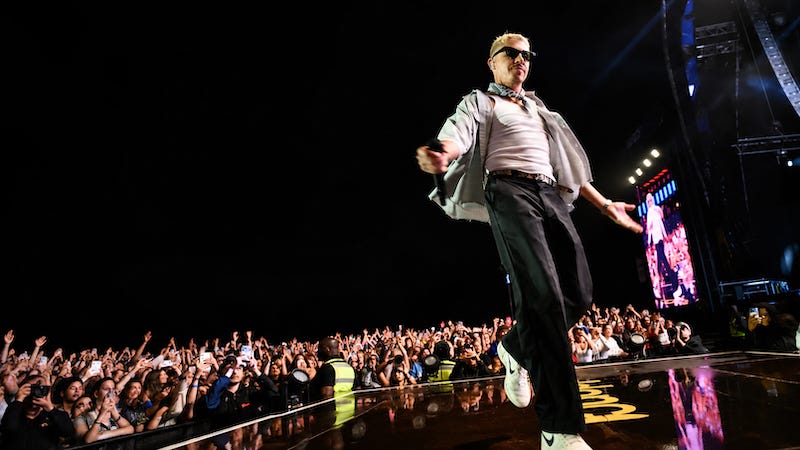
Macklemore has been speaking publicly about Palestine for several years, but his comments during two appearances supporting Sheeran in New Jersey last week suddenly reached an audience on a far greater scale, and that’s the issue for the Zionist movement. Macklemore condemned Israel’s actions in Gaza, displayed images of Palestinian destruction and told this massive audience that he wanted people in Gaza and the occupied West Bank to hear two words: “Free Palestine”.
He also addressed Jewish members of the audience directly, making clear that his criticism is directed at the state of Israel for its actions of apartheid and genocide inflicted upon the people of Palestine, and not a criticism of Jewish people. But providing these explanations didn’t stop the mobilisation of an immediate campaign from Zionist billionaires against him. Zionists destroyed the life and career of Michael Jackson, and it’s obvious they’re prepared to do it again to any performer who speaks up in support of Palestine.
The Israeli American Council called for Macklemore to be removed from Sheeran’s tour, the Stop Antisemitism group attacked his performance, and Robert Kraft, the billionaire owner of the New England Patriots and a major stadium near Boston, confirmed that he wouldn’t allow Macklemore to perform there, referring to his recent appearances and a broader history of commentary that Kraft considered offensive to the Jewish community.
And the next steps showed exactly how this power and influence works, without anyone needing the authority of government to support them. Kraft quickly rallied other stadium owners and told the tour promoter they wouldn’t accept Macklemore on the bill, putting in jeopardy concerts that has already sold hundreds of thousands of tickets. Sheeran – who, along with Pink, has lost so much credibility over this issue – claimed that “he doesn’t take sides” in politics (even though he’s strongly supported the Ukraine resistance against Russian invasion), and agreed to drop Macklemore from the rest of the tour.
Thanks to the actions of Kraft and Sheeran, the person who wants to support a free Palestine and speaking out against a genocide has lost access to the platforms from which he was speaking on. And this is how the supporters of Zionism act to shut down criticisms of Israel and the supporters of Palestine.
There’s also a clear contradiction here as well. One of the venues that has banned Macklemore – the Raymond James Stadium in Tampa – hosted Kanye West and his 150,000 fans earlier this year, despite his extensive history of explicitly antisemitic statements, including support for Adolf Hitler, denying the Holocaust, and selling T-shirts emblazoned with swastikas. At the time, the owners of the stadium resisted the criticism of West’s appearance and claimed they were defending the principle of “free speech” and were legally and contractually tied to hosting the event.
So, what’s the difference between West and Macklemore? Of course, it’s all about Palestine.
West has refused to support Palestine, or even talk about it, stating that he was “scared to talk up against the Zionists again” for fear of having his tours and concerts cancelled. We can see that Zionists will accept Holocaust denial, swastikas, support for Hitler – under the banner of free speech and assorted legalities – but all of that is thrown out the window when Palestine is mentioned, or when Israel is called out for its clear acts of genocide and apartheid. That’s the difference.
Although these incidents have occurred in different countries and are different types of incidents, when taken together, Kostakidis and Macklemore show a far more important issue than the endless argument over whether Zionist organisations possess “control”, which, of course, they do.
Real political power is usually more oblique and a lot more sophisticated. It exists when Zionist billionaires and organisations can mobilise resources against whoever they see as their opponent, gain the attention of decision-makers, create reputational damage, initiate expensive legal processes or create the commercial consequences that are powerful enough to send a message to everyone else who dares to speak out. It’s exactly what happens in Australia, and in the US.
The result of this is that a news article that’s scathing of Israel and supportive of Palestine will be softened up before publication or even removed; the academic who thinks twice before claiming Israel has committed genocide; the musician who decides that Palestine is not worth jeopardising a tour – just like Sheeran; a broadcaster who decides avoiding the subject altogether will create fewer problems for them; or the politician who understands that speaking forcefully about Israel will create a backlash against them or their family, that very few other foreign-policy areas seem to produce.
Kostakidis had her legal battle end without a finding against her, while Macklemore will always be capable of performing elsewhere and continuing to advocate for Palestine. But where is he going to perform?
This is how the Zionists and pro-Israel supporters operate and use their power so ruthlessly to achieve their political goals. In Australia, it was a coordinated and vexatious legal process against a well-known journalist; in the US, it was the commercial pressure and heavy-handed tactic – drop this guy, or else – but the message received by everyone else is pretty much the same: you’ll always be free to speak about Israel and Palestine, but if you do, there are severe consequences for doing so.
It’s a message Sheeran has understood very clearly, even if he has lost all his credibility in the process. It’s something for him to consider when he performs Thinking Out Loud at his next American appearance.


Sheeran has now lost another three support artist in solidarity with Macklemore. FAFO