


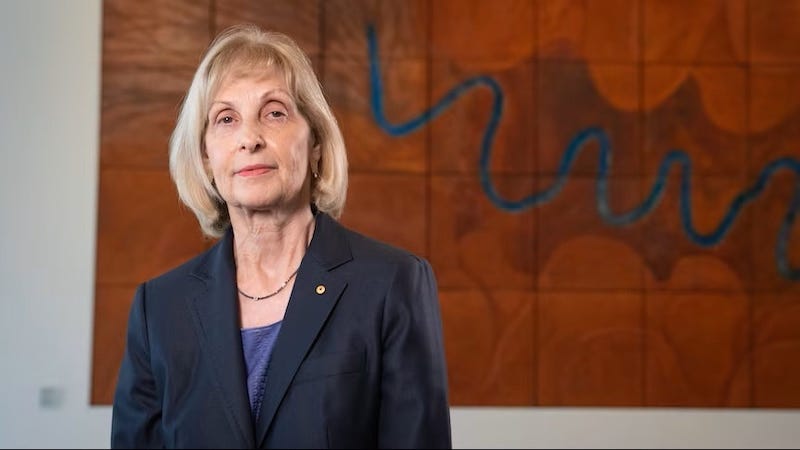
Jillian Segal was appointed as the Special Envoy to Combat Antisemitism in 2024, as part of the federal government’s response to a rise in antisemitic incidents – as reported by law enforcement and community monitoring bodies – after the October 7 attacks in Israel in 2023, and the subsequent war in Gaza. The logic of Segal’s appointment was seemingly straightforward, on the basis of antisemitism being real and rising, and that it needed attention at the highest levels of government.
But the role of this envoy was not simply about getting the attention for this issue – it was about creating a level of legitimacy, and to reach a level of trust, even among all of those groups of people who might disagree on aspects of foreign policy on this issue, and the various political ideologies that exist out there. Since the appointment of Segal, that trust has been falling apart.
The question isn’t about whether antisemitism needs to be addressed and reduced, but whether Segal is the right person to carry out these tasks. And the further point is, that if we currently have an envoy to combat antisemitism, and one to combat islamophobia, do we also need to have an envoy to combat anti-Asian racism? Or one to combat anti-Indigenous racism? Or homophobia? Or are these issues already covered already within existing legislation and structures? When considering this question, it’s clear that Segal’s position is genuinely redundant.
On top of that, critics argue that Segal is too closely aligned with the political positions of Zionist groups and conservative advocacy networks. Of course, this alignment is not illegal and might reflect personal convictions, but the role of the envoy is to sit at the point where racism, foreign policy, free speech and community relations all interact in a coherent way.
When an envoy appears to be clearly embedded within one political and ideological framework, their work risks being viewed as an enforcement of specific agendas, in this case, the concerns have centred on the perceived conflation of antisemitism with criticism of Israel. Jewish and non-Jewish Australians alike have argued that opposition to Israeli government policy – including opposition grounded in international law or human rights – cannot be treated as racial hatred, without contradicting the important parts of our democratic institutions.
These concerns are not a collection of abstract or obtuse opinions. In 2024, several Jewish community organisations stated that combating antisemitism must be clearly separated from the policies of the state of Israel. Not every Jewish person supports the Israeli government and it’s not a tenet of Judaism to accept Zionism in the way it’s being presented. There are anti-Zionist, non-Zionist, secular Zionist and pro-Zionist Jews, and presenting Judaism as a unified and homogenous group insults the broad and nuanced culture that has developed globally over the last 5,000 years or so.
The Jewish Council of Australia has argued that the criticism of Israel is not antisemitism, and has warned that an envoy to combat antisemitism should not be using her position to quell legitimate political speech. Those voices represent a substantial, but often marginalised part of the Australian Jewish community, including secular, progressive and anti-occupation Jewish people, who reject the idea that Israel speaks in their name.
The controversy surrounding Segal’s appointment deepened when it was revealed in 2024 that a family trust linked to the husband of Segal, John Roth, donated $50,000 to Advance Australia, a conservative lobby group that actively campaigns against Islam and issues such as pro-Palestine action and Indigenous rights. Of course, that is their right, as is the right for Jillian Segal to not have her politics dictated by her husband – and she denied involvement or knowledge of the donation anyway – but in public office, perceptions matter greatly.
Advance Australia is not a neutral civil society organisation acting in the public interest. It’s a divisive partisan actor engaged in polarising campaigns based around race, culture, and protest. When an envoy responsible for combating discrimination is even indirectly linked – through family finances – to such an organisation, it inevitably raises questions about what type of independence she holds.
Several Muslim and Arab community organisations publicly called for Segal to step down after these revelations were made public, and also questioned whether Segal still retained the confidence of the general community.
There’s also the broader debate about the freedom of speech, and suggestions that the proposed actions to combat antisemitism will suppress legitimate political expression, if the definitions are too broad. The Human Rights Law Centre did raise this as an issue of concern in a submission to the federal government in 2025, warning against that conflating of racial hatred with political advocacy, in the context of Israel and Palestine.
Another criticism relates to the creation of a hierarchy of racism and discrimination, as if one is more extreme than another. Of course, antisemitism is appalling and must be confronted but it’s not uniquely appalling. The different forms might appear in different ways but other forms of racism and discrimination – Islamophobia, anti-Indigenous racism, anti-Black racism, anti-Asian racism – are also pervasive and damaging.
In 2024, the Race Discrimination Commissioner Giridharan Sivaraman recommended that anti-racism responses need to address all forms of racism as part of a coordinated national framework, rather than pick and choose and elevate one form above others. Segal’s critics argue that her approach undermines this approach by treating antisemitism differently, rather than as an issue that’s structurally connected to other forms of discrimination.
Clear and accurate representation of the community is another issue. Australia’s Jewish community is diverse, spanning a wide range of different religious and secular traditions, and communities of Middle Eastern, African and European heritage. Several Jewish organisations – including Loud Jews Collective and Tzedek Collective – have publicly challenged these attempts by conservative peak bodies to present their own version of a single, unified “community position” on Israel–Palestine, and an envoy perceived as reflecting only one political or institutional subset of that diversity will struggle to claim legitimacy across the whole community.
Segal has also proposed a coordinated national framework that spans everything in society – law enforcement, education, digital regulation and public funding. It also recommends embedding a standardised working definition of antisemitism across government institutions, police training and enforcement of hate-crime, expanding Holocaust and antisemitism education in schools, increasing pressure on online platforms to remove antisemitic content, a national incident data collection database, and increasing security funding for Jewish community institutions.
And if this isn’t enough, the framework also proposes compliance mechanisms – including public reporting measures – and suggests that access to government funding for any organisation should be contingent on organisations taking demonstrable and identifiable action against antisemitism.
It’s not clear whether this national framework is an ambit claim, but it’s clearly an overreach, and it legitimises one interest group and suppresses government policy based on vague and undefined accusations.
When it was released in 2025, it was heavily criticised and quietly put onto the backburner by the federal government. After the Bondi terror attacks last December, it re-entered the public consciousness again. Whether it will be quietly pushed back onto the backburner again – which seems unlikely in this febrile environment where any act that might be remotely detrimental to the Jewish community is deemed to be antisemitic – or whether it’s discreetly going to be implemented remains to be seen.
However, it is one of the less credible and useful reports, and how it could even be considered by the federal government after the state of Israel has killed over 70,000 Palestinians is beyond belief. That she has overstepped her mark seems hard to argue against and, perhaps in normal circumstances, she’d be asked to step down or be sacked but, as we know, these are not normal circumstances.
None of this is to suggest that Segal is malicious, dishonest, or indifferent to discrimination, and her position was created to essentially push these issues as far as possible. But it’s also up to the government of the day to push back on these ambit claims and consider the rights of all parts of the community, and not just the select few who have the power and connections to strongly influence government decisions.
This argument is an institutional one, rather than personal. Envoys that are effective must be able to placate and accommodate adversarial communities, not harden the divisions that already exist. When an envoy becomes a lightning rod for these divisions rather than a mediator, that role ceases to function as originally intended and there’s not that much point in continuing any further now, even if the position itself is due to expire in 2027, just under 18 months away.
Antisemitism is a real issue and needs to have sustained attention from governments and the community to address it. But so do the many other forms of racism, and that work will continue whether Segal stays or goes. But if public confidence in the role has deteriorated – across Jewish communities, Muslim communities, and the broader public – then Segal’s continued tenure undermines the very objectives she was appointed to address. In that light, her resignation would not be a capitulation but would be an act of responsibility aimed at restoring credibility to roles that are already covered by many other parts of government.
Thanks to the Albanese regime, we have the new public ‘censor’ who will have sweeping powers to ‘correct’ the record. Imagine where these powers are going to go.
Excellent piece!