



For years, the Australian Parliament Sports Club in Canberra has been seen as a hit-and-giggle social club – a place where politicians, staffers, journalists and lobbyists could set aside the daily grind of parliamentary business and enjoy a friendly game of football or cricket. But there’s something far more sinister beneath that image of cross-party camaraderie and sport: the club, which has existed for three decades, is officially registered as a lobbying organisation, and this was only discovered when it went through a name change in late September. The president of this “sports club” is none other than Prime Minister Anthony Albanese, which means that he’s the head of a registered lobby group that could, technically, be lobbying the prime minister himself.
When independent Senator David Pocock raised the matter in the Senate, the Attorney–General’s Department quietly removed the club from the federal lobbyist register, hoping the issue would just go away but all it did was highlight those blurred lines and cosy relationships that dominate the political culture in Canberra – where lobbyists, journalists, and elected officials mingle under the guise of friendship, sport and just a bit of harmless fun.
But there’s nothing harmless about it; it’s just a sinister arrangement that gives privileged access to ministers and staffers that ordinary Australians will never have. Decisions are influenced not through open and public debate, but in the dark through casual chats on the sidelines. This is the real face of corruption in modern Australia – not the cliché of the cash in brown paper bags, but access and being close to those in power.
Senator Pocock, who is one of the few willing to challenge this culture of entitlement, was expelled from the club after voicing his concerns. “The president of the Parliamentary Sports Club is the prime minister,” he said, “effectively as president of a lobbying firm. When I raised concerns, instead of restricting lobbyists or rejecting corporate donations, the club kicked me out.” His expulsion reveals just how normalised the influence of powerful industries – especially gambling – has become in federal politics and anyone questioning this relationship is brushed aside.
This connection between the sports club and gambling companies is particularly insidious. Gambling firms, including foreign-owned operators, have long used sportswashing as a marketing tool and a political access point. Their sponsorships aren’t acts of polite generosity – they are careful investments in influence and tactics to increase their profits. While most Australians who enjoy an occasional bet might do so harmlessly, the profits of the gambling industry rely on those who can’t stop: the addicts who lose homes, families and their livelihoods. These are the people that should be protected or, at least, dissuaded from gambling – yet instead, Parliament’s own sports club has opened the doors to the very companies that exploit them.
That the club was registered as a lobbying group just shows how embedded corporate power is in political life, it’s just another avenue for the gambling industry – and other vested corporate interests – to influence and affect democracy through the back door.
The clubs of political power
The conflict of interest created by the Prime Minister presiding over a registered lobby group is something that has no precedent – as far as we know – and it exposes a deeper cancer within the system where we have the normalisation of the practices that, anywhere else, would be considered unethical and corrupt. How can elected officials justify membership in a club funded by industries they are supposed to regulate? Gambling, fossil fuels and defence contractors have all found their way into these so-called “social” spaces, turning sport and collegiality into a convenient cover for influence and access.
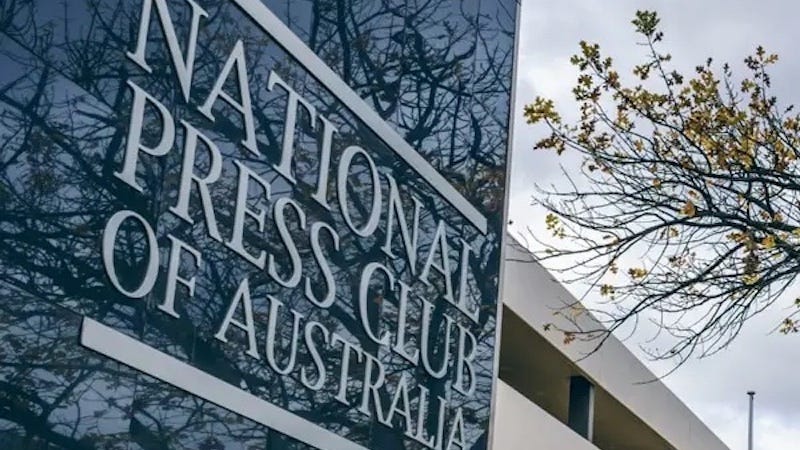
Like the National Press Club – another institution where politicians, lobbyists and journalists mingle under the same arrangements of corporate sponsorship – the Australian Parliamentary Sports Club is part of a broader ecosystem that clearly mixes political access with corporate money. And whenever these relationships are exposed, the knee-jerk reflect is always the same: dismiss, deflect, quietly move on, and hope that no one notices or, if they do, lay low for a while and wait for the issue to blow away.
The club’s CEO, Andy Turnbull, defended its registration as a lobby group as an act of “caution.” But what kind of caution requires formal recognition as a lobbyist? The explanation makes no sense at all unless one accepts that lobbying is not the exception in Canberra – it is the default position and why that the business of politics proceeds in Australia. These networks thrive because they are seen as a harmless tradition rather than conduits of influence.
In theory, such matters should be investigated by the National Anti-Corruption Commission, but this institution is just as compromised as any other. Heralded by the Albanese government as a landmark reform with great fanfare, the Commission has so far done little more than tick a box on the political KPI indicator, and is more of a paper tiger than an institution capable of confronting entrenched power and corruption.
Despite Labor returning to office in 2022 – a victory that was confirmed with a landslide in 2025 – the political culture looks and feels very much the same, with Anthony Albanese starting to look a lot like his predecessor, Scott Morrison. For sure, the Albanese government might project integrity and transparency, but episodes like this show a continuity with the Morrison years – a shared complacency about how politics, money and influence intersect and create opportunities for more graft and corruption. The faces may have changed, the tone might be softer, but the same machinery of access continues to run just as smoothly.
The normalisation of corruption in modern democracy
The world of politics has moved far beyond the passing of envelopes filled with cash for corruption to thrive: those acts are for amateurs. The innocuous structures of social clubs that allow influence and access to be done behind closed doors – is more than enough and holds the veneer of professionalism with suave drinking bars and dining facilities.
What we’re now seeing in Canberra is the exposure of the structures of power operating through social clubs, sports clubs and press clubs that function as fronts for the lobbying industry. The National Press Club, the Midwinter Ball, the Parliamentary Sports Club – all present themselves as spaces for community, charity, or good-natured competition, yet each offers something far more valuable to those with money and influence: access to government ministers and the decision makers in parliament.
Deals are discussed over drinks, access is traded through the handshakes and photo opportunities. The Midwinter Ball, dressed up as a glamorous night of goodwill, is perhaps the clearest example – a “charity” event attended by gormless politicians and compromised journalists who are seen as friendly and unthreatening. Sure, the event raises in the vicinity of $370,000 for charity but it doesn’t exist to serve journalism or public accountability: it simply exists to maintain relationships between those who should be holding each other to account. If they’re so generous, why not just ask the over 600 people who attend the event to buy a $500 ticket for a prize donated by one of the major sponsors – they’re all well-heeled, the ticket price would be a tax deduction, and the opportunity for corruption would be eliminated.
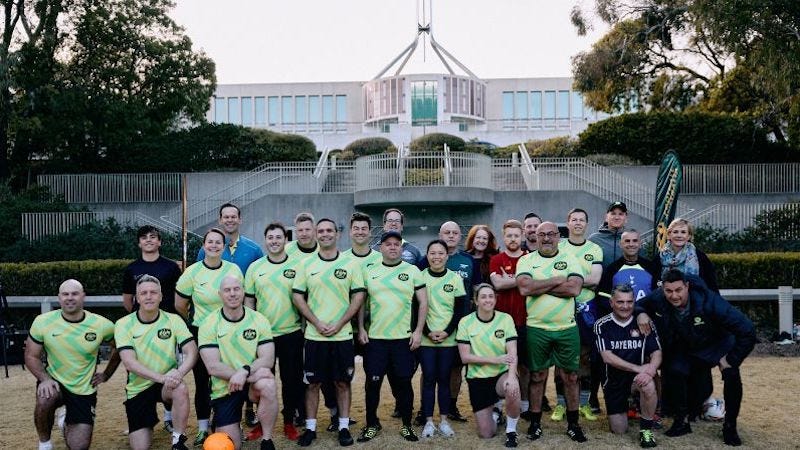
True journalism depends on holding a distance between the journalist and those they are holding to account. Some of the best reporters in Australian history refused to get too close to the powerful precisely because that closeness would always compromise their ability to scrutinise. Once journalists become part of the same social world as those they cover, the lines blur: tough questions are softened, scandals are overlooked and the cosy familiarity of Canberra’s “insider culture” replaces public service with complicity. Just like friends, it’s harder to ask the tough questions if you’re sharing lagers or playing touch football with them during leisure time. And it’s not just journalism that suffers – democracy and the public interest suffers as well.
These events are no longer seen as ethical minefields but as ordinary parts of political life: it’s all been normalisation. The acceptance of this behaviour – from press balls to sporting fixtures – has desensitised the public and insulated the powerful: it doesn’t look like the usual acts of corruption, so the public looks away. The rituals of access have replaced accountability, and the mechanisms that should keep democracy honest – the media, the public service, the anti-corruption bodies – are weakened by familiarity and politeness: we’re all mates here, please don’t waste my time with the tough questions.
Well-functioning democracies depend on a healthy balance between performance of government, scrutiny of their actions by those whose role it is to apply that scrutiny, and the integrity of all the people who are involved in these processes. But when politicians, journalists and lobbyists start to hover in the same social circles – or occupy the same space on the football field – the checks and balances that exist to maintain that integrity start to collapse. All we’re left with is the structure where influence and corruption hide behind the spectacle of football games, charity balls and speeches at press club – this is what corruption looks like in modern Australia: it’s not the illegal exchanges of money bags in smoked-filled backrooms, but a culture that relies on friendship and mates, and accountability being left far behind.
The perfect example of “accountability being left behind “ is what masquerades under the name of the NACC . Carefully designed by Albanese and the member for Isaacs so that no perpetrator will ever be called to account as they should be .
Clearly seen in the charade of the Robodebt saga . Also correct is that Albanese is showing himself to be no better than Morrison.
I despair at the state of Australian politics. I do believe that our political institutions are robust. But the influence of lobbyists is a rot on the institutions, especially parliament. That and the ALP acting as a centre right party that Whitlam would not recognise. The ALP is undermining Whitlam’s FOI legislation. The Public Interest Disclosure Act 2013 was introduced barely alive and there has been no effort to strengthen them. The same can be said for the NACC. There is no reason, other than self interest for these laws to be strengthened. Both the ALP and the LNP believe that they know best and FOI, Whistleblowers and NACC just get in the way of ‘good governance’. Oh we are still better than the USA and the UK but it is a matter of degree and we are slip sliding towards them.