


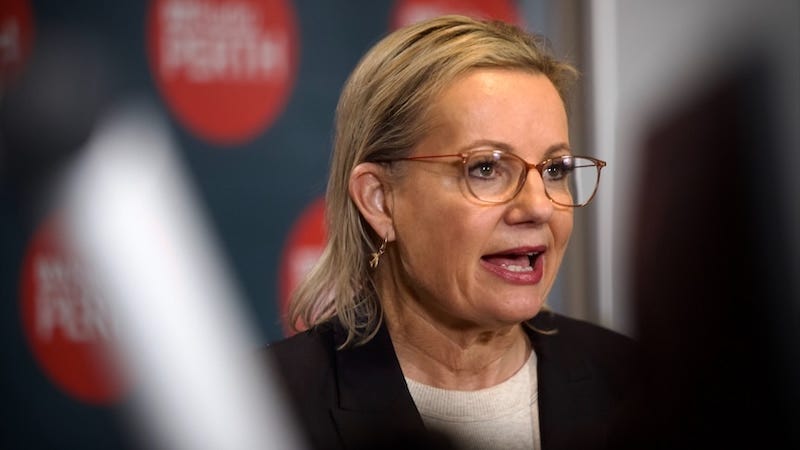
As Parliament moves through the final weeks of November – traditionally regarded in Canberra as the killing season for political leaders – the Liberal Party again finds itself staring at the prospect of internal turmoil. In itself, November carries no inherent political significance – astrologically or seasonally – but it is the last viable opportunity for a party to replace a failing leader before the year ends and the next parliamentary cycle begins. Two Liberal leaders have already departed: Brad Batten in Victoria (even though he was polling well as preferred premier, 45 to 34 per cent over Jacinta Allan); Leanne Castley in the ACT; a likely removal of Mark Speakman in New South Wales is coming up soon; and with just one sitting week left for the federal parliamentary year, the pressure on Sussan Ley is growing.
The Liberal party room was actually in Canberra during the week to settle its position on net zero emissions by 2050 and, predictably, rejected the target. The party also rejected gender equity quotas – despite repeated electoral results that suggest voters overwhelmingly want both stronger action on climate and far greater representation of women in Parliament. It’s a party deliberately distancing itself from the political mainstream – or trying to claw back the drift of votes over to One Nation – and in the process, is lowering its own chances of winning the next election (albeit, those chances are slim anyway), and probably the one after that too.
Speculation is high that Ley will not survive beyond the end of the year, despite claiming that her position to run at the next election has “been guaranteed” by the party room. All the political gossip revolves around a proposed “dream team” of Angus Taylor and Tim Wilson, although this combination looks less like renewal and more like a guaranteed deepening of the party’s electoral problems. Taylor’s factional lineage traces back to the hard right – the same faction that has repeatedly demonstrated an ability to destroy opponents and sabotage policy, with little capacity to govern effectively, as was shown constantly between 2013 to 2022, when they were last in office.
The Liberal Party’s culture wars are also being fuelled by the slow leak of details from its post-election review, conducted by Nick Minchin and Prue Goward. The full report is due in December, but early indications suggest it will provide a familiar list of failings and recommendations – similar to previous reviews the party has routinely ignored and is, more than likely, going to be ignored on this occasion.
Ley’s current predicament is ultimately a symptom of a deeper structural decay. When she was elected as leader after the 2025 election demolition in May, her role was to make the Liberal Party electable again – a task that would have challenged even the coalition of giants the party nostalgically invokes: Howard, Menzies, Deakin and Lyons. The modern Liberal Party always insists that it needs to go back to the future by rekindling the conservative heroes of theirs, yet it continues to double down on the very neoliberal and culture-war politics that have alienated the electorates it needs to win back the most.
Ley was expected to reconcile these contradictions while managing a party room increasingly dominated by the many male MPs who are more interested in ideological warfare than getting back into government. Her survival might be uncertain at this stage, but that might not in itself be so relevant – the far bigger question is whether the Liberal Party itself is capable of survival in its current form.
A party fighting with political reality
Before even reaching the question of leadership, the Liberal Party confronts a far deeper existential problem: it’s hard to believe that in 2025, it’s still debating whether to support net zero emissions by 2050. This is remarkable not only because the political argument was settled long ago – roughly two-thirds of Australians support the target – but because the rest of the developed world has already committed to it. Every major advanced economy has accepted the scientific and economic necessity of decarbonisation, albeit with each adopting its own pathway, technology mix and policy settings. And yet, barely six months after suffering the worst federal election defeat in its history, the Liberal Party has emerged more determined than ever to fight a battle the public has already moved on from.
The best example of this came from newly-installed South Australian Senator Leah Blyth, who suggested: “personally, I think net zero isn’t working for the Australian people. The economics of it and even the environmental impact… it just doesn’t add up”.
It’s a statement clear on its certainty but stops short of the explanation. Blyth didn’t bother to articulate what isn’t working, why the economics supposedly don’t add up, or how Australia is uniquely disadvantaged when every comparable economy has recognised both the necessity and the benefit of transitioning. What she did reveal, however, was her factional alignment: she comes from the conservative wing of the South Australian division, the same faction that’s driving the push to abandon net zero entirely.
Within the party room, 28 members voted to dump the commitment to net zero by 2050, 17 supported keeping it, and four were unsure – extraordinary, given the clear position of public sentiment. Once again, energy policy is poised to tear the Liberal Party apart, just as it did during the Abbott, Turnbull and Morrison years, which held 20 different climate and energy policy positions over a nine-year period.
Part of the Liberal Party’s motivation is ideological, but part of this is structural: the factions most opposed to net zero is also the ones with the closest links to the fossil-fuel industries. They continue to promote nuclear power – despite knowing that commercial reactors won’t be built in Australia for 30 to 40 years, if at all – because this idle pursuit of nuclear provides a justification for maintaining coal for decades and, because of this, fulfils the demands of the donors from the coal industry.
These actions of the Liberal Party and the refusal to accept the electoral consequences of their actions has already cost them dearly. The Liberals have lost core metropolitan heartland seats to teal independents over the past six years, primarily because the voters who broadly supported the party on economic and social stability, abandoned it because of its treatment of women and its refusal to take climate change seriously. These voters are educated, professional, affluent and deeply concerned about long-term environmental and economic security. They’re not just fringe progressives: they represent the voters that traditionally supported Liberal victories in the past, and they might not be making a return for some time to come.
The Liberal right seems to have convinced itself that instead of needing to learn from these hard lessons, the public itself is wrong and it’s the message that needs to be repeated more forcefully: eventually, the public will come around to their thinking. It’s a political logic that can’t be held onto for too much longer: the Liberal Party isn’t just out of step with the electorate, it’s moving in the opposite direction – their great hope is that the electorate will join them on this pathway to oblivion and that’s obviously not likely to happen any time soon.
Drifting towards irrelevance: A net zero game
The Liberal Party’s downward trajectory isn’t just the result of poor leadership or unlucky political timing; it reflects a deeper malaise, where the party has become consumed by internal survival rather than a coherent purpose. What once presented itself as a “broad church” has shrunk into a brittle, fractious organisation dominated by ideological but insignificant hardliners, religious conservatives and factional powerbrokers who have seized control of a diminished parliamentary rump and are feasting on the scraps of defeat. When a party reduces itself to this level, it becomes increasingly vulnerable to takeover by the most organised and aggressive internal bloc – and that is precisely what is happening.
The result is an organisation with no coherent direction, no intellectual rigour, and no ability to appeal beyond its shrinking demographic base. While every political movement has its cycles of renewal and decline – Labor is certainly the most experienced in this area – but Labor never lost its internal identity in the way the Liberal Party now has. Even at its lowest points, Labor understood what it stood for: the Liberal Party is shedding its identity piece by piece, alienating every significant electoral group except voters over 60, and even that cohort no longer provides them with a reliable level of political support.
Gen Z and Millennials are gone entirely – not that they were ever truly Liberal voters to begin with – and the younger end of Gen Z will enter the voting population in large numbers across the next two election cycles in 2028 and 2031. These younger voters overwhelmingly support climate action, social equality, gender equity and economic fairness and are aligned with almost everything that the Liberal Party currently opposes.
This demographic change isn’t a short-term problem: it’s an electoral crisis that will continue for the next decade or two. It adds to the belief that the Liberals may already have lost not just the next election, but four or five into the future. Although we can never predict the political circumstances that can arrive just around the corner – and when we least expect them – a party that is disconnected from younger voters cannot survive as a major force, particularly when those voters hold values that directly contradict the party’s current ideology. No leader – whether it’s Sussan Ley, Angus Taylor, Tim Wilson, Andrew Hastie or anyone else within the party – can fix a problem that is so deeply cultural and structural.
For the Liberals to rebuild, they need to confront a truth they have so far refused to acknowledge: the party has been captured by agents of chaos who offer no constructive agenda. Figures like Taylor, Wilson and the broader hard right are no better than university level politics at its worst, and excel at building an opposition to everything just for its own sake. They can block, undermine and destroy, but they cannot build. They point to Tony Abbott as their paragon of virtue without recognising that he failed so dismally that he did not even last long enough to qualify for his prime ministerial pension. His legacy is not one of achievement but of dysfunction, instability and squandered opportunity, yet this is the model the current-day Liberal Party looks forward to.
If the Liberal Party is to survive, it needs to reconcile itself not with its own factions but with the Australian people. It needs to abandon the belief that privilege and entitlement can be a substitute for competence, or that bullying can be a substitute for persuasion. It needs to recognise that holding on to extremist and minority opinions doesn’t make you crazy brave correct – it simply makes you wrong.
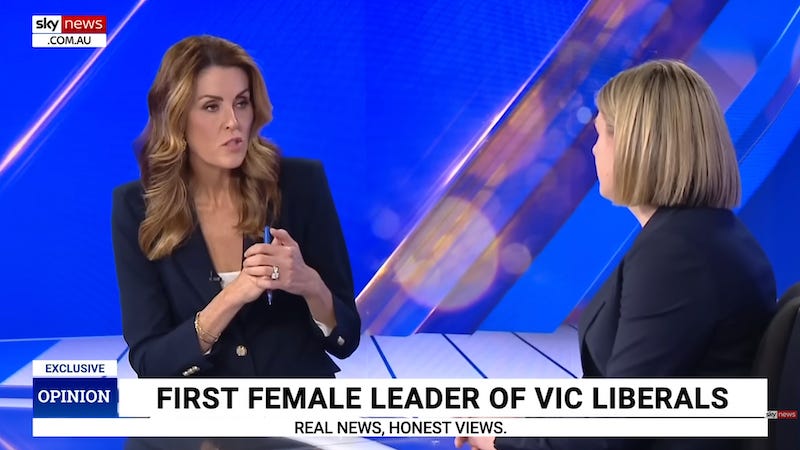
The party also needs to reform its culture of preselecting candidates who are obviously unfit for public office, and it needs to stop treating Sky News as a sounding board for its policy development: the newly appointed Victoria Liberal Party leader Jess Wilson held her first major interview with none other than Sky’s Peta Credlin.
If the Liberal Party avoided News Corporation altogether, it might rediscover the real centre of modern Australia: the workers and professionals squeezed by housing costs; the young families terrified of climate catastrophe; the small business owners seeking stability rather than culture wars; the diverse suburban and outer-metro communities that want competence, empathy and a plan for the future.
At the moment, the Liberal Party is failing on all of these issues. It’s drifting into political territory where the emergence of a breakaway conservative party – or a new hard-right force funded by disillusioned billionaires and business leaders – becomes plausible. And if such a party emerges, the existing Liberal structure could rapidly collapse. This is the pathway for the Liberal Party, and it’s a pathway that leads either to irrelevance or oblivion. Whether it survives, and in what form, is now an open question that many people are asking – and the vacuum it leaves behind will inevitably be filled, though by what, no-one yet knows.
Thanks Eddy.
It seems also that the final election results, which lumps the LNP, CLP, Nationals and Liberals together underplays the dire decline in the Liberal vote, which must have been barely 26% last election.
With current polling under Ley, it must be closer to 22%. The current electoral system (which I do not actually like) in single member electorates will make it near impossible for the Liberals to win back metropolitan or regional city voters outside of QLD.
As David has said previously, it may be a situation similar to the UAP after their defeat in 1943, wholly discredited there may be a new party formed.
But without proportional representation and an increasingly fractured electorate, the 65% that vote against Labor will cede 100% of the power to the ALP. This is disastrous as the ALP is fairly mediocre at the moment. They look only reasonable in comparison to their key opposition.
Today, I posted an article on my ‘Laugh or Cry’ Substack that might be of interest to readers.
It’s along similar lines to this, with emphasis on what I call the “mental defectiveness” of the Liberal hard-right.
It’s a highly critical, no-holds-barred piece on the demise of the party.
Hope you like it …
https://www.laugh-or-cry.com/p/hard-right-conservatives-mental-defectiveness