


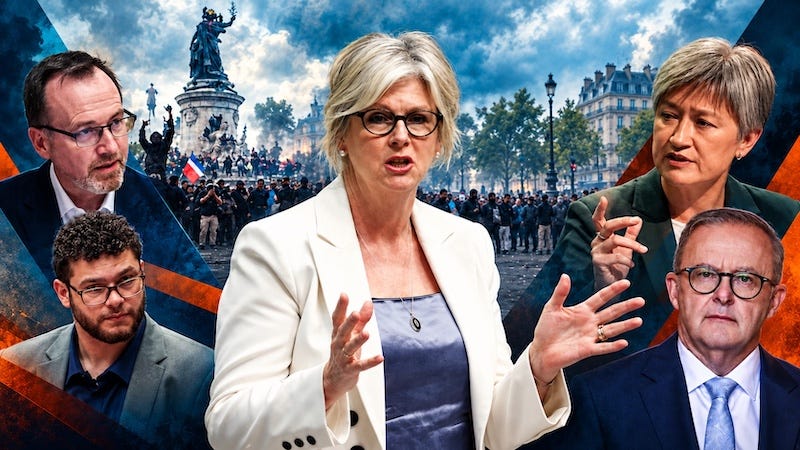
An act of cowardly violence
The alleged attack on independent MP Helen Haines in regional Victoria raises some disturbing questions about political hostility, the intimidation of elected representatives and the increasingly toxic environment in which Australian politics is operating in.
Before drawing the conclusions about what occurred – and it’s not clear at this stage what exactly occurred – the immediate priority has to be for the wellbeing of Haines, followed by a thorough investigation, and establishing why a 43-year-old man decided to drive his Toyota Landcruiser – allegedly – into one of Australia’s most respected parliamentarians.
While the suspect’s motivations are unclear, eye-witness accounts and police statements suggest that the incident was deliberate. Whether it was politically motivated, however, is a matter for investigators and, hopefully there will be some answers soon. What cannot be ignored is the deterioration of political discourse, with more than 1,000 reports of threatening or harassing behaviour against federal parliamentarians over the past year, and growing concerns about the abuse, intimidation and sexual violence directed towards female politicians.
Haines represents the rural Victorian electorate of Indi, a region that also experienced the bizarre seven-month manhunt for Dezi Freeman, the self-declared “sovereign citizen” who shot three police officers, killing two. There’s no established connection between Freeman and the incident involving Haines – and we’re not suggesting that there is – but his actions show how anti-government hostility can result into extreme violence.
We need a better understanding of why some individuals come to regard violence as a legitimate response to their frustrations, and whether inflammatory right-wing populist rhetoric – which seems to be fashionable at the moment – is contributing to this process.
Labor’s problems start at the very top
During his time as the leader of the Labor Party – since 2019, and now the party’s third-longest serving leader – Anthony Albanese’s greatest political asset has been an obedient caucus that given him the most power over the factions that any Labor leader has ever had. But it seems that it’s a power that’s starting to fray at the edges.
For too long, Labor MP’s have been accepting the decisions handed down by a small leadership group, and are beginning to question the mistakes that they have to defend, and an economic agenda that they are increasing unable to clearly explain to their electorates. This has been one of most disciplined Labor governments that we’ve ever seen, but with a large Caucus – 124 members and so many ambitious and impatient backbenchers – their recent overwhelming success might be sowing the seeds of their downfall.
And it’s the smaller issues that seem to be causing the problems: the ATO credit-card debacle is probably the best example, where credit cards payments were no longer going to be accepted for the BAS and GST obligations of small businesses. Ministers knew months ago that changes were being considered, yet when the time came, the government still scrambled to manage the backlash. Albanese’s intervention in the issue then invited other questions about Chalmers’s authority on financial issues, although the treasurer denied that he was overruled by the PM. This itself shouldn’t be a factor because a Prime Minister will always have the ultimate say, but an avoidable policy mess became another distraction from the main political issues of the day.
We’ve always pointed this out that the bigger question is what Labor intends to do with power, because it seems very unprepared to expend any of its political capital so, in the absence of a powerful and overriding reformist narrative, it’s the smaller and more esoteric issues that the backbench doesn’t really understand anyway, that end up causing all the problems.
There isn’t a leadership challenge to Albanese at the moment – perhaps he has too much power for that to happen, and some of these issues could be related to mid-term problems that governments always come across and have to work through – but problems don’t go away by themselves. And if they don’t go away, he might be checking over his shoulder more frequently than has for any other time during his time as Labor leader.
Wong’s bizarre election call for Palestine
Foreign Minister Penny Wong has demanded Palestinian elections “without delay” – now! – after President Mahmoud Abbas cancelled the upcoming November 28 elections, and rescheduled them for September 2027.
But based on recent events – even more recent than Israel’s occupation commenced in 1967 – Palestinians might reasonably ask who will guarantee they can actually survive an election campaign. After Israeli settlers attacked photojournalist Heidi Levine and, then on the following day, European diplomats and a visiting French mayor, demanding an election requires more than castigating the leadership of a country that has suffered a genocide, apartheid and war crimes. If foreign visitors cannot safely observe an olive harvest in the West Bank, what are the chances of protection for Palestinian voters, candidates, election workers and international observers?
The Palestinian leadership has cited concerns of continuing Israeli attacks and restrictions on election materials and observers entering Gaza. But what is Wong thinking: where can people vote safely, who can campaign freely, and who can independently verify the result? And who will keep the maniacal and genocidal Israel Defense Forces away from the scene, who will have a massive incentive to disrupt the election as much as possible?
The President Volodymyr Zelenskyy has delayed elections in Ukraine since March 2024, over two and a half years ago, yet Wong has never said anything about this, or showed that she is “deeply disappointed” with that delay. Likewise for Nicaragua, which has delayed its elections until 2027. Obviously, Wong has selective vision: Palestine is “difficult to judge from afar” when Israel commits genocide in Gaza – or when an Australian aid worker is deliberately targeted and killed by the IDF – but it’s never too far away to make judgements about when the Palestinian Authority should hold an election.
Of course, the 90-year-old Abbas deserves serious scrutiny over the lack of elections, with the previous one held in 2005. This is unacceptable: Palestinians do deserve a government that is held accountable for its actions. But the hectoring from an insignificant foreign minister about their elections while failing to secure the conditions for them to success goes beyond the pale. Australia should make more concrete demands for Israeli compliance, civilian protection and unrestricted electoral access: that would be a far better pathway to follow.
Why now? The politics behind a crisis for the Greens
The allegations concerning Jordon Steele-John needs serious investigation, but with procedural fairness for those who have been raising these concerns, and for the Senator himself. He’s currently facing allegations of sexual misconduct – which he denies – including an alleged incident of sexual harassment and a separate sexual assault complaint that he says police investigated without laying any charges. And these are complaints that need to be investigated properly and without fear or favour, and any investigations need to be carried out in due course.
But there’s the curious issue of timing. Older concerns have circulated within the party for some time, and the WA Greens says those matters were addressed at the time and not unsubstantiated. Why, then, are they resurfacing alongside more recent allegations now, just as new Greens leader David Shoebridge attempts to establish his leadership and sharpen the party’s challenges to the Labor government? What new evidence has emerged, and what explains the timing of this release?
Of course, allegations of this nature should never be based around political considerations, but it’s a question of why this has surfaced just at this point of time.
Steele-John alleges that complaints have been weaponised in an internal preselection contest, and has released a lengthy public statement that seems to be more a document to tell the reader how to interpret these historical events, rather than trying to establish what actually happened.
Have these disclosures arisen from the factional struggles within the Greens? Have tensions following the leadership contest several weeks ago played any role? We’ll never find out, but who brought this material to the media, why now, and whose political interests does it really serve? Is it a shot across the bow after the UK Green Party “Zionism equals racism” resolution, a warning that suggests it’s something the Australian Greens should not even go near?
The Greens are like any other political party, and there will be internal machinations based around personal grievances and payback. But despite this, sexual misconduct is still sexual misconduct, if that’s what has occurred – this material doesn’t establish any guilt at all, that has to made clear – but a credible inquiry needs to examine these allegations and then the public can view the party’s response, and decide if there’s any consequences out of this, politically or legally.
France burns while Australia fiddles
It might not seem apparent, but the recent upheaval and riots in France is the beginning of the endgame of neoliberalism, at least in that country: it’s that constant promise of imposing austerity today for the sake of prosperity tomorrow, but it’s a promise that for many people has yet to be fulfilled, and it’s likely that the prosperity will never arrive.
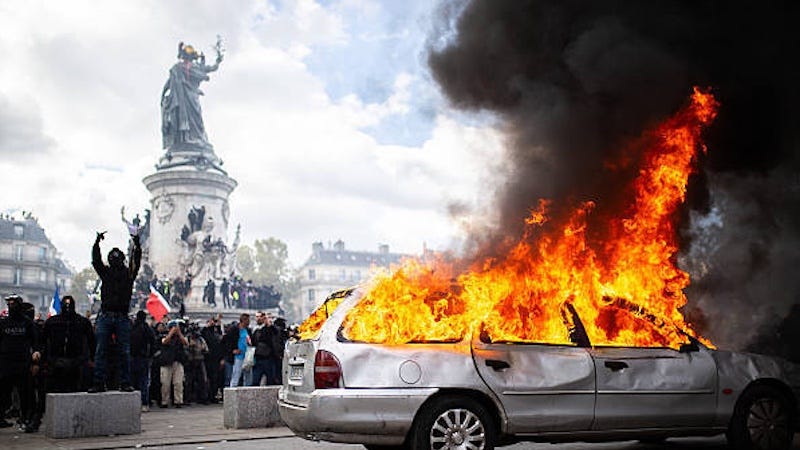
For the many households facing rising costs and students enduring deteriorating schools, that version of tomorrow keeps being postponed. Hundreds of thousands people marched on the streets of the big cities in France on the weekend, overwhelmingly peacefully, before violence and looting started to grab the headlines. Despite this, it’s a message that’s starting to resonate, and resonate very strongly: people are hurting, and they want change, now.
This is how economic insecurity can morph into a political crisis. Governments keep insisting their choices are responsible, while citizens everywhere are experiencing those supposedly responsible choices as a decline in public services, poor budgets and the rapidly diminishing prospects of a positive future.
French President Emmanuel Macron has promised expanded powers to prohibit gatherings, as if banning protests is the solution to massive economic problems. It’s a familiar solution: instead of resolving the issues that caused the problems in the first place – worshipping at the altar of neoliberalist economics and endless material growth – governments prefer to exert more police control and clampdowns.
These events should be a warning for Australia, they’re not happening in isolation: while Australia begrudgingly accepts whatever illogical solutions are proposed by government – unlike the French nation, which is quick to show its unhappiness and disillusion with government – there isn’t an infinite supply of patience within the electorate.
Albanese and Chalmers cannot indefinitely ask struggling households for patience, without presenting a roadmap for where the Australian economy is heading. Ultimately, successful politics is based around giving the public want they want and, at the moment, they’re after improvements in housing, better public services, higher wages and security, supported by fairer taxation system and a willingness to confront concentrated wealth and the vested interests. The government isn’t providing enough of what the public wants, and that’s the problem.


