


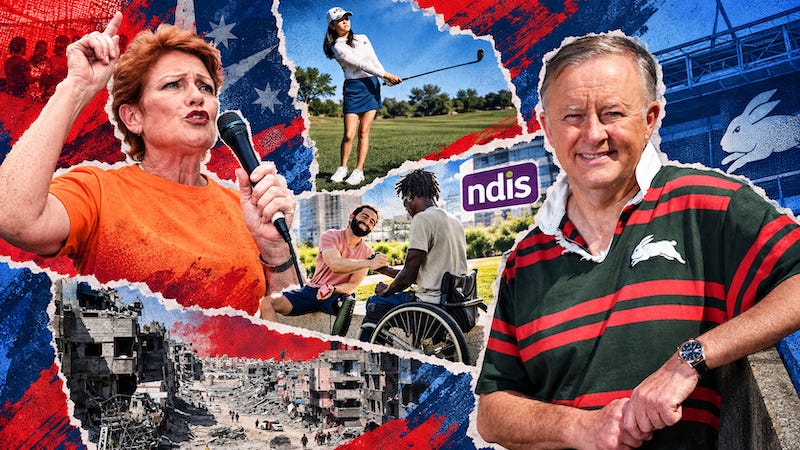
The Albanese government is coming across that uncomfortable rule of politics: a rort doesn’t become acceptable and respectable, just because it’s your side that’s doing it. The $560 million Major and Local Community Infrastructure program is becoming a serious integrity problem, with analysis showing around three-quarters of its funding flowing to electorates held by Labor before the 2025 election, while 45 electorates received nothing at all.
The $6 million promised to Marrickville Golf Club makes the optics of this program considerably worse. The club is in Anthony Albanese’s electorate of Grayndler and had granted the prime minister an honorary membership that he failed to declare. Albanese says he doesn’t play golf, but that’s not the point. The question isn’t whether the prime minister owns a set of nine-irons; it’s why an invitation-only grants process was distributing millions of public dollars to politically advantageous projects with limited competition and scrutiny.
The Labor Party spent years and year – quite rightly – attacking the Morrison government’s “sports rorts” program administered by Senator Bridget McKenzie and promised to end the politics of pork-barrelling. Yet, here it is several years later, implementing the same scandalous and partisan programs it once accused the Liberal Party of.
The Australian Greens are pushing for a parliamentary inquiry in this issue – if the grants were allocated entirely on merit, the government needs to demonstrate this. Otherwise, voters can reasonably conclude that pork-barrelling hasn’t disappeared from within the federal government, it has only changed from one side of politics, to the other.
Pressure on Labor for real action on Palestine and Israel
Australia’s recognition of Palestine continues to be a diplomatic pantomime, with the government actively undermining the Palestinian state that it claims to recognise as an independent nation.
The foreign minister Penny Wong says further targeted measures against illegal settlements and settler violence are being considered, yet the government remains reluctant to embrace restrictions on trade associated with those settlements. The contradiction is becoming impossible to hide from: if the settlements are illegal – as stated by the government on many occasions – and Palestinian sovereignty is genuine, why should economic relations connected to that illegality continue?
Senator David Pocock is urging the government implement “red lines” legislation to ban Australian goods from being used by the Israeli military – it makes sense if Australia claims to uphold its international human rights obligations, especially on a day when Israel has killed another 10 Palestinians near Khan Younis, including a pregnant women. So much for Israel’s so-called “cease fire” agreement.
Meanwhile, the Royal Commission on Antisemitism and Social Cohesion is working towards the release of its December report, in the midst of an argument that goes far beyond definitions of antisemitism. The critical question for the Commission is where legitimate action against genuine anti-Jewish hatred ends and restrictions on anti-Zionism, Palestine advocacy and criticism of Israel begin. These are important distinctions and ones that need to be clearly separated.
Taken together, these debates expose the central dilemma for the Labor government: it wants recognition of Palestine without a disruption to its relationship and military trade with Israel, and wants to have a strong opposition to antisemitism without appearing to suppress political dissent. But, so far, it’s taken the more unscrupulous path, one that will end up pleasing no one at all – except Zionist interests, of course – primarily because it failed the basic test on supporting human rights for Palestinian people, when they have been clearly breached by Israel.
One Nation shows who they really are
The most significant story on the Australian conservative right is no longer One Nation’s rise during this year, but the political pull it’s exerting over the Liberal and National parties. Pauline Hanson doesn’t need to become prime minister to transform Australian politics – she’s in the wrong chamber of parliament for a start – but all she needs to do is for the Coalition to keep adopting the territory on which she wants politics fought.
And it’s a spectacle that’s becoming increasingly chaotic. Andrew Hastie has called Hanson and Barnaby Joyce “lying cowards” after being branded a “traitor” in a juvenile cartoon – best described as Politics for Two-Year Olds – while Hanson’s comments about Anthony Albanese’s late mother and public housing show the mindset and the inner thoughts of this grotesque woman.
Yet the Coalition’s response to Hansonism remains strategically confused. Migration, tobacco excise, government spending and the familiar culture-war complaints all offer opportunities to chase those voters who are drifting off towards One Nation. But every time Angus Taylor shifts in Hanson’s direction, he reinforces the argument that she identified the real issues first. And why vote for the imitation when the original is available?
The alternative – confronting Hanson front on and calling out this fool whenever possible – carries its own electoral risks of creating sympathy, irrespective of how much bile she sends out the other way. And that’s always going the trap. Of course, there’s also many people who are supporting One Nation because they’re being totally turned off with both Labor and the Coalition, and want to send a message that the business-as-usual politics that’s presented by mainstream politics isn’t enough anymore.
But the surprise will arrive when they realise that while One Nation wants to rattle the cage, it’s not there to change the system: under One Nation, there’ll be more neoliberalism, not less; more control by corporations; more support for big business and less support for workers; more fascism, not less. And definitely less public housing.
Cost of living, housing and the opinion polls
Behind almost every political argument sits the same old reality: too many Australians feel they are working harder simply to stand still and, in many cases, going backwards. Housing, mortgages, rents, energy and groceries are consuming household incomes, and voters are becoming increasingly unimpressed by assurances that the economic fundamentals are sound and everything is going to be alright.
The political consequences for Labor are becoming – to borrow a few phrases from Penny Wong – very concerning.
In the latest opinion polls, Resolve has Labor on 28 per cent of the primary vote, with One Nation just behind on 27 per cent, while confidence in the government’s economic management has deteriorated. Around 74 per cent of people are concerned about federal debt and 48 per cent want spending cut. Whatever economists and the Reserve Bank board might say about the complexities, voters are delivering a far simpler message: the economy isn’t working in their favour.
That frustration within the electorate creates the perfect conditions for populist economics. One Nation’s proposal to let workers divert compulsory superannuation into mortgage repayments, rent or current income is seductive: it’s easier to forget about that retirement in 30 years’ time when the electricity bill is due this Friday. But raiding future retirement savings to compensate for today’s unaffordable housing just transfers the failures of the economy from one decade to another.
Labor’s problem is that structural reform takes time, while the patience within the electorate is quickly evaporating right now. But this is where that cliché of the political narrative comes into play: if the electorate can see that while the circumstances are not favourable right now, and they develop an understanding that there is the template for creating better circumstances for the future, they will reward the government.
But this is a government that’s been in office for four years, and it’s had enough time to create the narrative – and the policies to support this – but hasn’t done enough in these areas. A weak Housing Australia Future Fund just isn’t really going to solve anything. As a result, economic insecurity is becoming political insecurity, and One Nation is keen to exploit this gap.
NDIS cuts are about to become real
Nothing reveals a government’s priorities quite like the things it decides Australia can afford, and those that it cannot. From 1 October, the harsh NDIS reforms will become real for many participants, with support budgets changing – more than likely, decreasing – as their plans are reassessed.
Labor insists that the expenditure growth needs to be controlled to preserve the long-term viability of the NDIS. Of course, that’s a reasonable objective, but “sustainability” becomes considerably less abstract when an individual with a disability loses the financial support that their lives actually rely on.
And at exactly the same time these cutbacks are coming in, another $2.4 billion has been found for air and missile defence, contributing to the $30 billion planned for an integrated system over the next decade.
Add the ridiculous AUKUS deal and Australia’s broader military expansion, and suddenly the language of budget restraint that’s applied to the NDIS, becomes remarkably flexible when it applies to military spending.
Apparently, social programs of any nature must continually demonstrate their affordability, eliminate waste and justify individual expenditure, because it always has to represent value for money for the taxpayer, while defence projects involving astronomical amounts of public funds are unavoidable strategic necessities that need to be paid to support the industrial military complexes in the submarines dock of the US and UK.
The involvement of Lockheed Martin Australia in this military spending also raises another obvious question: as defence spending increases at this astronomical rate and without limits, how much public money will ultimately become revenue for multinational weapons manufacturers?
Governments will always say that budgets involve the difficult choices. But it seems that there are certain areas that are far easier to cut, especially when it comes to the most vulnerable people in society.