


The recent treatment of Pulitzer Prize–winning journalist Chris Hedges in Australia has exposed a deep moral and professional failure within the mainstream media. After his scheduled address at the National Press Club was cancelled a few weeks ago – a cowardly and politically compromised decision – the speech he was due to deliver was hosted at independent venues in Sydney and Melbourne, and is available online through Consortium News. Listening to that speech, it’s clear why the Press Club cancelled the event – it wasn’t convenient, polite or politically safe – they were going to being held to account and, generally, powerful players in Australia’s mainstream media do not like being held to account.
In his speech, Hedges criticised Western media for its reporting on the events in Palestine, and called out the journalists who have largely ignored the genocide in Gaza, and defaulted to a recycling of Israeli government talking points instead of trying to verify the truth. His argument was simple and clear: Western journalism has abandoned its true purpose and has lost its integrity.
If we needed a reminder of this collapse of integrity in journalism, it was on full display when Hedges had a follow up appearance on the ABC’s Late Night Live, and was interviewed by David Marr. What should have been an important exchange between two experienced journalists instead became an act of defence in protecting the narratives of power and establishment. Marr insisted that journalists have an obligation to report the “excuses” or explanations offered by the Israel Defense Forces and, in a rebuttal that should be evident to everyone, Hedges replied with a simple statement: “no… our job is to report the truth”.
This small exchange revealed everything that’s wrong with the response of mainstream journalism to Israel’s war on Gaza. Rather than interrogating power, many journalists act as an echo chamber for it. Marr’s suggesting that this idea of “balance” needs to repeat official propaganda – is exactly the type of moral relativism that Hedges has spent decades railing against. The ABC, once regarded as the pinnacle of independent journalism – not just in Australia but internationally – has increasingly become a platform for rehearsing the official lines of Western governments and their allies. While there might have been strong resistance in the past – such as when Prime Minister Bob Hawke pressured the ABC to give less coverage to anti-war perspectives and more prominence to the government’s pro-war position during the 1991 Gulf War – today, it seems to be a case of just tell us what you want us to say, and we’ll say it.
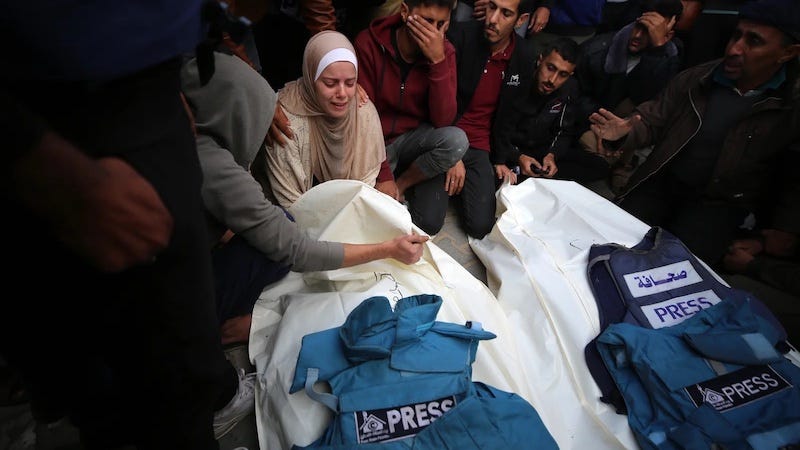
Meanwhile, journalists continue to die in Gaza – not as incidental casualties of war but as deliberate targets. Israel has bombed homes and offices known to house reporters and, in some cases, the bodies of journalists were found to have been mutilated, in an obvious act to stop the documentation of the genocidal actions of the Israel Defense Forces. This is like no other conflict: more journalists have been killed in Gaza than in both world wars, the Vietnam War, the wars in Yugoslavia, Iraq and Afghanistan combined, according to the Watson Institute for International and Public Affairs’ Costs of War project. In Gaza, the targeting of journalists and aid workers has become a routine hobby of the IDF, and always met with Western indifference and excuses when it happens, as demonstrated by Marr in the safety of his studio environment.
This is what Hedges was trying to expose: a moral corruption so deep that even the murder of journalists provokes barely more than bureaucratic shrugs and a few media releases from foreign ministers wanting to show concern. His message is a call for courage and reflection – qualities now largely absent from the institutions that once defined the Australian media, at least at the ABC.
Hedges’s insistence that “our job is to report the truth” might sound like an old-fashioned or even a naïve ideal, during an age of managed narratives and ideological posturing, but it’s that single statement that cuts through the evasions and reveals the crisis of journalism today: when telling the truth becomes a radically subversive act, it’s not the failure of the journalist – it’s the failure of the media establishment itself.
The collapse of credibility
This confrontation between Hedges and Marr might not make front-page news – and certainly not within Australia’s mainstream media – but it says a lot about a deeper and more corrosive problem within Australian journalism: the willingness of respected figures and institutions to protect power rather than challenge it. This is not just a professional failure, but a moral one – the kind that defines the boundaries of acceptable speech in a country that supposedly sees itself as a protector of freedom of expression.
Others in the field have faced the same pressure and chosen a different path. The journalist Antoinette Lattouf – one of the journalists who remembered that our job is to report the truth – was dismissed by the ABC for posting factual information about Gaza, and refused to bow to the immense intimidation from the ABC. Her career suffered temporarily, but she kept her credibility – and, in the long run, that’s what matters in journalism. She’s now rebuilding her platform through independent media and podcasting, proving that holding onto that integrity is critical, even if it ends up taking the journalist to a different field. Marr, by contrast, traded his credibility for favour from the establishment, and this trade has cost him far more than he realises. And once credibility is thrown away so easily, it’s very difficult to get it back.
Two of the clearest guiding principles in journalism are often quoted but rarely followed. The first, from the legendary BBC interviewer Jeremy Paxman, suggested that his first preparational thought before interviewing political leaders was why is this lying bastard lying to me?
The second one is more readily quoted and comes from the academic Jonathan Foster: “If someone tells you it’s raining and another tells you it’s dry, it’s not your job to quote them both – it’s your job to look out the fucking window and find out which is true”. Journalism doesn’t need to be overly complicated, and we should be able to narrow it down to these basic credos: seek the truth, verify it, and tell it without fear.
This moral inversion – where empathy becomes heresy and truth-telling becomes a risk to one’s career – has destroyed more reputations than it has saved. From journalists through to executives, many have chosen to sacrifice integrity to appease political and institutional power. As with Marr or the former ABC chair Ita Buttrose – who was the main instigator of the sacking of Lattouf from the ABC in 2023 – the question lingers like a stale smell: was it worth destroying your reputation so comprehensively? Was the defence of the state of Israel and the preservation of corporate relationships associated with the Israel lobby, really worth destroying your own credibility and conscience?
Those who speak truth in times of suppression, like Hedges or Lattouf, will ultimately be remembered for their courage; those like Marr and Buttrose will be consigned to the dustbin of compromise, remembered for their fear of speaking out and holding up the white flag of surrender. This is their legacy.
The global surrender to Israel’s narrative
This is part of a much larger pattern that we can see in many Western democracies. The same instinct to protect Israel from criticism has infected entire governments, political parties and public institutions, even when it’s to their own cost. From London to Berlin, from Canberra to Washington, politicians and journalists are destroying their credibility to defend a state that’s engaged in systematic violence against Palestinian people.
In the United Kingdom, the Metropolitan Police have humiliated themselves by arresting elderly peace protesters, people in wheelchairs and pensioners under vague pretexts linked to pro-Palestinian demonstrations and the proscription of Palestine Action as a terrorist organisation, and public resources are being wasted to criminalise people of conscience.
The UK Prime Minister Keir Starmer, recently wanted to overrule Birmingham police after they decided to ban the supporters of Israel’s Maccabi Tel Aviv club from attending a football game with Aston Villa, citing public safety concerns over violence by the club’s fans, as demonstrated by their violent, destructive and offensive behaviour in Amsterdam during a game against Ajax in November 2024.
Starmer immediately condemned the decision as “antisemitic” and that “no one should be stopped from watching a football game simply because of who they are” – even if the Birmingham police described the Maccabi Tel Aviv supporters as a “toxic combination of hooliganism and anger” – adding that he would do “doing everything in our power” to overturn the ban.
A few days later, Israeli police cancelled a domestic Maccabi match in Tel Aviv for the same reason: the violent behaviour of its supporters. The hypocrisy did the full circle, and the Labour government was made to look foolish: what was regarded as “antisemitic” in the UK was the same action taken by police in Israel. At least in this case, the calls by Starmer to do everything in our power calmed down: surely by now, he’d realised the stupidity of his actions but even still, we can’t be too sure about that.
This willingness to sacrifice dignity and reason for the sake of political support and unison with Israel borders on the pathological, a kind of collective conditioning – like the Manchurian Candidate holding up the Queen of Hearts – a reflexive, panicked obedience that overrides any form of moral and political logic. Institutions that should stand for public accountability instead retreat into an absurdist clown show, protecting the Netanyahu government from even the mildest criticism. All throughout the media and within politics, public figures are throwing away their integrity – if they ever had it in the first place – ever so eager to look foolish and prostrate themselves to maintain favour with a malevolent foreign player in Israel, even if they are causing a genocide in Gaza.
These motivations are not a secret: money, influence and the racist imperial history that views Israel as the West’s outpost in the Middle East/Western Asia: a friend who is doing the dirty work of the United States and other imperialist partners. But even acknowledging those obvious influences doesn’t make the behaviour less disturbing. It’s an abdication of moral agency on a mass scale – the surrender of conscience to propaganda. And the cancer has spread far beyond politics, culture and the media: even sport is not immune.
In Melbourne last week, the mascot “Captain Blue” was sacked by the Carlton Football Club after walking out of a Bar Mitzvah when he discovered it was raising money for Israeli soldiers. His comment – “I’m not doing this for fucking Zios” – was quickly framed as an act of antisemitism – apparently the term Zios is now deemed to be antisemitic and derogatory – and he was dismissed. In another case earlier this year, Fremantle Dockers captain Alex Pearce was forced into public contrition after reposting a pro-Palestine message from the Irish band Kneecap, and the usual suspects from the pro-Israel lobby came out to demand his suspension from the AFL.

In another issue, the cosmetics retailer Lush closed down its stores and website across Australia on Thursday and installed “Stop Starving Gaza” signage in its shop windows, only for shopping-centre managers at Westfield to issue a directive to cover over these signs – a simple humanitarian message that was deemed to be offensive to Israel. How have we arrived at this point in history, where the brutal, fascist and genocidal operations of the state of Israel, is so openly protected by corporate interests?
When athletes and business are punished for important moral gestures – even a sports mascot – it shows how deeply the fear and coercion from the Israel lobby has filtered through into public life. An Australian culture that once prided itself on fairness, debate, and dissent now polices and clamps down on empathy.
Australia – and every democracy that claims to value liberty – needs to stop criminalising truth and compassion. Free debate, religious equality and the right to dissent won’t survive if public discourse is managed by intimidation and the worship of a foreign government, even when it’s committing genocide. The silence that’s being enforced today in defence of Israel’s war in Gaza is not neutrality – it’s outrageous complicity.
No-one should ever need permission to speak the truth, and it’s a question of whether we want to live in a society that’s governed by fear from organised power, or one that offers a space for the moral courage to speak out, no matter how uncomfortable that might be.
You mentioned the word "propaganda" once and I think that is key to the moral and ethical decline we are experiencing. Journalists like Chris Hedges are not allowed to speak the truth because it does not conform with the Western propaganda as you said.
I remember reading books and watching documentaries 40-ish years ago about Nazi and Soviet propaganda: posters and films shown before movies etc. Who didn't read Orwell, Bradbury et al at school, teaching us about the control of information? All the old sci-fi shows where surroundings are depersonalised, everyone is dressed the same, looks the same, has a common enemy.
Today the propaganda comes from all angles - politicians, establishment media, algorithms on social media, AI, marketing, TV, film, podcasts, bestseller book lists.
People like Chris Hedges, Kneecap, Palestine Action protesters, Dr Mo - these are voices we need to amplify, share them with everyone you meet. I've reached the point where I don't care if people get sick of me talking about Palestine and genocide and authoritarianism and climate crisis - that's all I can think about.
Spot on.
Any ideas about what we can do about it? I ask seriously as I have none. Journalists to standfast? Big money backers of the true view? Ban all the stupid streaming remakes of reall life intrigue which brainwasheds and normalises the bad behaviours. Stronger growth in independent media?
Late night live lost me towards the end of PA's last rambling few years and DM's hesitant trial.
I think this can be summarised by the Meidas touch observation: "They have no moral clarity".