


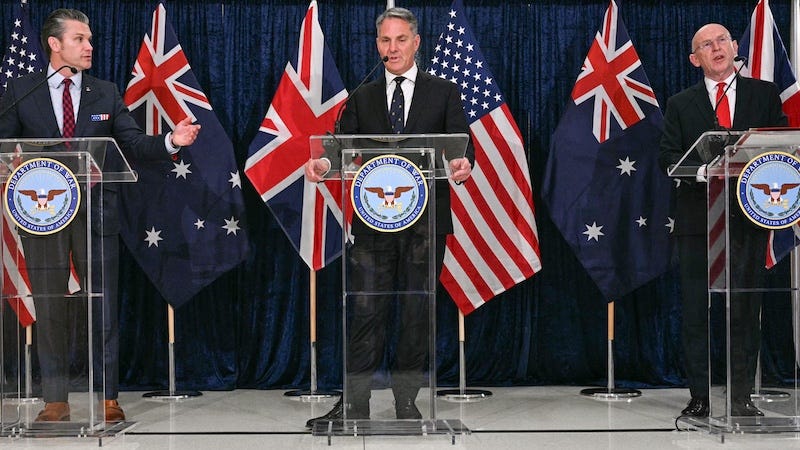
This week’s briefing outlines the big issues to look out for: the hidden implications of AUKUS and integration into US military structures; a housing crisis that governments continue to talk about but seem unwilling to solve; and growing pressures on universities as international students and migrants become political scapegoats for policy failures.
AUKUS and Israel: The alliance Australia was never asked to join
Australians have spent the past five years arguing about the cost of AUKUS, the viability of the submarine program and whether the United States can actually or will deliver what has been promised. But those arguments are distracting from a much larger and far more divisive issue.
We now know that AUKUS was never just a program about submarines – although that’s what successive governments have kept telling the public – it’s a program for embedding Australia even more deeply into American military, intelligence and industrial systems, and it will be embedded so deeply that it will be impossible to get out of. And once we’re in there, we’ll also inherent all of America’s strategic relationships, whether we like it or not.
This is a big issue because the United States is now moving to deepen its military integration with Israel, with proposed legislation before Congress which will connect defence technologies, intelligence systems, research programs, logistics networks and weapons development between the two countries to an unprecedented level.
For Australia – already integrating itself into US military structures through AUKUS and other agreements – the implications are pretty clear. If Australia becomes a part of the American defence ecosystem, and the US defence ecosystem becomes integrated with Israel, then Australia becomes a part of Israel’s military and strategic framework too.
There’s been almost no public conversation about whether Australians are comfortable with this deeper military connection with Israel. And sure, most of this is being decided in Washington behind closed doors and will be voted on by US Congress, but it’s all wrapped in the language of the alliance, the interoperability and national security bullshit that’s espoused by the defence minister Richard Marles and, most importantly, we’ve been told nothing at all about these developments.
Given the direction the United States has taken under the Trump regime, it’s debateable whether Australia should maintain good relations with the United States. But diplomatic relationships should be able to survive catastrophic administrations. If AUKUS is bringing Australia closer into the expanding web of US–Israel defence integration, then the public deserves an honest debate about it. So far, we haven’t heard anything at all.
The housing crisis nobody wants to fix
House prices across the nation have fallen by around 1 per cent since the federal budget was announced last month, and for many, this is a sign that the housing market might be cooling down. But the problem is that this is only a small drop and with a national median house price of over $1 million – a drop from $1,000,000 down to $990,000 still makes that house unaffordable – it’s not clear if this will make too much of a difference at this stage. Sure, it’s better to have prices decrease than increase, but they’ll have to drop by a lot more if housing is to become affordable again.
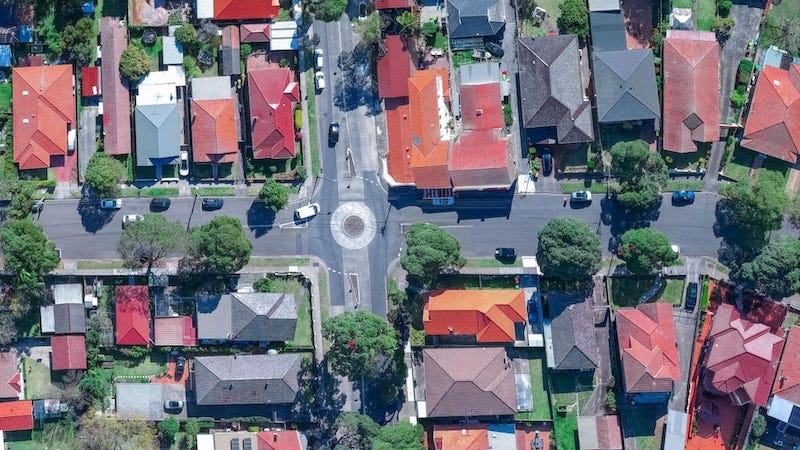
The problem is that housing is stuck between two political realities. Governments regularly acknowledge younger people are being locked out of home ownership, while simultaneously pushing policies that are designed to ensure existing property values never fall significantly. Politicians then talk about affordability, but panic at the prospect of genuinely affordable housing.
Inflation is still high at 4.2 per cent but has moderated somewhat, although groceries, rents, mortgages, and energy costs do remain high. For many households, official economic improvements exist largely on paper while financial stress remains a daily reality.
Housing sits at the centre of this because it’s become a symbol of an economic system that has increasingly rewarded the asset class over the working class. Those who bought decades ago have often accumulated extraordinary wealth through little more than the luck of timing and the many policy changes from successive governments that have rewarded this luck, while Millennials and Gen Z face larger deposits, higher debts and increasingly insecure rental markets.
Housing affordability should remain a major political issue during the week – the majority owner of RealEstate.com.au – News Corporation – will be watching to see if property prices do drop even further, which, of course, will be reported as a calamity for the asset class, rather than a step in the right direction for housing affordability.
Falling universities standards and the migrant as the convenient scapegoat
Australia’s university sector is discovering the consequences of policies they should never been forced to introduce in the first place. For decades, governments steadily withdrew public funding while encouraging universities to behave more like corporations, forcing them to chase international student revenue to fill the gap.
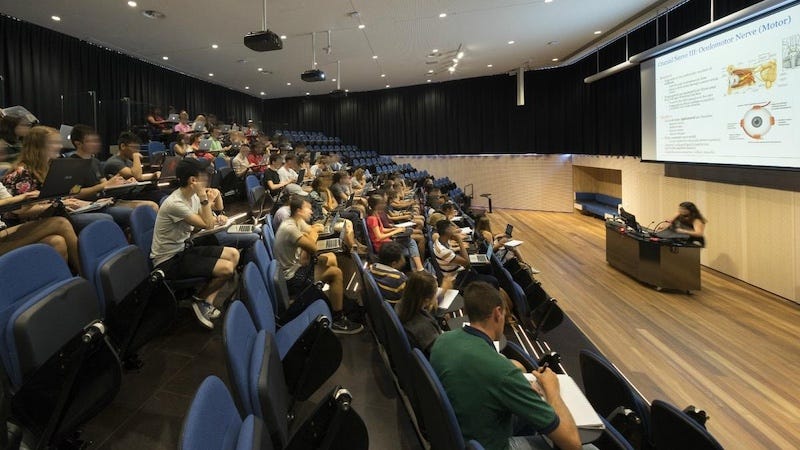
There’s absolutely nothing wrong with having international students – it broadens the diversity of campus life, works as a two-way process of cultural exchange. Even if international students only stay for the term of their course, they engage locally and take their experiences and knowledge back to their own communities in their home countries.
If we can ignore the fact that most universities used these students as cash cows and did very little to support them through additional language skill courses and pretty much left them to their own devices, now that migration reduction is becoming a political target – including international students – universities are being punished for a dependency that successive governments have actively encouraged over the past 30 years or so, even though they were warned not to.
And just as it is with housing, the Albanese government is caught between two competing political pressures. There’s a great deal of hostility towards migrants being hurled about by One Nation, and this is being amplified by all the right-wing political opportunists who blame migrants for virtually every social and economic problem, real or imagined.
On the other hand, universities have been warning about budget shortfalls, academic job losses and declining research opportunities if international student numbers continue to fall. And with the education minister, Jason Clare, asleep at the wheel – and possibly distracted with trying to shore up his leadership credentials in a post-Albanese environment – the government is not defending the university system that has been falling apart for some time.
The housing debate is good example of government shirking its responsibilities. International students have become a convenient scapegoat for a housing crisis that has been decades in the making. The evidence points overwhelmingly towards tax concessions, speculative investment, planning failures and chronic underinvestment in public housing as the primary reasons for unaffordability. Yet blaming international students and migrants is politically easier than confronting a property market that has enriched investors while locking younger generations out of home ownership.
Meanwhile, Australia’s universities are showing signs of a broader decline. Falling global rankings, governance scandals (a big hello to Julie Bishop), controversies over executive salaries and the growing casualisation of staff all points to institutions struggling to reconcile their public responsibilities with private-sector business models that were foisted upon them in the early 1990s, where it became more important for universities to look like the business quarters of Sydney and Melbourne, than to have academic rigour and credibility, and act like centres of education, research and critical inquiry.
What we’re seeing at the moment is the culmination of years of neglect of the university sector: more international students to help pay for the high remuneration packages of poorly qualified chancellors (once again, a big shout out to Julie Bishop); and a new fancy building here and there to keep up appearances – it’s a bit like all those parents who complained to the NSW Department of Education about demountable buildings at primary schools, although in this case, it’s the vice-chancellors who are doing all the complaining. The message always has to be: it’s not the look of the building that matters, it’s all about the quality of education that occurs inside the building.
And what we’re seeing is that old familiar political pattern: a political class searching for easy targets while avoiding difficult reforms. Students become statistics, migrants are kicked into and blamed for everything, and universities become collateral damage in a debate that rarely has anything to do with education at all.


The modern tendrils of control arguably render nations so sclerotic that reconstruction becomes possible only after collapse.
Having several years ago read and lauded Mearsheimer & Rosario's brilliant book How States Think, I now believe it's utterly misplaced. Its arguments remain spot on, but its core premise - that modern states / politicians can be, or even can aspire to be, rational actors - has been systematically falsified by real world experience over the last decade or so.
Which also puts Peter Turchin's summary work "End Times: Elites, Counter-Elites, and the Path to Political Disintegration" into perspective. Empires can fall in weeks, days, or even hours, as his big data research ceaselessly reminds us. We live in interesting times!