


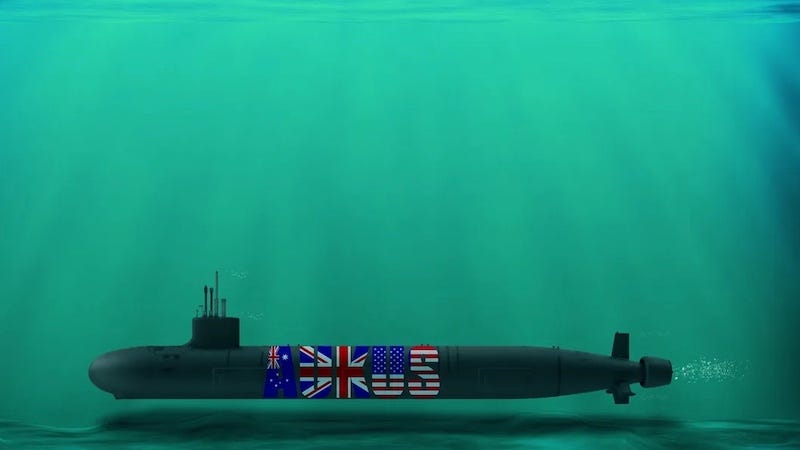
The former prime minister Malcolm Turnbull’s latest offerings in the AUKUS debate have once again revealed the big contradiction within Australia’s most expensive defence project ever: we are committing hundreds of billions of dollars to an ethereal submarine program which essentially will remain outside of Australian control and create a pathway for more US intervention in our military and political affairs.
Appearing before an independent public inquiry into AUKUS – established by a group of former MPs, retired military and naval officers, leading strategists and academics, human rights lawyers and union leaders, primarily because the deal continues to be shrouded in secrecy despite the incredibly high stakes and massive cost – Turnbull described the agreement as a “colossal mistake” and warned that it could leave Australia without an effective submarine capability during the 2030s.
His criticisms weren’t just directed at the extraordinary cost of the project – $368 billion – but the assumption that the United States and Britain will have the capacity and political will to deliver what Australia has been promised.
Under this deal, Australia is expected to operate eight nuclear-powered submarines by the 2050s, but this will depend on an unlikely sequence of events: first of all, extending the life of the ageing Collins-class fleet, training Australian personnel on allied submarines, acquiring American Virginia-class submarines at some point during the 2030s, and eventually constructing the British-designed SSN–AUKUS submarines in Adelaide.
Each of these stages has its own risks, but the immediate problem is the capacity of American production. The US needs its own shipyards to produce an average of 2.3 submarines each year to replace its own fleet but its current output is around 1.3 boats, a shortfall of one boat.
Also, US law requires its president to authorise that the transfer of submarines to Australia won’t affect America’s capabilities. This essentially means that the Australian delivery of its own submarines isn’t guaranteed just because our government has signed an agreement and began transferring copious amounts of money in 2022. If the US decides that its own operational requirements are the priority – and why wouldn’t they – Australia will end up waiting indefinitely for submarines that will never arrive.
The Albanese government’s decision to acquire three in-service Virginia-class submarines, rather than the proposed combination of two used boats and one newly built vessel, is essentially an acknowledgement of those constraints, although no one in government is prepared to admit to this, with Defence Minister Richard Marles presenting the change as a “good news” story – a far simpler arrangement that should reduce costs and ease pressure on American shipyards.
Yet it also means that all three of Australia’s initial nuclear-powered submarines will have already been used by the US Navy – and who knows for how long – which means that their age, remaining operational life and eventual maintenance requirements will depend totally on decisions made in the White House, and at the whim of a future US President.
Supporters of AUKUS argue – and most of those are within government – that focusing on today’s production rate ignores the billions of dollars being invested in American shipyards and the time available before the first transfer, currently expected in the early 2030s.
Australia has already committed US$3 billion towards the US submarine industrial base, while Australian personnel are already training inside the American military. Sure, there’s a chance that production may improve significantly before the submarine transfers are due, but that’s not a guarantee, and Australia has limited power to enforce an outcome in its favour anyway. The revised arrangement might end up making the delivery easier, but it doesn’t remove that condition that American military requirements will always come first at every single occasion.
Turnbull has also raised serious doubts about Britain’s capacity to deliver the SSN–AUKUS design on which Australia’s longer-term fleet depends. Describing British naval shipbuilding as an “industry in disarray”, he argued that Britain may struggle to produce enough submarines for its own navy, let alone sustain a joint program that’s also meant to supply Australia.
Critics of Turnbull are suggesting that his criticisms are based around the cancellation of the French submarines deal that he set up while he was Prime Minister – and that might be one of his driving motivations – but with hindsight, we can already see that the deal with France and the Naval Group was far superior, cheaper, and had more certainty attached to it.
A silent US invasion
Even if the promised submarines do eventually arrive – and that is a big if – AUKUS is already producing something far more politically significant than any issue related to submarines: an ongoing American military presence in Australia, and that’s something that the public has never been asked about.
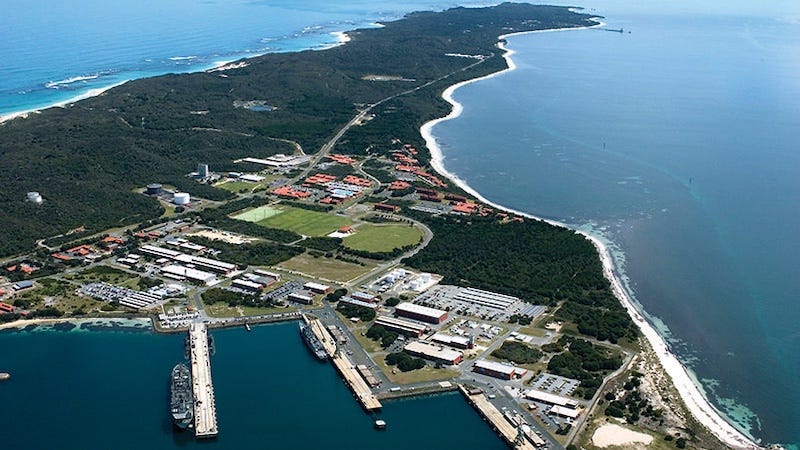
From 2027, the Submarine Rotational Force–West program is expected to bring up to five foreign submarines to HMAS Stirling on Garden Island, just off the coast of Perth. Different ministers keep emphasising that these vessels will rotate through an Australian-owned base rather than be permanently stationed there, but it’s an argument that doesn’t hold much substance when we look at all the administrative structures, human resources, and the services are being developed to remain on a more permanent basis.
In May this year, the US Navy formally established Naval Support Activity Stirling in Perth, stating that this exists to support “the fleet, family and fighter”, and its relocation material provides information for American military personnel and civilian employees moving to Western Australia, including where to find the best local schools, support for housing, healthcare and recreation facilities for a “positive family life”. That doesn’t seem to be a temporary arrangement, as the government keeps insisting.
By around 2030 – just four years away – the American presence associated with submarine operations will include up to 2,300 service members, civilian employees, contractors and dependants. This isn’t just to support an occasional naval visit: it’s the development of a substantial American military community with the administrative system that required to sustain it for a long-term or permanent time.
Defence Industry Minister Pat Conroy briefly added to the confusion last week – deliberate double-speak or otherwise – by calling the arrangement only a “five-year commitment”, before also suggesting it would be an “enduring element” of AUKUS. It’s either one or the other – it can’t be both – but the government is using a wide range of weasel words – “rotation”, “access”, “support activity” and “enduring presence” – to avoid the more politically unpalatable description of what is actually taking place here.
Of course, the government is correct when it says that HMAS Stirling remains Australian territory and it will be an Australian naval base. But that doesn’t mean that the United States won’t have de facto control over these operations, in the same way that it controls bases in Cuba, Denmark, the Pacific and Indian Ocean regions, and Pine Gap in Central Australia.
And these are the question ministers continue to avoid. Who will have the real control over this base? Could Australia realistically deny American submarines access to HMAS Stirling during a future conflict that it does not support? Could it refuse the use of Australian maintenance, communications or intelligence infrastructure for these purposes? What if Australia takes a different position to the US over a confrontation with Taiwan or other country within the South China Sea region?
Before suggestions are made that it could never come to this, Australia should look to Okinawa islands in Japan for an indication of where this could all be headed: for sure, Western Australia is not under American occupation – although some might like to dispute this – and the scale, history and concentration of US bases in Okinawa are vastly different.
However, the experience of Okinawa shows how a foreign military presence initially justified by a post-war strategy can become deeply entrenched and extraordinarily difficult for local communities – or even a national government – to change. Residents in Okinawa have spent decades dealing with aircraft noise, military accidents, environmental contamination, unauthorised land use and crimes committed by US military personnel. Could these same issues be experienced by the people of Perth? There’s no guarantee that they would but if they ever did, there’d be very little that local communities could do about it.
The surrounding areas of HMAS Stirling – Rockingham and Safety Bay – will be expected to absorb all the additional demand for housing, schools, roads, healthcare and other public services. Some local businesses – mainly hotels and restaurants – might benefit from the increased defence spending and presence, but experience shows that those gains are rarely distributed evenly. There are many legitimate concerns about infrastructure, safety and environmental issues that any community should be entitled to ask before a large and enduring foreign military presence arrives on this level, but it’s almost as though governments have forgotten to ask or don’t even care about, because it’s all a forgone conclusion.
We also have to remember that AUKUS is not occurring in isolation. It’s building on the joint intelligence facility at Pine Gap, expanded access for US aircraft across northern Australia, the deployment of US Marines in Darwin, and a higher level of integrated military planning.
Of course, Australia has hosted these US forces and facilities for decades – Pine Gap was opened up in 1970 – but this AUKUS deal takes the relationship into a new phase by making Australia’s most important future military capacities dependent on high-level integration with the United States, as though the two military forces will be indistinguishable. And this is all taking place with almost no parliamentary debate. This is the price Australia pays for a bipartisan understanding between Labor and the Coalition, which has insulated Parliament from any form of scrutiny on these decisions, and left the public in the dark.
The submarines – whether they arrive or not – are almost irrelevant, as is the large sums of money that are being wasted here. The even bigger danger is that AUKUS is slowly and silently reorganising Australian territory, infrastructure and strategic policy around the needs of the United States way before the public has been given an honest account of what the consequences are.
By the time Australians are finally able to see the full effects of AUKUS, most of it will be too deeply embedded to change anything at all – just ask the people of Okinawa – and that’s why every political leader who has been involved with the charade of AUKUS should be condemned and hounded out of office.
The secretive manner in which this whole matter has been conducted screams betrayal of the Australian nation ,its people and our future . In my view it is well nigh treasonous ; tossing away our sovereignty without a word of debate in parliament .
That Albanese , Wong , and “snow globes” Marles assume they can give away billions of dollars of taxpayer funds to the US , for
submarines that may never arrive , without the smallest consultation with the public ( and particularly affected electorates 😡) is the very antithesis of Democracy . ( But Albanese has shown all too little regard for the public interest since becoming PM.
Seemingly he would rather build and pay for housing and facilities for American military personnel on their bases , than build houses for homeless Australians . ) I hope enough voters wake up to this level of abandonment before the next election . This government is beyond a disgrace.
Perhaps also look at how the Trump administration is treating Greenland in how the Texas based Greenland Energy is, as we speak, is trampling that sovereign rights of Greenland in its quest for oil.
Australia should be very afraid because in a few short years Australia could, realistically, lose its West Australian gas reserves to the USA.
WE HAVE INVITED THEM IN AND THEY WILL FUCK OUR SOVEREIGNTY.