


This week’s briefing outlines the big issues to look out for: more useless military spending by the Australian government… Queensland arrests for pro-Palestine banners… Trump’s on-again, off-again war… the slow decline of One Nation.
Australia drifting towards another round of futile defence spending
Australia’s stance in the on-again/off-again/on-again US–Iran confrontation is once again exposing the duplicity of a political class that tries to convince the public about its independence but, in reality, defaults to the position of acquiescence to the United States.
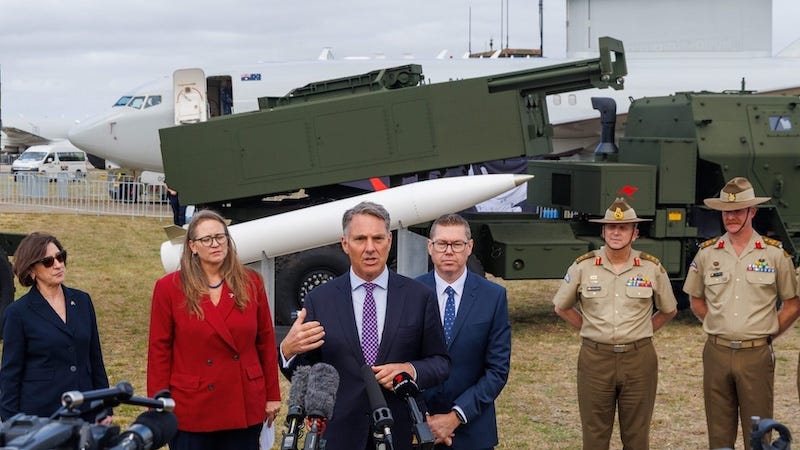
The Albanese government has publicly resisting pressure from US President Donald Trump to participate more forcefully in a conflict created by the United States – which was essentially for the main purpose of boosting the profits of the oil barons and vested interests in the US – but we have to remember that they previously resisted the calls from Trump to increase military spending, only to announce on the weekend that – you guessed it – military spending is going to receive a significant boost.
The Defence Minister Richard Marles – who casually makes these announcements as though he is cutting the ribbon at the opening of a new fountain at the local park – has released the National Defence Strategy, which will increase defence spending by $53 billion over the next decade, taking defence investment up to 3 per cent of national GDP. While it’s short of the 3.5 per cent demanded by the United States, it’s still a 50 per cent increase, just at a time when we keep being told that there isn’t enough government revenues to support housing reform, better public services, public infrastructure, public school funding, hospitals, mental health, the National Disability Insurance Scheme, measures to reduce domestic violence.
Why is it that every dollar for essential services has to be argued for incessantly, assessed whether it represents value for money by an endless stream of committees and bureaucrats in Treasury, and reluctantly released by government as though the public is extracting a deeply embedded tooth – yet $53 billion for defence and appeasement of an idiot king in the United States is given away with alacrity. Not as cheerfully given away as the $368 billion price tag of AUKUS, but still frittered away without any of the usual checks and balances that are applied to every other measure of government spending.
Who has time to support vital public services and social investment when we’re on the verge of backing an aimless war in a distant country – waged by an even more distant ally that doesn’t know what it’s doing?
The slogan police in Queensland and NSW
While the conflict in Iran has consumed most of the world’s attention and pushed the conflict in Gaza into the background – the issue of Australia’s commitment to free expression when the political pressure grows is once again in the spotlight.
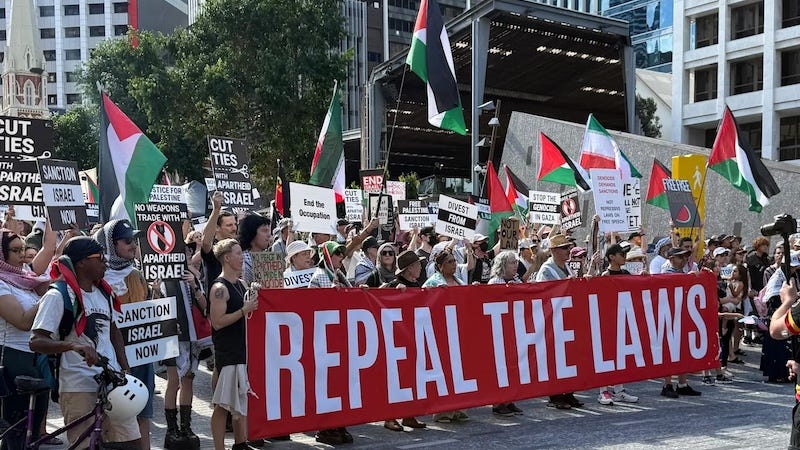
Since October 2023, the Albanese government has made poor attempts at a delicate balancing act: signalling “concerns” about humanitarian conditions in Gaza, while avoiding a diplomatic conflict with Israel, and catering for the extremist pro-Zionist groups that is resulting in further controls over university curricula, what’s permitted within cultural institutions, and what type of political expression is allowed on the streets. Just like the spending on defence, there isn’t a coherent position provided by the government, just this endless appeasement and acquiescence to this pro-Israel lobby, and then trying to contain any political fallout that arises from it.
Queensland’s tightening of protest laws, particularly on Palestine solidarity, reveals how quickly governments reach for new laws and restrictions when dissent becomes inconvenient for them, or their supporters. Twenty people were arrested in Brisbane for holding up a banner with the phrase “from the river to the sea”, words that are banned in Queensland because it’s part of an expression that is – according to these new laws – reasonably expected to menace, harass or offend a member of the public.
At least in New South Wales, the attempts to criminalise the use of “from the river to the sea” and “globalise the intifada” have stalled because advice to the NSW government is that to enact such laws would be unconstitutional. This follows on from the removal of the Public Assembly Restriction Declaration laws, after the NSW Supreme Court deemed them to be unconstitutional, due to the restriction of political communication, and threatening fundamental civil rights.
The broader issue is not so much the draconian banning of such certain words – as bad as that is in itself – but that we have weak and careless leaders such as Queensland Premier David Crisafulli and NSW Premier Chris Minns who are only too happy to throw away democratic rights and freedoms, just so that an exclusive and powerful group of people in Australia don’t have to have their consciences pricked when they do their Sunday shopping, or be reminded of the crimes of genocide being acted out by the state of Israel.
Trump’s continuing crisis
“We’re going to knock out every single power plant, and every single bridge”. No, these are not the words coming from the mouths of Iranian “mad mullahs”, or a mass of anti-American protestors on the streets of Tehran; they are coming from the keyboard-commander-in-chief, US President Donald Trump.
It’s now a cliché to suggest Trump is not of sound mind and, therefore, time to invoke the articles contained with the 25th amendment of the US Constitution, but it’s clear that he’s neither fit nor appropriate to be President. No US President should ever behave like this, irrespective of their political leanings.
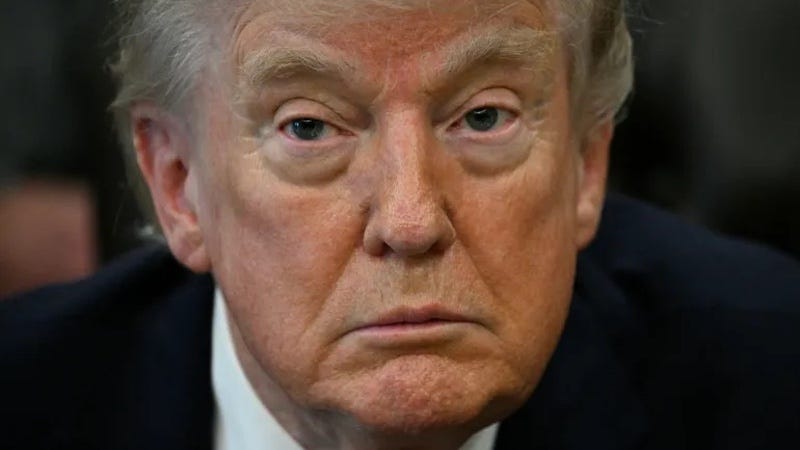
The Iran crisis is obviously a failure of diplomacy and a case study in how instability can be manufactured, amplified and politically exploited by a corrupt leader. Under Trump, the United States has vacillated between threats made on Truth Social, grandstanding and vague claims of negotiations, creating a volatile mix that makes him look more like a convenient idiot manipulated behind the scenes by his powerful and leeching benefactors.
Iran’s moves to close the Strait of Hormuz again are being framed by the US as provocation, yet they are the ones who refused to end their blockade after Iran opened up the strait. It’s almost like the politics of the playground acted out by a geriatric leader, but instead of a bruised lip or a black eye in a fight caused by a 10-year-old overgrown bully, this has far greater consequences – to global shipping routes, energy markets and civilian lives – with scant regard being given to any of these issues.
For Australia, the crisis exposes a familiar story: dependence on global energy flows and an obedience to a US alliance that limits our autonomy. We are tied to decisions made by others, and elsewhere: the Prime Minister can claim some success in being able to obtain the supply of 100 million litres of petrol from Malaysia, but this is the equivalent of one day of consumption in Australia. Once again, Australia finds itself reacting to a crisis it has no role in affecting, yet, inevitably helps to sustain it by not calling out the actions of the United States.
One Nation meets the limits of outrage
The latest round of opinion polls shows a dip in the support for One Nation, and this suggests that there are limits to a style of politics that’s built primarily on grievance.
After surging earlier in 2026, One Nation is losing momentum, with voters drifting back toward the major parties, as economic anxiety begins to outweigh the protest of being permanently “pissed off”. Cost-of-living pressures, global instability and the “serious” policy questions have always been the roadblock for One Nation, and this tends to expose the gaps between political anger within the electorate, and political credibility. Yes, the electorate can get angry about key issues that they feel are not being addressed by government but, ultimately, they will choose candidates that can solve problems, not just sit down and complain about it endlessly.
What makes this dip more crucial is the timing. The decline coincides with more scrutiny of the quality of One Nation candidates, including the ones who won seats at the recent South Australia election – management of electoral funds, and the kinds of controversies that are arising, including the employment of a staffer who was jailed for rape in 2018.
Populist movements such as One Nation do thrive on a reputation as political disruptors, but now the electorate has kicked the tyres and looked under the bonnet, they are seeing a political movement that enlists some unsavoury characters, seems to be pilfering public funds, and offers few solutions to the many problems they like to complain about, which usually focus on those issues that tend to bring out the worst in people.
Voters might flirt with outsider politics when their frustrations reach a breaking point – and some may remain there – but many others will retreat to familiar institutions when the uncertainty deepens, especially when they can see that these outsiders don’t have much to offer to the public.


I think that Australia's dependence on America (mainly military alliance) is less than Canada's dependence (military, economic).
I don't think that it is within the capabilities of Albanese or anyone else in Australian politics right now to look and learn from Carney on how to deal with America and lead our country. So many nation building opportunities being wasted.
Austerity for renewable energy, while fossil fuels get the ALP royal treatment. Maybe that's why Labor is not lowering GHG emissions as fast as we need to lower them in order to avoid the 2% increase in GHG emissions over pre-industrial levels, let alone the 1.5% target we need to aim for.
Austerity for political expression, while royal orders from HRH Minns to Police NSW, and from the ALP to Australian security apparatus ensure the oppressive silencing and punishing of political dissent on US and Israel war crimes. ('Don't mention the war'.) Maybe that's why NSW and Australian Greens are working to reclaim the right to dissent from Royal Labor, by enshrining the right to protest in law, and by ensuring no-one engaged in non-violent protest or civil disobedience can be given a prison sentence.
Austerity for public health, education, and housing, while private investors get the ALP gravy train of all the benefits with none of the taxes. Lucky investors take over everyone's essential services, often leaving us without recourse, just computer programs prioritizing cost reductions over service provision. Maybe that's contributing to why our communities still have too many failures of mental health, homelessness, and crime.
If only there was a solution. https://www.taxthe1percent.com.au/