


Albanese embraced Trump, and now he’s paying the price
The Prime Minister Anthony Albanese is now scrambling to talk up the virtues of ending a war that he was one of the first leaders to support. Nine months after welcoming and eagerly endorsing Donald Trump’s military strikes against Iran – almost pushing himself to the head of the queue – Albanese is calling for de-escalation, after surveying the economic wreckage Trump has created and, no doubt, the electoral punishment that was handed out in spades to the Republican Party in the US midterm elections last week. But even of that, we can’t be too sure of what exactly Albanese is seeing.
Trump’s strategically unsound war and mindless tariffs have helped drive up energy costs, fuel inflation and deepen economic uncertainty, not just in the US, but all around the world. Australian households are also paying the price, while Albanese has announced that his diplomatic approach to Washington is not for changing, an obvious recipe for disaster that everyone can see – except for Albanese.
Albanese has surprisingly cultivated Trump when many leaders understood the wisdom of keeping their distance from such an unpredictable and incompetent president. Now, with the Democrats controlling Congress, former Labor minister Ed Husic has called for a diplomatic reset, and with the $368 billion AUKUS arrangement facing renewed scrutiny, Albanese’s all-the-way-with-DJT approach looks increasingly reckless.
The bigger problem is Australia’s willingness to outsource its strategic interests to the US, regardless of who sits in the White House or what damage their decisions inflict upon Australia. And it’s not just Albanese: it’s the defence minister Richard Marles and foreign minister Penny Wong, among others. It’s clear that they are selling out Australia’s interests, even if we aren’t quite sure what their Faustian deal is at the moment.
We’re not suggesting anything here, and apropos of nothing at all, we’d like to point out that the former Labor minister, Graham Richardson, held three secret Swiss bank accounts.
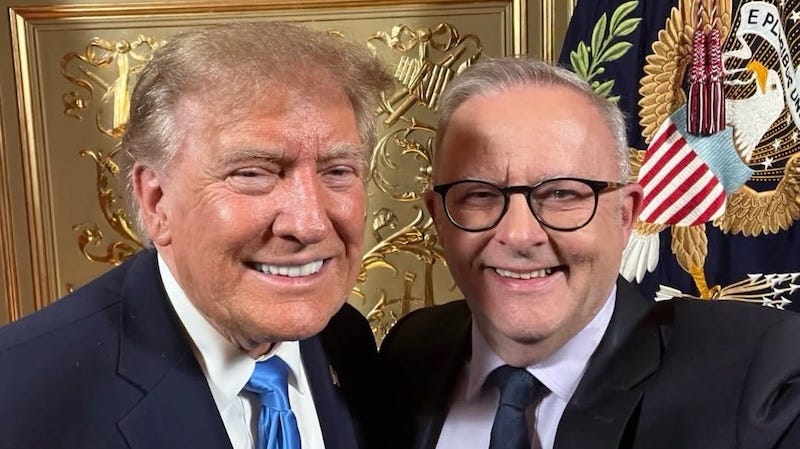
Good political leadership will avoid the disasters before they arrive, and this is a problem Albanese invited upon himself earlier this year. He had many opportunities to create some distance from Trump in February. Instead, he chose to keep himself close, even posting a selfie with Trump, which we are still trying to work out why he decided this would be a good thing to do.
Politics always has a habit of repaying leaders when they misjudge so badly, and the Australian electorate will be wondering why they should pay for his misjudgement.
Are we really teaching history, or just manufacturing Zionist consent?
The education minister Jason Clare has fully endorsed new teaching resources proposed by the Social Cohesion Education Advisory Council, which will include antisemitism, Jewish history and the Holocaust, but overlooking one inconvenient issue: the Holocaust is already taught in Australian schools, and is more than adequate. So, what will be added that is not already there, and whose political interests does it serve?
The teaching of history in schools should encourage critical inquiry, not politically determined outcomes as defined by a group of Zionists, who are already interfering far too much in Australian politics, education and culture.
Students should also understand colonial genocide, the destruction of Indigenous societies in Australia, Armenia, Ukraine, Bosnia, Rwanda, Sudan and the ongoing genocide in Palestine. Will they learn about the other German genocide in Namibia in the early 20th century, or the 10 million Congolese people killed by King Leopold in the late 19th century? That’s a genocide worth talking about.
And will students be encouraged to separate Jewish identity from Zionism, antisemitism from criticism of Israel, and Israel’s persecution of Palestinians since at least 1948, through the Nakba?
We’re not arguing the Holocaust shouldn’t be studied in Australian schools: it already is, and it’s more than adequate for general knowledge, and especially for those students who wish to specialise in history studies, or comparative religions – it’s a core part of the curriculum. But why should a Palestinian refugee child at a school in Lakemba be forced to learn a history from a Zionist perspective, supporting a state of Israel that has terrorised his country of origin and family for over 80 years?
This announcement has been made at the same time we find out that 72 per cent of Year 10 students are failing to meet basic civics benchmarks. This additional curriculum is Albanese’s equivalent of the failed Howard government’s chaplaincy program that was rorted, involved a great deal of proselytising, was unaccountable and failed to achieve many benefits for the schooling system.
The real test is now going to be what these new resources contain, who develops them and whether teachers will retain the freedom to challenge their contents in the classroom. There’s nothing worse for a teacher to stand in front of a classroom and offer instruction to able and willing students that they know is likely to be state-sanctioned propaganda. Governments are trying to protect school students from screens and devices; why allow something that has the potential to cause greater harm and detract from Albanese’s so-called “social cohesion”?
If Jason Clare’s reforms are not going to include the uncomfortable questions about Israel, Palestine – and Australia’s own colonial past – they risk becoming an exercise in political messaging, rather than a genuine education.
And just so we get a good idea of what’s going on here, Clare did go to Israel in 2008, through AIJAC’s 2008 Rambam Israel Fellowship, with full travel and accommodation paid for by the AIJAC. But we’re sure there’s no correlation between that trip and this recent decision.
The $2 million price of academic freedom
If interfering with the school system is not enough, the Albanese government is increasingly intent on turning Australian universities into institutions of political compliance, rather than their sole purpose of educating adult students, with the new threat of $2 million penalties for failing to adequately combat antisemitism, according to an undetermined formula.
Universities already have obligations to protect students from discrimination and harassment, and the question here is why additional punitive powers are necessary, who decides when a university has failed, and whether criticism of Israel will become a taboo target.
This is where Special Envoy Jillian Segal’s broader antisemitism agenda is very problematic, as we’ve outlined many times at New Politics. When definitions of discrimination try to cover legitimate political expression, university staff will have every incentive to suppress controversy, rather than defend academic freedoms.
Why tolerate a difficult debate about Gaza on campus, when cancelling an event is a lot easier and will protect an institution’s funding and reputation? It’s already happening now under a highly compromised and incompetence university sector; what’s to stop it happening more often under this legislation, or debate about Israel and Palestine removed entirely?
As it should be in schools, universities are places where powerful governments, ideologies and historical narratives should be challenged, not protected from scrutiny. If academic freedom tries to exist so that no-one is offended, it no longer exists.
AUKUS: We pay $368 Billion to surrender our sovereignty
Australia’s most expensive defence commitment ever has received a damning review from an independent public inquiry headed by former Labor minister Peter Garrett and former defence chief Admiral Chris Barrie. And the Albanese government’s response has been to pretend the problem doesn’t exist.
This inquiry recommends abandoning AUKUS – don’t we all – and establishing a royal commission into how Australia became committed to spending $368 billion on nuclear-powered submarines that will never arrive. And they’re not alone in this recommendation: more than 1,000 submissions have been sent to the inquiry, mainly raising questions about sovereignty, strategic independence and the danger of being dragged into an US war with China, if it ever comes to that.
Yet Anthony Albanese and Richard Marles are stubbornly defending Scott Morrison’s ridiculous deal created in 2021, unwilling to question the wisdom of outsourcing Australia’s security to an increasingly unpredictable United States. With Donald Trump’s authority severely weakened by the US midterm elections, we could say that the Democrats will just continue with AUKUS, but there’s a new type of Democrat who will be occupying the US Congress, and they may well end up scuppering the deal. Which, of course, would land more egg on the face of the Albanese government.
For $368 billion, Australians deserve something more convincing than bipartisan obedience and submarines that might turn up sometime in the 2040s. Or never at all.


Albanese cosying up to Trump and pandering to Israel are the reasons why I will be voting Green.
Labor doesn’t care if their allegiance to Trump, the US, Israel and Zionists gives one nation power. That’s what they want.