


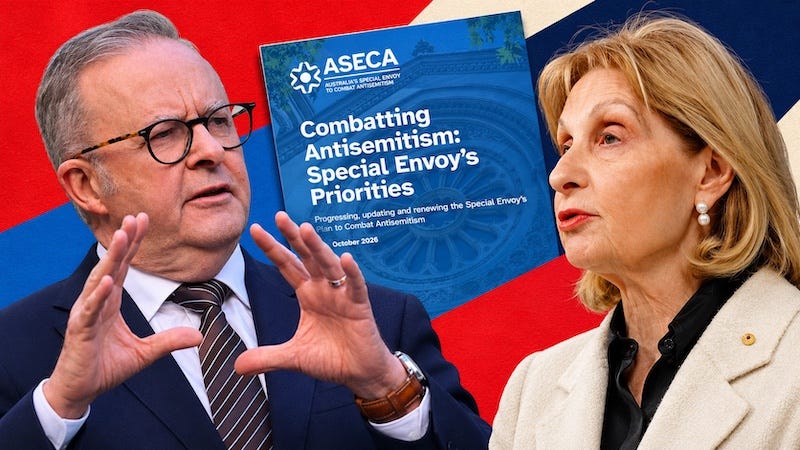
There’s a fundamental difference between reducing antisemitism and giving an unelected government official great influence over what Australians can say, where they can protest, which cultural events receive funding and how public broadcasters handle the complaints that are made against them.
And it’s a difference that’s becoming increasingly difficult to see with the work of Special Envoy to Combat Antisemitism, Jillian Segal.
Segal’s latest policy agenda is contained in ASECA Priorities, and is a substantial expansion of her ambitions – not for the Australian community – but that of Zionist interests and the state of Israel. In her report – which I have to say, is one of the more outlandish and extreme ambit claims that we’ve ever seen – there are calls for further restrictions on public protest, limits on face coverings, additional scrutiny over specific types of visas, conditions attached to arts funding and the external oversight of complaints involving the ABC and SBS.
You could mount an argument for each of these issues – only just – but when taken together, these are extreme measures that go far beyond protecting Jewish Australians, and affect the freedoms – and, arguably, lessen the protections – for the entire population.
We’ve gone past the point where every argument or every article that’s published needs to include the rider that of course, antisemitism shouldn’t be tolerated – it’s been so overused over the past three years and extorted for political gain by Zionists and pro-Israel groups, that fewer people now understand what it means, and even less people care about it.
The sole ambition of Segal seems to be to outlaw all criticism of Zionism and the state of Israel, and many people can see and understand that if this comes under the purview of her definition of antisemitism, it will become one of the biggest attacks on fundamental freedoms that this country has ever seen.
Segal has revealed her hand far too often, and too obviously, and this time around she’s introduced the concept of “progressive antisemitism”, and made the claim that the bulk of antisemitism – through her interpretation which now seems to include everything – emanates from the left side of politics. It’s a despicable slur and, as usual, there’s no evidence provided to support this claim – aside from ethereal feels-opinions – and it’s clear that applying a left–right divide to this debate is particularly dangerous.
There’s also an obvious contradiction here. Many prominent critics of Israeli government policy are themselves Jewish, including the author Antony Loewenstein, Sarah Schwartz from the Jewish Council of Australia, and many other Jewish organisations opposed to the occupation of Palestinian territories, such as Jews Against Occupation ’48.
Where would their opinions and opposition sit within Segal’s spectrum of “progressive antisemitism”? According to Segal’s proposals, their opposition to Zionism and the state of Israel would essentially place them in the category of “second class Jews”.
Segal insists that legitimate criticism of Israel under her proposals would be allowed, but this is another example of her duplicity. What exactly is “legitimate” criticism? Would we still be able to criticise Israel for its acts of genocide against the Palestinian people? Its war crimes and brutal practice of apartheid? What is illegitimate criticism, according to Segal? She’s never willing to provide examples of this because her aim is to force the government to introduce legislation that includes the more extreme IHRA definition of antisemitism and to criminalise criticism of Israel.
Segal is an appointed envoy, not an elected representative. If she wants to introduce these extreme measures, let her run for office, and propose this agenda as a lowly backbencher – presumabley as an elected representative for the Liberal Party or One Nation – and see how far she gets. As her title suggests, her role is to combat antisemitism, not to be a servant to Zionism and the state of Israel, and bend parliament to her will.
Prime Minister Anthony Albanese should reject this report, and if he hasn’t got the courage to do this, allow it to be swallowed up by the bureaucracy of Canberra, and slowly move towards ensuring Segal’s position definitely ends in July 2027, which is the natural expiry date of her three-year term. Segal’s appointment was supposedly to strengthen social cohesion, but her office is advancing a specific political agenda that risks achieving the exact opposite.
The Wall of Tears: when remembering dead children is not allowed
If we need to have a glimpse of what the future will look like if the agendas of ASECA Priorities are ever realised, look no further than the south coast of New South Wales, where yet another exhibition has been cancelled, this time by the “friend of Israel”, CEO Andrew Constance, the former NSW Treasurer who still maintains strong links with the Australia–Israel Chamber of Commerce.
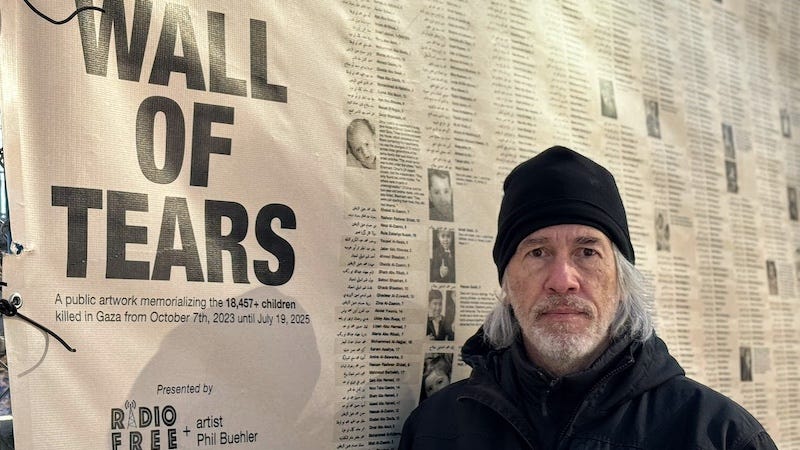
The exhibition – an installation by American artist Phil Buehler – was scheduled to open on November 4 and commemorates the 18,457 Palestinian children killed in Gaza by the Israel Defense Forces since October 2023. This is not a military installation, or a political cause, or an invitation to cause violence: it’s a simple memorial to children whose lives had been lost in a devastating conflict. It’s not overly didactic, and it’s simple: a title, a long list of names on a white background, with some smaller photographs next to a few of the names.
Yet Constance cancelled the exhibition just a few days before the opening, after he commission a risk assessment that nobody asked for, one that considered the use of security personnel, metal detectors, restricted entry and even armed guards. Why was Constance even considering this, and what exactly was he expecting would happen during the exhibition?
There was no specific threat that was identified, because it’s very likely that there wasn’t one. It also needs to be explained why this exhibition could be held in many parts of the world – London, New York, San Franciso, Mexico, Amsterdam, Sydney, Western Australian Parliament, the lawns of Parliament in Canberra – yet in the slumber town of Shoalhaven, the council decided that it needed to be cancelled.
For those who might not be unaware of Constance, he is a model of political failure and incompetence. After an unspectacular 12 months as Treasurer, he was dumped and demoted to the portfolio of Transport and Infrastructure. Under his leadership, trains that were literally the wrong size for the existing rail network were procured; River Class ferries were built that were too big to pass under two bridges on the Parramatta River; and cost blowouts in the projects under his management were close to $5 billion.
After he resigned from state politics, he had four unsuccessful bids to gain either a Senate or lower house seat – five attempts if you include his abandoned Eden-Monaro bid in 2020, when he announced his preselection bid, only to withdraw the following day – and somehow became the CEO of Shoalhaven Council, even though he wasn’t the first-choice candidate, with some councillors suggesting flaws in the recruitment process and political conflicts of interest.
Of course, how Constance got into the position is a separate issue, but his competence and ability to follow due diligence are important factors. Where the police consulted in his considerations? Why would there be a need for security, and would ordinary security arrangements have been enough, if at all? Were organisers – Shoalhaven Friends of Palestine – given an opportunity to address the concerns, given the late notice they were given about the cancellation? And were there any complaints or pressure from pro-Israel advocacy groups and, if so, who made those complaints?
The history of cancellations over the past three years involving Palestinian material in public places makes that question quite a reasonable one, and what makes this particular cancellation significant is that it’s arrived at the same time as the release of Segal’s outrageous policy agenda.
If we are unfortunate enough to have Segal’s agenda introduced – and given the amount of compromised and pusillanimous politicians we have in this country, there’s always a good chance of that happening – not only will we see more of this type of censorship in publicly-funded institutions such as councils, state galleries and other venues, but it’s likely to extend to other areas as well.
After the cancellation of Wall of Tears was announced, it was quickly relocated at the nearby town of Berry at Uniting Church Hall (and then onto Kiama and Port Kembla) – which presumably had no security issues or need for metal detectors – and decided to show the world what Zionists would prefer to forget, in case they be reminded of the insanity and extremism of their own ideologies.
Segal’s proposals will prevent anyone seeing works of this nature, like a censorious high-priestess deciding what can be viewed, and what can’t, with the prospect of criminalising any attempts to reveal what it is that can’t be seen. That’s where all of this is heading: like a modern version of Plato’s cave, where we are taught to fear the shadows on the wall and denied the chance to see the reality that exists far beyond the fear.
If vaguely defined political expression – according to Segal’s proposed star chamber of acceptable political taste – becomes subject to lawfare, the consequences will move far beyond cancellation, on to financial penalties, and finally towards criminal prosecution.
There’s something quite disturbing about a society – under the influence of a cabal of Zionists – where commemorating children killed in war becomes so controversial that a regional council and a public gallery uses the ruse of a risk assessment – that for some reason includes metal detectors and armed guards – to cancel the proposed memorial.
Let’s enter a parallel world just for a moment and imagine how Australia would respond if an exhibition in memory of the 850 Ukrainian children killed since Russia’s full-scale invasion in early 2022 was cancelled following interference by Russian operatives in Australia. The Prime Minister would make an announcement before the media even caught wind of it, and the Russian ambassador would be on the first plane back to Moscow. We would then be told that this constituted a serious interference in Australian affairs and a disturbing attempt to silence the truth. Which, of course, it would be.
But on Palestine, we have silence. No words from the Prime Minister about this cancellation. No word from the Foreign Minister. The freedom-of-speech warriors have nothing to say either. It’s as though these interventions by a foreign influence are perfectly normal, and we should simply accept that a South African-born zealot can influence our laws on behalf of Israel.
Wall of Tears was intended to draw attention to children whose lives have been taken in all wars – including those in Gaza killed as a result of decisions made using algorithms and AI operated by cowards sitting in a military office block in central Tel Aviv. Instead, its cancellation has become a central point over who really controls the boundaries of acceptable political expression in Australia.
A democratic society can’t claim to defend democratic freedoms while allowing political feels-opinions to determine which victims will be remembered, which injustices may be reported on, and which governments we are allowed to condemn. If the Australian community can’t freely commemorate children killed in war, what exactly are the freedoms our governments are pretending to protect?
Do Zionists, Jews and Israelis not understand the message they are sending to the world when they classify condemnation of genocide and the mass murder of children as being anti-semitic, i.e. a hatred of Judaism and Jews?
They are saying, by those actions, that Israeli terrorism, genocide, ethnic cleansing, rape, torture, murder, theft, destruction, the intentional murder of children ( documented) and the creation of the greatest number of child amputees ever seen in one place in human history, along with an official Israeli policy of banning anaesthetics, antibiotics, painkillers, prosthetics and wheelchairs, represent Judaic and Jewish practices and values? That is as anti-semitic as it gets.