


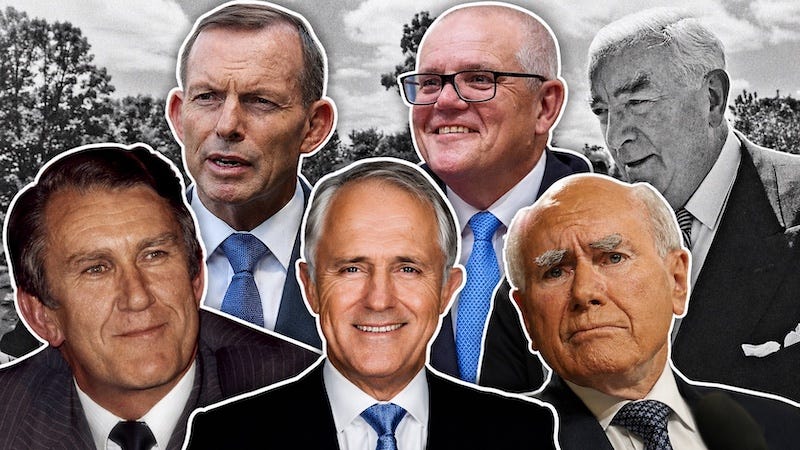
The Liberal Party’s latest bout of soul-searching has arrived at a very familiar point: the problem isn’t the packaging, it’s what’s inside the package. Following another round of disastrous opinion poll numbers, senior figures of the Liberal Party are openly discussing a rebrand, with suggestions that the party’s name may have become an electoral liability.
In the advertising drama series, Mad Men, Peggy Olson asks: “If this was a dog food, we’d change the name, so why don’t we just change the name?”. We’re not suggesting that the Liberal Party has reached the point of dog food – others might – but it’s a remarkable admission for a party that once regarded itself as Australia’s natural party of government, having held office for 51 years since it was formed in 1944, or 63 per cent of that time.
Changing the name is far easier than confronting the reasons why the electorate has walked away from the Liberal Party. After making the endless push for privatisation, deregulation, tax cuts for high-income earners and an increasingly market-driven approach to housing, wages and public services, many people associate the party with a system that has delivered unprecedented wealth to those already at the top while leaving everyone else facing stagnant living standards and diminishing economic security.
The problem for the Liberal Party is that they continue to make that mistake that the lowest point in its history is therefore an opportunity to bring in a marketing solution to a political crisis, instead of looking directly in the mirror and realising that they are the actual problem.
The irony here is that the Liberal Party – in the Menzian tradition – once saw itself as the party of aspiration and opportunity, but also providing a modest safety net for those who might be lagging behind. Today, many younger Australians see it as the defender of inherited wealth, property speculation and entrenched privilege. And something that’s been created over many decades, coupled with the nasty right-wing hate promoted during the Howard era, is not going to be repaired by a fancy new logo or a name that continues to deceive the electorate. Isn’t it bad enough that the use of “Liberal” in its name disguises what is essentially is a hard-line conservative party?
Rebranding might end up produce a few favourable headlines and a few look-here moments, especially from their friends in the mainstream media, but will the voters buy it? Olson’s question in Mad Men captures the basic instinct of advertising that a brand refresh can change perceptions. In politics, though, voters generally look beyond the label: if the product behind the name remains the same, a new name by itself won’t deliver any long-term political benefits.
The teals become a part of the establishment
The launch of Community Strong Australia is a sign that the teal movement – some of them, at least – has decided to become what they’ve always opposed: the structures of a political party. It’s not exactly a name that rolls of the tongue – something like the Teal Alliance would have been far more suitable if that’s the path they were going to go down – and it has all the hallmarks of being market tested to the point of being meaningless, but that’s beside the point. What started off as well-funded community independents campaigning against the excesses of the major parties is now showing all the signs of the political establishment it has always claimed to challenge.
The rationale being offered by current independents Allegra Spender and Zali Steggall is fairly straightforward: Australia’s electoral funding laws have always favoured the formal party structure, making it difficult for like-minded independents to form allegiances and hold more political influence. It’s always going to be a trade-off – is it better to have clear independence, or form a party that will enable the pooling of resources, manage co-ordinated campaigns and build a national brand, and hold power to account more effectively? How independent are the teals anyway, considering the massive support they receive though the Climate 200 group?
The bigger question is what the teals actually represent. They have successfully positioned themselves as competent, moderate and evidence-based, and their appeal relies heavily on integrity, climate policy and professional management – all highly desirable attributes for political operatives – but the far more contentious issues about wealth concentration, housing speculation, corporate influence and growing inequality seems to have been overlooked. The seats that are occupied by teal independents are also the most affluent in Australia and that might be the reason why they’ve paid lip-service to some of these issues.
This might end up being both their strength and their weakness. They do offer reassurance to voters frustrated with the major parties without asking for fundamental changes to the system that produced that frustration in the first place. But the economic insecurity that is affecting many people across Australia is hardly felt at all in the seats currently held by the teals.
If these electorates feel that the main point of difference for the teals was the fact that they are truly independent from the party structures, the day Community Strong Australia was announced last week could end up being its high-water mark and hard work performed by these independents over the past decade runs the risk of being lost.
The limitations of Hanson’s monoculture
The latest opinion polls contain an uncomfortable message that neither major party seems particularly eager to confront. Labor has stabilised after its post-budget wobble, the Coalition has sunk to historically weak levels, and One Nation continues to command support that would have been unimaginable just a few years ago, albeit with a slight drop. Yet beneath the headline figures is a different reality: there’s not much enthusiasm for any of the parties or leaders, and it seems to be more a case about choosing the least-worst option.
Anthony Albanese is comfortably ahead of Angus Taylor as preferred prime minister, but much of that advantage reflects the Opposition’s inability to present itself as a credible alternative rather than any excitement about the government’s agenda. Meanwhile, the Coalition appears trapped in a cycle of self-inflicted decline, searching for better messaging while avoiding the harder conversation about whether any of its political and economic offerings matches up to the lives Australians are actually living.
Meanwhile, support for One Nation has dropped slightly, and we suggest that it will continue to drop, as each new bizarre announcement is made by Pauline Hanson, to give us an idea of what’s really going on inside her head. The latest from her “monocultural series” is that Paul Hogan and Norman Gunston (who, incidentally, is not a real person) are the classic definition of the monoculture that she is espousing, even going to the extent of claiming that the current World Cup Socceroos team, is also an excellent example of “monoculture”.
This claim would be a surprise to many people, as the squad is made of players from Italian, Scottish, Cypriot, Ugandan, Sudanese, Tanzanian, Serbian and Dutch backgrounds, which would seem to be the true essence of multiculturalism, but perhaps we’ve been wrong all along and Pauline knows best. We is all Straylian now.
But this politics of nostalgia is starting to wear thin. For years, Hanson has built her political brand around the promise of returning Australia to an imagined past: a simpler, more familiar, more “Australian” nation supposedly before multiculturalism, migration and social change arrived unwantedly on onto the scene, and ruined the national story. Right at this moment, it’s an effective political strategy because calls for nostalgia rarely requires evidence; it just requires people to believe that yesterday was much better than today (narrator’s voice: no, it was not much better than today).
It’s not possible to feed the public this constant line of fact-free bullshit and expect they will fully accept this rhetoric forever. Nostalgia does have its limits: as the cost-of-living crisis deepens and housing becomes increasingly unaffordable, voters are beginning to ask more practical questions.
How will a return to Norman Gunston help to reduce grocery bills, lower rents or make it easier for young Australians to buy a home? And by the way, who is Norman Gunston? Played by Garry McDonald, the character of Gunston hasn’t appeared for over 45 years. He might have been the precursor to Da Ali G as far as his style is concerned, but how many people in the electorate would know who he is?
It’s cyclical, but this culture-war politics has probably reached its limits too. Hanson insults the intelligence of the public by offering inane and outdated cultural references as solutions to the big problems the country faces. The public might detest many of our politics leaders, but they too can see that Hanson is the fool on the stage who is being seriously exposed as her audience grows.
Political theatre can attract attention, but eventually voters expect substance. If economic insecurity continues to dominate public life, there’s not much of a future for the likes of Hanson and One Nation, despite what the opinions polls might be saying today.
If dear ol' Pauline thinks Paul Hogan and Norman Gunston are the bees'-knees of 'Straylian culture, I hope no one mentions Ted Bullpit to her. Enough comment about her for now.
In terms of "least worst options", I've already started wondering how I can vote below the line in a considered way. PHON definitely last, probably preceded by the Tories - sorry Libs. Then where? ALP pretty close to next but how do can I rank independents when half of them don't put any information out? Hardly informing voters of where they stand. Makes it a toss up between Greens and Independents of the non-Zali-Allegra (Libs in disguise) and non-Pauline persuasians.
Let's hope things improve between now and the next election, but I'm not holding my breath.
The decline of the Liberal Party has been, from my perspective, a self inflicted wound. With the rise of the ‘Dries’ in the 1990s and the subsequent push to remove the ‘Wets’. It has been a twenty year destruction of the Liberal Party from within. What astounds me is that even today the Right is blissful unaware of their role in the decline and destruction of the once great Liberal Party.