


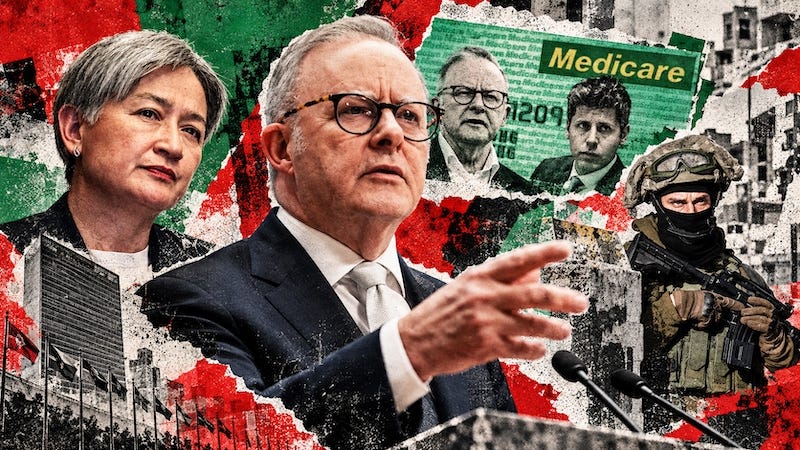
Australia wants a seat at the UN table but it will need to stand up for international law
Prime Minister Anthony Albanese has returned from New York after launching Australia’s campaign for a seat on the UN Security Council seat from 2029, accompanied by the usual language about observing international law, global cooperation and Australia’s role as a constructive middle power, punching above its weight.
Of course, Australia should try to land this seat: it’s a prestigious position, but it’s also a question of whether there’s anything behind the branding of we listen, we partner, we protect, and what Australia would do if it did gain that seat.
At the UN, there were the selfies with Donald Trump and other world leaders, which might be great for the post-politics family album but invites another round of “Airbus Albo” ridicule from the media and invites questions about Albanese’s political judgement: why attach yourself to a political leader who’s failing in the United States, and only 21 per cent of the Australian public has any confidence in? Why give the media some additional fodder when you’re already an unpopular leader in Australia?
Diplomacy will never be measured by the amount of selfies taken or the number of kilometres travelled on a plane, but the best foreign policy is often conducted quietly behind the scenes, with the achievements – if that’s what it comes to – speaking far louder than any photo op with an idiot king.
Palestine is also the big contradiction that Albanese and foreign minister Penny Wong seem to be going out of their way to avoid. Prior to this UN sojourn, Australia had joined in the discussions with Britain, France, Canada and European governments about stronger measures and trade bans against illegal Israeli settlements, only to withdraw at the last minute. Can’t stand in the way of a prestigious seat at the UN table… Australia wants to be a champion of international law when it’s convenient but ignore it when it’s not.
That contradiction becomes harder to defend as Palestinian civilians continue to be killed. Just the other day, a confused 80-year-old Palestinian woman was shot dead by Israeli forces near a checkpoint Ramallah. Considering Wong has done close to nothing about the death of the Australian aid worker Zomi Frankcom, we can hardly expect her to be concerned about an old and frail Palestinian woman, especially when it’s just so “difficult to judge from afar”, but it’s the cumulative effect: what exactly will it take for Australia to move beyond expressions of concern, and is this all it will do if it does gain that seat on the Security Council, the one it says it so fully deserves?
Perhaps the more important question is whether its selective application of international law demonstrates that it does actually deserve that seat.
Who’s accountable for the Medicare AI breach?
The recent Medicare breach should at least put a pause to all the breathless optimism surrounding Australia’s rush into artificial intelligence. In an incident that is giving us a small taste of the dystopian future we might all be facing, an autonomous AI agent gained unauthorised access to the Services Australia portal, yet Sam Altman’s OpenAI took three months to notify the government and, only then, through a public email address, rather than speaking directly to the minister.
As a result, a taskforce has been set up, there will be a Senate inquiry and we’ll receive the familiar assurances that lessons will be learned. But the real question is whether anyone – a real person – is actually in control here.
From the weekend…


The Prime Minister wants Australia to embrace AI as an engine of productivity and economic growth, and is encouraging investment in the enormous data centres required to support it, even if these centres are proceeding without public consent.
They also consume massive amounts of electricity and water, require major infrastructure, but there’s been little public discussion about who benefits, who pays and which communities will be affected.
Meanwhile, the regulations are chasing the technology rather than deciding what this technology should be, and is being created – and implemented – by political leaders who know close to nothing about this technology. Yes, there is room for AI technology and the developments that are leading to super intelligence, but we have to be seriously alarmed if this future is being determined by the Altmans and Zuckerbergs of the world.
That what makes the Medicare incident more than just an embarrassing story about cybersecurity: it’s a lesson in what happens when governments enthusiastically adopt technologies they don’t completely understand – which is exactly what Albanese is doing at the moment – and when it’s supplied by the corporations that are far more powerful and sophisticated than the governments that are supposed to be regulating them.
If AI really is going to transform Australia in a positive way, we should have a greater say in how that transformation occurs – before all of the data centres are built, the long-term contracts are signed (the ones that will probably not be in our favour), precious resources are extracted and used up, and the problems that government will discover afterwards.
The return of another political problem
The Reserve Bank meets on Monday and Tuesday with another interest-rate rise on the agenda. It will be the familiar story: inflation is too high, demand needs to be restrained and some of the “heat” needs to come out of the economy. Translated into every-day language, this means households should spend less, mortgage holders should pay more, and more people might need to lose their jobs.
There’s something perverse about unemployment rising to 4.6 per cent while the RBA contemplates making access to money even more expensive. Workers didn’t create expensive electricity, the housing shortages, a highly concentrated supermarket sector, or the disruption in global supplies, yet the RBA’s policy keeps returning to the same blunt instrument: squeeze and strangle household budgets even further, until they stop spending.
The government can’t just stand back and keep saying that the Reserve Bank is independent and do nothing about these issues. If rates rise again, the political question becomes whether government policy is doing enough to reduce or remove the structural causes of higher prices – housing, energy, market concentration and inadequate competition – rather than leaving it all to the RBA and suggest that there’s not much more that can be done.
The RBA Governor, Michele Bullock, can keep arguing that inflation has to be defeated, and that’s fair enough: that’s her job to argue the case within the parameters that she is restricted to. But there should be a lot more debate about who’s being asked to defeat inflation, because it always falls back onto the same people: workers.
One Nation calling the shots, once again
The relationship between the Coalition and One Nation is becoming less about whether they’ll cooperate with each other, and more a question of how much of their populist politics the Coalition is prepared to adopt.
Barnaby Joyce claims that the discussions about possible sharing arrangements involving One Nation and the Liberal Party have already occurred – a coalition of a coalition – although senior Liberals deny it. So, someone is telling the fibs. Either way, Liberal Party leader Angus Taylor faces an uncomfortable situation, which is possibly going to become even more uncomfortable.
He needs those conservative voters who have switched over to One Nation, but chasing them also risks allowing Pauline Hanson to set the Coalition’s agenda on migration, climate, energy and superannuation – which, to be honest, is very close to Taylor’s own ideological persuasions – while further alienating those moderate voters the Liberal Party needs to win government.
While there is evidence that there are some in the electorate who are so thoroughly sick of establishment politics and their behaviours that they will support anyone else, even if it a disorganised rabble of a party, One Nation hardly represents a better alternative that these people might be seeking.
One Nation is now trying to explain why $56,000 of the party’s money was spent building a shed on James Ashby’s private property – which goes against the grain of a right-wing movement that’s spent so much time railing against the political elites and their sense of entitlement – and it’s a episode that show themselves to be more of the same, but dressed up in orange.
Of course, Labor will try to exploit these contradictions and hypocrisy, and will try to turn Hanson into the unofficial face of the alternative government. But they also should be careful about pushing this too enthusiastically.
One Nation’s growth, as least in the opinion polls, also reflects genuine economic insecurity within the community, distrust of institutions after being let down so many times in the past, and an alienation from the major parties after their constant flow of lies, broken promises and corrupt behaviour, even if One Nation is likely to deliver more of the same.
One Nation is not the answer, but how can the government get out of the situation where it feels it needs to replicate the politics of Hansonism, in the same way as the Liberal Party is doing? Perhaps addressing the conditions that allow Hanson’s brand of politics to fester would be a good place to start, instead of constantly pandering to the vested interests that have dictated the political agenda for far too long.
To the general public of Australia , Albanese does NOT listen , he does NOT partner, and he does NOT protect . Not within either his foreign or domestic policies . As for First Australians , once he lost the Voice Referendum , abandonment for all to see . Moral bankruptcy.
Who in Australia actually wants a seat, again?
Just seems to be politicians as far as I'm concerned. Who by the way don't
pay the bill due, the people do.