


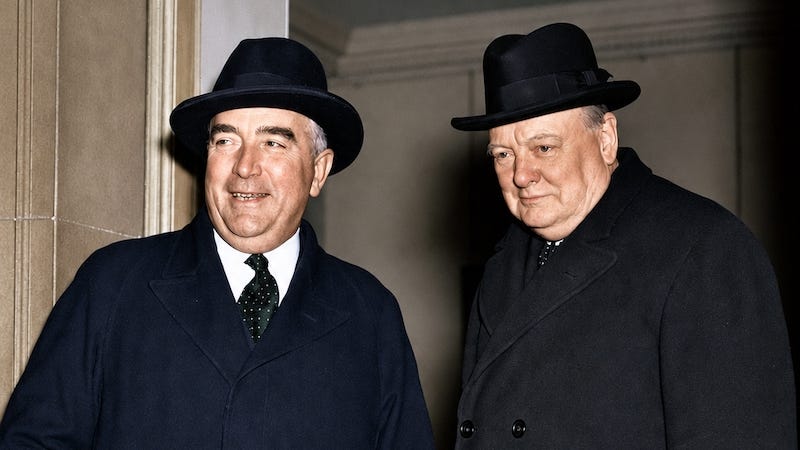
Defence Industry Minister Pat Conroy was right to argue at his National Press Club address that Labor should not surrender patriotism, defence or national security to the conservative side of politics. He was also right that Menzies’ record on appeasement is considerably more complicated than the polished version preserved by the Liberal Party. But once the debate shifted from saying Menzies supported appeasement towards Nazi Germany to describing him as an “appeaser”, and then suggest that he was a “coward”, the historical argument gave way to the standard fare of political theatre. And that’s a distinction that really matters.
Appeasement itself is a judgement about policy. Cowardice is a judgement about character, and in the case of Menzies, it brings up one of the ugliest episodes in Australian parliamentary history.
Conroy’s National Press Club speech wasn’t really about the 1930s, it was meant to be about national security today. By invoking the spirit of Labor leaders from Andrew Fisher to John Curtin, he argued that progressive politics has its own patriotic tradition and that Labor governments have repeatedly defended Australia in moments of crisis. These historical references were intended to strengthen Labor’s contemporary defence credentials, particularly around AUKUS.
That, of course, is a perfectly legitimate political undertaking. But history reconfigured to serve the purposes of current-day politics is often simplified until it becomes a part of a myth. Menzies is particularly vulnerable here, because there are really three versions of him.
Three Menzies, three different legacies
There is the pre-war Menzies: brilliant, ambitious and intellectually formidable, but still finding his political footing. Then there is the post-war Menzies: the founder of the Liberal Party, a builder of modern Australian conservatism and still Australia’s longest-serving prime minister. Then there is the memorial Menzies: the sacred Liberal ancestor, invoked by today’s members whenever the party needs legitimacy or a tradition to lean on.
The third version of Menzies is the one that dominates modern politics, and the Liberal Party is more interested in preserving this part of him, rather than examining his full legacy. But it’s the first Menzies who matters most in this current debate. In 1939, Menzies did support British appeasement towards Nazi Germany – sealed by Conservative Prime Minister Neville Chamberlain’s so-called “peace in our time” declaration. It doesn’t mean he necessarily admired Hitler or wanted Germany to prevail, but it meant that he shared the assumptions of much of the British political establishment, which believed negotiation might preserve peace while the military preparations continued behind the scenes.
Those assumptions also reflected the trauma of the First World War, the weakness of the League of Nations and the widespread fear of yet another European catastrophe, so soon after the previous one. Australian foreign policy remained deeply tied to Britain, and Menzies naturally viewed Australia’s interests through this imperial perspective.
When Germany invaded Poland and Britain declared war in 1939, Menzies announced that Australia was also at war. His famous broadcast reflected this imperial loyalty that was common at the time, but not sympathy for Nazism.
However, his private correspondence reveals that the appeasement thinking lingered after the war had begun. Writing to Stanley Bruce, Australia’s High Commissioner in London at the time, Menzies speculated about possible German peace proposals and questioned whether Britain and France could sustain a prolonged war over Poland. His remark that “nobody really cares a damn about Poland as such” remains a sore point. So too does his suggestion that Britain should not dictate what form of government Germany ought to have. But these comments don’t make Menzies a Nazi sympathiser, rather they show that he continued trying to understand Hitler through conventional diplomacy when events had already demonstrated that Hitler could not be managed by conventional diplomacy.
That is the real historical criticism. There are other areas where Menzies commentary proved to be controversial – in 1938, as Attorney–General, Menzies went on an extended tour of Europe, suggesting that Hitler was “a dreamer, a man with many good ideas”, and observed that there “is a good deal of a real spiritual quality in the willingness of young Germans to devote themselves to the service and well-being of the state”. He also went on to address audiences in Australia by describing as a positive “the exalted and almost spiritual worship of the state by many Germans”, and that he looked forward to a system of democracy where “we can have real discipline and real efficiency and real cooperation”.
This is where Conroy’s argument is strongest when carefully framed, and weakest when exaggerated. Saying Menzies supported appeasement is historically defensible. Suggesting he remained open to negotiation after the invasion of Poland is also defensible. The more accurate statement is also the stronger argument: Menzies supported appeasement, seriously misjudged Hitler’s intentions and entered the war as the loyal leader of a British dominion. That is serious criticism without descending into caricature.
The word “coward”, however, belongs to an entirely different historical argument. The origins lie in one of the most vicious speeches ever delivered in the Commonwealth Parliament. After Prime Minister Joseph Lyons died in April 1939, Earle Page refused to serve under Menzies and launched a deeply personal attack. Rather than criticising Menzies’ policies, Page questioned why he had not served overseas during the First World War., where Menzies had remained in Australia while his brothers enlisted abroad, a decision made within his family.
Page transformed that private decision into a public accusation, suggesting Menzies lacked the courage necessary to lead Australia in another war. The speech horrified Parliament and even Labor members came to Menzies’ defence. And ironically, Page damaged himself far more than his intended target. Before the speech, Menzies was often regarded as brilliant but aloof. Afterwards, he appeared dignified under attack – Page has unintentionally given Menzies something he had previously lacked: public sympathy.
The lessons modern politics refuses to learn
Today’s Labor Party doesn’t need to question Menzies’ courage, as it already possesses a stronger historical case based on his political record. The greater irony is that the real Menzies is far more interesting that the mythical Menzies. The first Menzies ended his term as Prime Minister as an abject failure, suffering the ignominy of losing government from the floor of parliament rather than through an election, ultimately resigning in 1941. Yet it was these failures that the laid the foundations of his post-war success.
The second Menzies learned from defeat: he realised that anti-Labor politics required more than just parliamentary numbers. It needed institutions, a new form of political language, organisation and a social coalition that could withstand the test of time. His famous “Forgotten People” speeches reflected lessons learned through political failure as much as ideological conviction. His authority and influence over Australian politics arrived not because he had never been wrong, but because he understood why he had failed.
That is the greatest lesson that the modern Liberals have forgotten: learning from their failures.
Today’s Liberal Party invokes Menzies constantly while forgetting the qualities that made him successful. Menzies did the hard work of building institutions, rather than slogans. He understood building coalitions within the community was far more important than the politics of grievance.
However, Labor shouldn’t become complacent on all these issues either – it has its own tendency to transform history into political mythology, and is very good at it. John Curtin was undoubtedly one of Australia’s greatest prime ministers, but he also had many flaws and shouldn’t become just a symbol used to legitimise every contemporary defence policy proposed by Labor.
Curtin’s greatness wasn’t based around patriotic rhetoric but in his willingness to rethink Australia’s strategic position when circumstances demanded it. He broke with old assumptions because Australia’s security at the time required independent judgement.
Conroy is right to argue that Labor possesses a serious national security tradition stretching from Fisher and Curtin, through to Chifley, Evatt, Whitlam, Hawke and Keating. Progressive politics has never been incompatible with patriotism, despite what the conservatives want everyone to believe.
But reclaiming that tradition requires more than invoking names from the pages of history. Placing AUKUS within Curtin’s legacy doesn’t suggest AUKUS itself is strategically wise, affordable or genuinely enhances Australia’s sovereignty. However, the left should claim national security by doing what conservatives too often refuse to do: to think historically.
That means understanding alliances without worshipping them, recognising the threats without abandoning independent judgement – as Curtin did during the Second World War – and treating defence policy as part of a broader democratic national project rather than political symbolism.
Menzies deserves criticism, and a lot of it. He supported appeasement, seriously misread and misjudged Hitler and approached the war primarily as an imperial loyalist rather than the leader of an independent Australian nation.
But that isn’t the whole story: he also rebuilt Australian conservatism after a devastating defeat, created the Liberal Party, developed a political language that shaped Australia for a generation, and managed to transform his personal failure into enduring political success.
To acknowledge those achievements is not to endorse his style of politics or his ideology: it’s really a matter of taking history seriously, through the prism of its unvarnished truth. And that is what Australian politics too often refuses to do.
The current controversy initiated by Conroy serves a useful purpose. It reminds us that “coward” is the wrong word to use in the case of Menzies, because it repeats a discredited personal attack dating back to Earle Page. It reminds us that “appeasement” is a serious historical judgement that requires the correct evidence and context. And it reminds us that history becomes most dangerous when political parties transform it into mythology.
Menzies doesn’t need protection from history, as he becomes a far more interesting character when history is allowed to speak honestly, even if he’s not valued highly from the perspective of the left. What we know is that the first Menzies failed, and the second Menzies learned from that failure. The memorial Menzies teaches us almost nothing. That is the Menzies we are too often prevented from remembering – not because the facts are hidden, but because the myth is politically more useful.
Labor’s task isn’t to replace one myth with another. It’s to do something much rarer in Australian politics: tell the truth carefully.
Much rarer in *any* politics, I’d say. Well said!
Really enjoyed the History lesson on Menzies, hopefully Labor can learn from history and turnaround from our blind trust in the USA as a caring Ally
Thank you Peace be with you