


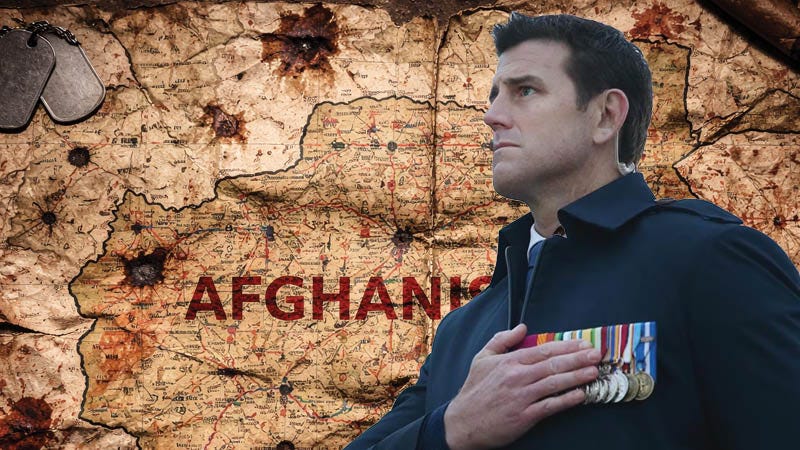
The arrest and charging of Ben Roberts-Smith on five counts of war crimes has exposed yet another schism within Australian politics, and it reveals just how quickly the principles of justice can be thrown away when placed against nationalism, power and myth. The response from prominent conservative figures has ignored the seriousness of these allegations – the unlawful killing of Afghan civilians – and has focused on defending the reputation of a decorated soldier, at the expense of the rule of law itself.
Figures such as Pauline Hanson and Gina Rinehart – a mining magnate who really should have no role in political life – have publicly questioned and condemned the charges, while media proprietor Kerry Stokes – who financially backed Roberts-Smith’s failed defamation cases to the tune of $30 million – is using his substantial media assets to push for his innocence. What’s emerging from these responses is not a careful assessment of the available evidence, but a knee-jerk defence of Australia’s war symbolism and jingoism.
The legal reality of this case should be very straightforward: Roberts-Smith, like any other accused person, is entitled to the presumption of innocence and a fair trial, and that’s exactly what he’ll receive. The charges against him will be tested in a criminal court, where the burden of proof will be high and the consequences will be announced by a judge, if he’s found guilty. In other words, it will just like any other case that runs through the Australian courts, every single day.
The nature of these allegations is also important. It’s not a question of split-second decisions made in the chaos of combat – the so-called “fog of war” – where tragic mistakes can occur. Instead, the list of accusations includes deliberate acts of violence, including the alleged execution of detainees and the practice known as “blooding”, where junior soldiers are ordered by their superiors to kill prisoners. These claims, supported by testimony from fellow soldiers, go to the heart of military ethics and discipline: all is not fair in love and war, and murder – by any other name – is still murder, irrespective of where it might happen in the world.
The fact that members of Roberts-Smith’s own regiment came forward is particularly significant in a culture that’s often characterised by loyalty, silence and subservience to rank, suggesting a level of concern that goes far beyond what could be assumed to be internal disagreements or personality conflicts.
The political defence of Roberts-Smith by conservative figures also reveals a deeper issue with accountability. For some, the idea that a recipient of the Victoria Cross – the nation’s highest military honour – could be implicated in war crimes is simply inconceivable, especially when placed next to that Anzac narrative that has come to dominate Australian identity for well over 100 years.
This narrative, propped up by Bob Hawke in the 1980s, and supercharged during the Howard era, has elevated military service to an unrealistic level of national virtue. To then acknowledge any form of wrongdoing within this narrative is regarded as sacrosanct by conservatives and is seen as a huge blow to national pride. Yet this is precisely why accountability in this case matters: if the law is not going to be applied equally, then it stops functioning as the law.
There are also the usual racist undertones in this reaction from conservatives, particularly in the indifference shown towards the victims. The Afghan civilians at the centre of these charges are totally absent from the rhetoric of the defenders of Roberts-Smith, always navigating back to his status as a “war hero” and national figure. And they are so absent that we’ve barely heard their names before: they are Ali Jan, a farmer and father from the village of Darwan; Ahmadullah, a man with a prosthetic leg – the same leg Roberts-Smith used as a trophy to drink alcohol from; Mohammed Essa, the father of Ahmadullah; an unnamed elderly man; and another unnamed detainee in Chinartu.
It also sets up that partition between whose lives are really valued – our own Anglo-heroes – and whose suffering is deemed irrelevant and easily ignored – barely known people on the other side of the world, with a different coloured skin, culture and language.
What should also not be forgotten in this case is the profound contradiction in the Australian justice system. David McBride, the former military lawyer whose disclosures helped bring allegations of war crimes committed by Roberts-Smith to light, is currently serving a five-year prison sentence for leaking classified information, despite acting in what he has consistently argued was in the public interest.
His relatively quick prosecution – and Australia’s constant pursuit of whistleblowers – is in contrast to the slow process of holding alleged perpetrators of war crimes to account. The message this sends should be highly concerning to the Australian community: exposing wrongdoing is punished more swiftly and severely than actually committing the wrongdoing. There’s also that long tradition of Australia glossing over war crimes and accepting war criminals, as was so clearly documented in Mark Aaron’s concise publication on this issue, War Criminals Welcome: Australia, a Sanctuary for Fugitive War Criminals Since 1945.
The role of government in this situation should also not be ignored. The Attorney-General at the time, Mark Dreyfus, had the authority to intervene in cases like McBride’s, but declined to do so, an action continued by his successor, Michelle Rowland. This reluctance reflects a broader pattern where national security considerations – however flimsy – are prioritised over transparency and accountability, even when the serious allegations of misconduct are involved, and it’s a position that risks undermining public trust in both the legal system and democratic institutions.
Beyond the immediate legal and political implications, the Roberts-Smith case should also force a stronger debate about Australia’s broader military engagements and whose interests they serve. From Vietnam in the 1960s, to Iraq and Afghanistan in the 21st century, Australia has repeatedly aligned itself with United States-led conflicts, often with limited public debate and without much scrutiny.
The consequences of these decisions include lives lost in other countries, communities destroyed and, as the case of Roberts-Smith suggests, potential war crimes and violations of international law. The question is not only about whether individual soldiers should be held to account, but whether the political decisions that place them in these situations are themselves subject to adequate scrutiny. That’s not to excuse the allegations against Roberts-Smith but, perhaps, he shouldn’t have been in Afghanistan in the first place.
Then, there is the question of national character. A mature democracy doesn’t try to shield itself from the uncomfortable truth; it confronts it head on. That willingness to investigate, prosecute and, if necessary, convict those accused of serious crimes – even when they are celebrated figures – shouldn’t be seen as a sign of weakness, but a sign of strength. It reaffirms that the rule of law doesn’t depend on the medallions that someone pins on their chest, but is applied equally, and that no individual is above it.
The outcome of Roberts-Smith’s criminal trial will ultimately be determined in court – and we assume, a jury chosen from the public – and this is as it should be. But there’s a greater test that’s already going on in the background. It lies in whether Australia chooses to uphold the principles it claims to defend, or whether it allows myth, power and political expediency to override justice. So far, it’s upholding those principles when it comes to Roberts-Smith – if not to David McBride – but the case itself will be test of how far Australia is prepared to hold itself to account.
An excruciating & demoralising but necessary read: thankyou for restoring names to victims, for analysing & critiquing the hypocritical addiction to war/hero/martyr mythologies, and for your telling comparisons between the framing and treatment of whisteblowers versus war criminals.
The upcoming book "Challenging Anzac" designates a chapter to Roberts-Smith and the themes highlighted in this article. Are we really surprised where critiquing the ANZAC legend is considered sacrosanct that prominent members of our society are willing to defend Roberts-Smith, even after being found on the balance of probabilities to be a murderer.