


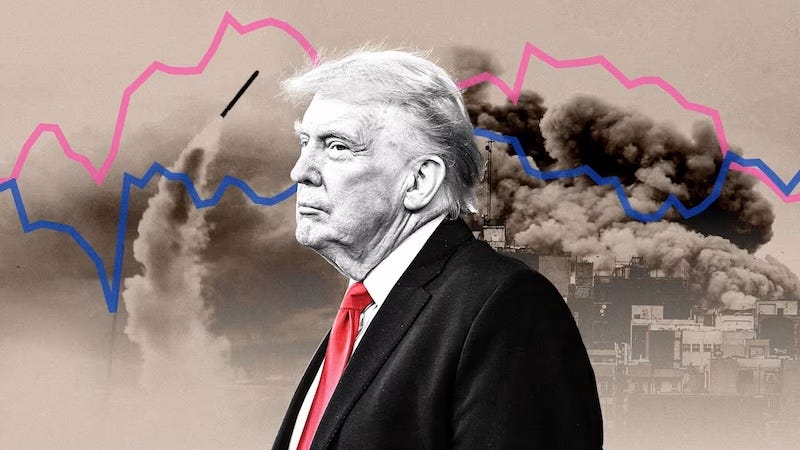
What is unfolding in Iran isn’t just another regional conflict – history is filled with conflicts that began with limited or ambiguous aims, only to spiral out of control and into crises that ending up reorganising the global order. From the outbreak of the World War I – triggered by a petty accusations in parts of Europe and the one shot from a radicalised activist in Sarajevo, but sustained by drawing in different allies and a litany of strategic mistakes – to the long, grinding war Vietnam, modern warfare has repeatedly demonstrated how the absence of clear political objectives can produce outcomes far beyond the intentions of those who initiate the conflict.
The attacks by the United States and Israel on Iran have been framed by President Donald Trump as a move toward “stability”, but their consequences sound very similar to these earlier examples of diplomatic disorder and regional power games. Rather than containing the risk – which is what competent leaders should be able to do – the United States has intensified it, creating shocks throughout energy markets, supply chains and international economies. The world’s major economic blocs – the North America, China and Europe – now find themselves exposed to a crisis that should have been avoidable, but also repeats the many mistakes of the past.
The most immediate effect this time around has been disruption to global energy markets, a pattern seen repeatedly in modern history. The 1973 oil crisis, when the Gulf States punished the US and the Western world for supporting Israel in the Yom Kippur War, demonstrated how political problems in the Middle East can create supply shocks, and cause a serious economic crisis, and the attacks on oil infrastructure and shipping lanes during the Iran–Iraq War in the 1980s also destabilised global supply chains in a similar way. Today, the Strait of Hormuz – where roughly a fifth of the world’s oil supply passes through and just off the western coast of Iran – is providing yet another example of how a crisis in the Middle East can have major effects throughout the global economy.
For countries such as Australia which are heavily dependent on imported refined fuel and are firmly integrated into global supply chains, these shocks will be felt severely, with the onset of higher petrol prices, higher production costs and inflation. And this is how geopolitical miscalculations cause everyday economic pain – rising energy costs push up transport and manufacturing expenses; in turn, businesses will pass these costs onto consumers; inflation picks up; and institutions like the Reserve Bank respond by tightening up monetary policy. The term “stagflation” was a big part of the economic discussions during the 1970s, and there’s been whispers of it making an unwanted comeback – a stagnation in economic growth and a stubborn inflation that’s difficult to reverse once it sets in.
What makes the current situation particularly dangerous is not just the economic shocks, but the absence of a clearly defined strategic objective. Military generals and political leaders do study classical strategic theory (or, at least, they should) – Sun Tzu and Carl von Clausewitz for example – and war, in this sense, is understood as a continuation of politics by other means. In other words, it needs to serve a political end – Sun Tzu felt that the better leaders avoided war altogether but, if it cannot not be avoided, then it has to fit into political goals. But it’s just so hard to see what the political goals are for the United States – there might the Christo–fascist–Zionist–religious–ideological goals but, politically, it’s not so evident.
Without a defined endgame, the engagement and escalation of war risks becoming a self-perpetuating action that’s difficult to get out of, as was evident in both Vietnam and the post-2001 conflicts in the Iraq and Afghanistan, where ambitious wars based on ideology and retribution failed to achieve anything of note, except for more death and misery for the local communities.
The United States is the world’s largest energy producers, and it appears less vulnerable to supply disruptions than in previous decades. Yet history shows that global energy markets operate beyond the control of the United States. During these times of war and disruption in the Middle East, even countries with significant domestic production have been affected by global price shocks – oil is a globally traded commodity, and price volatility seems to go way past the borders of countries, regardless of their ability to produce and refine the product.
For Western allies – who might now be reconsidering their relationships with the United States – the effects on their economies are going to be even more disastrous. The economies of Europe, still dealing with the long-term consequences of their debt crisis and the energy disruptions following Russia’s invasion of Ukraine, will face further pressures from the rising cost of oil and energy. Asian economies, intrinsically linked into global manufacturing networks, are very vulnerable to disruptions in shipping routes and the flow of commodities. Australia, with its limited domestic refining capacity and high reliance on imported oil, sits right in the middle of this vulnerability, and is likely to suffer a world of economic pain over the coming months.
And this is primarily because the United States is led by a President who is too busy immersing himself in the books of The Art of The Deal, than flicking through the literature of wisdom by Sun Tzu and von Clausewitz to guide him though this calamitous and foolish war.
Historically, even the most controversial and misguided military campaigns have been justified within a defined strategic framework, however flawed. The Cold War, for example, operated under the doctrine of containment – a clear, if highly contentious, principle guiding US foreign policy for decades. In contrast, the present situation suggests not a coherent doctrine, but a game of roulette, hoping for the right numbers to appear when the wheel stops spinning. But they never will.
