


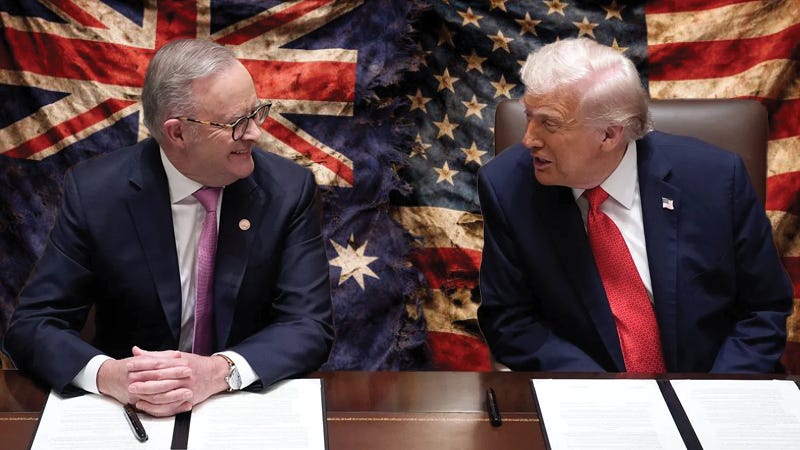
The optics in the Oval Office were carefully managed and staged; there were the big smiles, the warm handshakes, flattery and “mateship” exchanged in spades and, of course, a big cinema-style promotional video to go with it after it was all over. This was the first official meeting between US President Donald Trump and Prime Minister Anthony Albanese, where he was welcomed as a “friend” and praised for the $13 billion deal on rare earths and critical minerals. The language was very comforting and saccharine to the point of boredom, but it was what not said that that mattered the most – the health of democracy in the United States – and all the other issues that are always the ones that are assumed to be beyond question.
At the same moment that this meeting in late October was being pushed forward as a diplomatic triumph, the United States was undergoing a major institutional crisis. Economically and militarily, it’s still the most powerful country in the world – for the time being – but institutionally and democratically, it’s showing all the visible signs of decay. Trump’s return to the White House has been accompanied by sweeping tariffs, erratic trade policy, mass deportations and arrests by ICE, travel bans and the steady erosion of civil and human rights. And they’ve happened very quickly too: these are the big existential issues that any country that claims to share values with the United States should be alarmed about, yet they barely rated a mention in Australia’s politic elite and mainstream media.
Instead, the big political and media obsession throughout most of the year was all about whether Albanese could secure a meeting with Trump at all, and when it would happen, playing out like a strange will-he-won’t-he celebrity dating game, with breathless speculation and over-the-top sighs of relief once the meeting finally went ahead.
It was then treated like a diplomatic coup in its own right, like the meeting with a majestic king, as if the simple act of being accorded an audience with unstable president was a massive strategic success. But this was all a sideshow: the substance of the relationship was barely questioned, and the terms of the deals, their long-term implications, and how they are in Australia’s national interest were barely analysed.
There’s no dispute that Australia benefits from having a good working relationship with the United States, as it would with any other major power in the world. But it’s equally undeniable that the relationship is very one-sided. Agreements on rare earths, critical minerals and defence co-operation overwhelmingly serve US strategic and economic interests, not ours. And it seems that Australia supplies everything – including political lap-dog loyalty – while it’s the United States that accumulates all the advantages.
At a time when the US presidency has become volatile and unpredictable, Australia should at least be asking how it protects itself from a partner whose leader changes decisions at whim, and then sometimes goes back to the choices that he previously rejected. It should be asking whether a deeper engagement with Asia, Europe and the Global South might provide a counterweight against the continuing instability in the United States. It should be debating how to develop a genuinely independent foreign policy rather than genuflecting at the altar of the United States: instead, Australia doubled down.
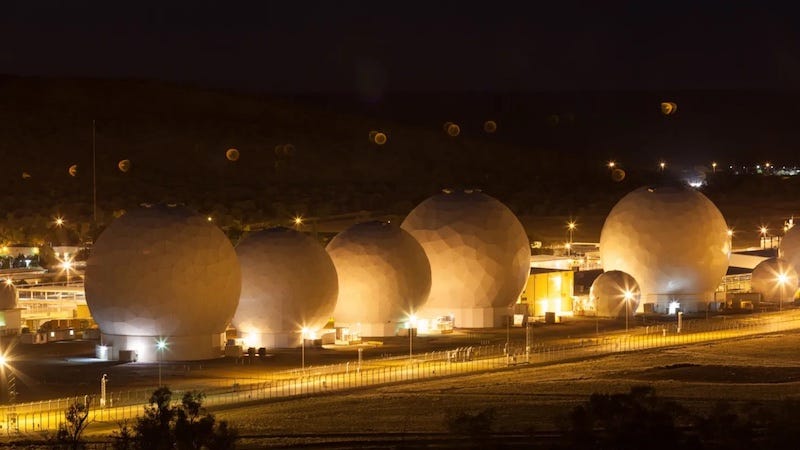
Of course, this isn’t a new development: the US–Australia relationship has always had an opacity that clouds the key issues and creates a smokescreen, rather than provide any clarity. Australians still can’t be told why Pine Gap, a massive security installation in the middle of the country, remains effectively off-limits to Australian scrutiny. There are many other moments in the history of the alliance where Australia could have negotiated harder and chose not to – this Trump era has just exposed this habit and shown it to be more of the same.
Trump himself is the one who makes any analysis more complicated: he’s widely regarded as a capricious and incompetent leader, yet he occupies the most powerful political position in the world. That contradiction is precisely where smaller allies might have some leverage but Australia, in this case, has not attempted to use it. This can’t be because its leaders are inexperienced: Albanese is neither stupid nor politically naïve, having risen through the hard-nosed factional politics of the Labor Party and has survived mainly because he is capable of clever political calculations and smart moves. That makes Australia’s passivity all the more puzzling.
Perhaps this compliance is act of performative politics: allowing Trump to believe he has secured a “great deal”, keeping relations smooth in the hope of something larger down the track. If that’s the strategy, there’s little evidence of what that “something larger” might be. What is more obvious instead is a government that’s happy to make the offer of gifts – or the appearance of gifts – to a volatile leader who needs to have his enormous ego massaged at all times.
The media’s fixation and obsession on whether Albanese was going to offend Trump, embarrass himself, or fail to flatter Trump enough also bordered on the absurd. Sure, he is the president of the world’s most powerful country, but he’s a leader who prefers unquestioning loyalty, particularly from men, and that he has little tolerance for dissent or independence. Being close to such a figure shouldn’t be a badge of honour yet in Australia’s political and media culture, it was sold as exactly that.
The US–Australia alliance does remains intact, but it increasingly exists as a theatrical performance, rather than a strategy benefit for Australia, and it’s rarely questioned, even though the costs and risks are quietly building up.
Sovereignty in name only
Australia loves the language of “sovereign choice” in foreign policy, and we always say it with a straight face: independent decisions, national interests, freedom to navigate our own course, and so on. But the moment you ask the questions about Pine Gap, or AUKUS, or this critical minerals deal, it’s a choice that doesn’t appear to be so free after all. How free are the choices we’re making when so much of the architecture underneath the alliance is largely insulated and turned away from public scrutiny?
Pine Gap is the clearest example of this. A highly secretive satellite surveillance and intelligence facility on the outskirts of Alice Springs, it’s deeply integrated into US military operations and intelligence gathering across the world. And yet, for everything that this implies, it exists in a political void: no debate, little transparency, and almost no mainstream willingness to ask the most basic democratic question – who ultimately controls what happens there, and to what end? Australians are expected to accept that it’s “necessary,” that it keeps us “safe”, that the details are “too sensitive”, and that the alliance depends on it.
And now we have the critical minerals agreement as a part of this arrangement. There’s billions in joint investment, Australia is supplying rare earths and critical minerals that feed directly into the industrial needs of the United States: weapons systems, batteries, advanced manufacturing, the strategic supply chain that Washington has decided it needs to control in an era of great-power rivalry with China. It’s being presented as a win–win situation but the strategic benefit is overwhelmingly in the favour of the United States. Australia’s role is to provide the inputs – resources, access, reliability – while the US converts that into capability, leverage, and the projection of power.
If Australia was to negotiate hard – really hard – Pine Gap and our mineral reserves would be the strong bargaining chips, not in a crude, Trumpian transactional way, but as part of a mature relationship between sovereign states: what do we get in exchange for hosting a facility so central to US operations? What guarantees do we have about how our resources are used – in war zones, for example – how to value add, where do the jobs sit in this supply chain, and what obligations will the US take on when its own politics becomes too unstable for Australian interests?
This is where the relationship begins to look less like strategy and more like stakeholder management and damage control. A country such as Australia has to keep one superpower satisfied – the US – so it can preserve a functional economic relationship with another, in this case, China. It’s a narrow window though: feed Washington enough to prevent retaliation, provide different signals to Beijing so that the lucrative supply of trad doesn’t collapse, and hope neither side forces a real choice. If that’s the logic, then the “deal” is not about Australia winning anything: it’s more about Australia managing risk in a world where it lacks the confidence – or the authority – to act in a truly independent way.
The real cost to Australia’s relationship isn’t only measured in money, or even in true independence: it’s measured in regional credibility. The more Australia is perceived as an extension of the United States – a de facto 51st state – the more it raises doubts in the countries whose trust we actually need on a day-to-day basis: Indonesia, South Korea, and smaller regional states that watch the behaviour of great powers with a close eye.
China, for all the real and imagined tension that’s pushed by the mainstream media and conservative politicians, is an intelligent strategic actor, as it has been for thousands of years. It can separate the chaff from the class, can play the waiting game and assumes that Australia will do what it always does – talks and asserts independence but, in reality, practises dependence. But in South-east Asia, where the historical memory of Western power and colonial influence still runs deep, the optics of this close Australian alignment with the United States can be corrosive. It feeds into that narrative – sometimes encouraged by domestic players within those countries – that Australia is a Western tool, a deputy sheriff of the US, and offers a platform for the agenda of other countries.
And that’s the ultimate contradiction of this relationship: a solid source of security with the United States can become a strategic millstone around the neck. The alliance might be absolutely necessary, and it might be delivering some advantages to Australia. But when it’s treated as something that we can never question or debate, we have to wonder what the real value to Australia actually is. And in this situation, Australia isn’t really choosing its own positions, but having decisions made for it, engaging in performative politics, and trying to live within those limitations that have been imposed upon it.
I think this commentary is mostly baloney. Yes the USA is a big problem in many ways and I do not believe we can trust it to act rationally and morally. Still the salient point is that its interests align with ours. It is a natural ally now as it was in the 1940s when Japan was a threat to both the USA and Australia.
The USA has certainly never been unfriendly to Australia. We really do not want to find out what it might mean to "find our security in Asia" as some people keep saying if the USA gave up the west Pacific to China's sphere of interest. The fact that the USA invests in defence assets in Australia is the best assurance that they need us just as we need them - probably the best basis for an alliance that there could be.
I suspect Albanese's aims included making America more dependant on us for essential resources, attracting investment for processing minerals here, while avoiding a current diplomatic stoush.
In other words, it was crisis management, based on the truth that Trump will only be around for 3 more years, and there will be life after Trump.