


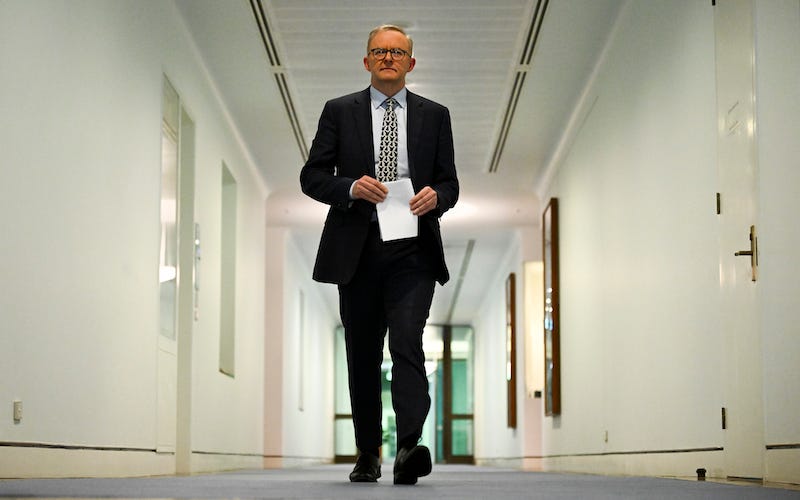
First of all: Thank you to all of our supporters and subscribers throughout the year, we cannot produce New Politics without your support. We wish everyone all the best for 2026 and beyond – even to our most ardent detractors and fiercest critics. We always have to channel the spirit of the 1914 Christmas Truce to remind ourselves that despite the differences that do exist in the world, we always need to find ways to resolve issues collectively. It can be done.
After its emphatic victory at the 2025 federal election, the Labor government finished the year in a position of overwhelming political dominance. Numerically and psychologically, it held all the advantages that any government could reasonably wish for. The parliamentary numbers clearly show this: there were so many Labor MPs – 94 – filling the chamber in the House of Representatives that members were forced to spill over onto the opposition benches, just to be able to sit down. It’s a reminder to the Liberal Party every time Parliament sits – it’s the Labor Party that has all the power, the authority and the electoral momentum – and, on paper at least or visually in Parliament, it’s a government that should be governing with a high level of confidence, and it’s not unreasonable to assume that it’s very well placed to secure another term, whenever the next election is held.
But despite its massive numerical advantage in Parliament, the central problem that defined Labor’s year was not the lack of authority, but a failure to translate that authority into decisive action. The government continued to govern as though it was in a fragile position, avoiding political risk and perpetually being anxious about a backlash, irrespective of where it might come from. There must be a confidence that exists within the Prime Minister, Anthony Albanese, on a personal level – how could there not be after winning the most comprehensive second-term election victory ever – but it’s just not evident in the performance and actions of this government. This is a government that is in a confident position, but not displaying much of that confidence.
What we can see instead is that familiar pattern of Albanese’s caution and compromise, highlighted by an ongoing and unhealthy attachment to bipartisanship with a rabble of a Coalition that now holds just 42 seats in parliament and is hopelessly divided. Throughout the year, Labor continued to behave as though a consensus with the Coalition was both necessary and a political virtue – and far more preferable to making deals with the Australian Greens – even when it’s been repeatedly demonstrated that this kind of goodwill is rarely reciprocated.
Whenever the Coalition holds office, it shows little interest in accommodating the wishes of Labor, treating it with open hostility and using the power of government to further its ideological objectives. In opposition, the Coalition has offered little in the way of constructive policy engagement, instead defaulting to the culture wars and division for its own sake, especially in the earlier parts of the year when Peter Dutton was the leader. Despite this, Labor remained deeply averse to being portrayed as reckless or radical, even as the political fortunes have shifted in its favour so decisively. And it’s this fear of negative framing that seems to be holding back the Labor government from using the massive opportunity that’s been provided to it by the Australian electorate.
There is a widely-held assumption in politics that the second year of a government’s term is when the more substantial change begins to materialise, when long-promised reforms begin to appear, and the type of policy changes demanded by the base of a party finally start to arrive. It’s certainly what the Howard government did in 1997, 2002 and 2005, and, in a system that has a three-year political cycle, it’s usually the middle year where these changes are bedded down, allowing the final year of a term to see these changes bear electoral fruit, just in time for the next election.
But it doesn’t happen by default – policies don’t just automatically appear out of thin air – they need to be actively created, argued for and forced through. Throughout 2025, Labor often appeared to be waiting rather than leading, happy to assume that the Coalition’s ongoing disarray would continue indefinitely, and that no credible alternative would emerge to challenge its dominance. For sure, this is what eventuated at the May election, and it’s fair to say that perhaps even Labor was surprised at the size of its comprehensive victory.
But political vacuums rarely remain empty for too long, and political parties that appear broken – such as the Liberal Party – can recover, sometimes it happens quickly under the right leadership and the right circumstances. New political alliances can also arise, reshaping the electoral landscape in ways that we can’t predict. While the prospect of teal independents consolidating into a formal party remains unlikely, such a development would instantly alter the political landscape, and create challenges not only for the Liberal Party, but for the Labor government as well. A demoralised and fragmented opposition is one thing; but an organised, well-funded and strategically competent alternative is something completely different. We’re not suggesting that this will happen, but there’s always a potential for it to happen.


Complacency has undone governments before, perhaps the best recent examples of this are the final terms of the Labor government after 1993, and the Coalition after 2004, when both of these long-term governments were expected to govern indefinitely, only to be turfed out in the subsequent elections. Labor itself was once written off as electorally irrelevant in the mid-1960s – similar to the way the Liberal Party is being written off at the moment – until a single figure by the name of Gough Whitlam emerged from the backbench and transformed the party’s fortunes.
This is an ongoing lesson of political history: the dominance that exists today can never be guaranteed tomorrow, and it’s always best to go for the maximum that can be achieved, while the power to do so is held. Political confidence that isn’t matched with a conviction, a grand ambition and bold action, can quickly fade into vulnerability, and this is something that the Labor government was veering towards during 2024. As we now know, this vulnerability didn’t cost Albanese at all, and the results are there for everyone to see – a massive 94 seat-victory out of the 150 seats on offer – but the big question will be whether the Labor government can now use the power that it has been granted by the electorate in a far better manner than it has displayed so far.
Waiting for the big bang that might not arrive
This end of year period always has to provide us with some optimism for the future – it’s the festive season for most people throughout Australia, it’s a time of goodwill and many of us wish each other all the best for the upcoming year, irrespective of which field we might come from, and who we might be offering those wishes to.
So, it is a bit harsh to be grumbling at this time of the year, but as this year comes to an end, it’s not clear what the Labor government is planning to do in 2026 – the famed “second-year” of the parliamentary term – and there isn’t a sense of the direction that we’re all going in. Nothing concrete has been outlined about what the government intends to do next year and that long-held belief that the second year of a term is when a government unleashes its boldest reforms is increasingly looking less like a plan and more like a comfortable political myth that will become true, only if we can all believe in it.
Of course, the role of government is to provide stability and competence, but simply continuing with the failed neoliberalist policies of the Coalition and stabilising those isn’t enough. Otherwise, what is the point of a Labor government if all it’s going to be is a placeholder that continues with the same, provides ministerial positions and employment for staffers, and not implement a true Labor agenda?
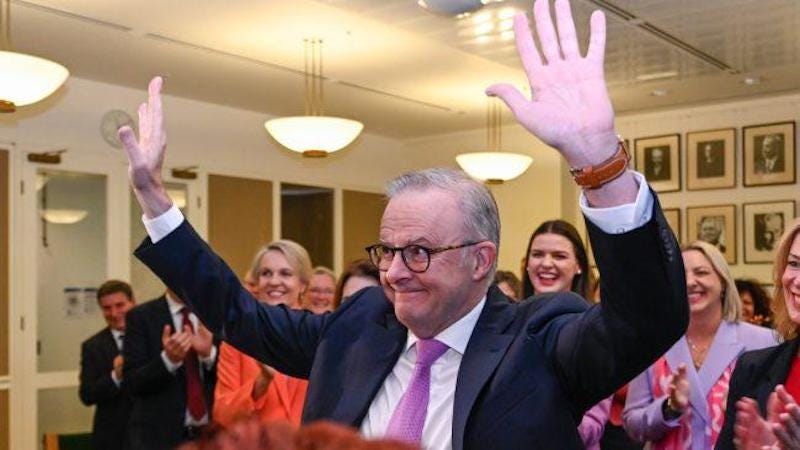
Recent history should temper expectations of the second-year big bang in policy reform. In 2023, the second year of Labor’s first term, significant things did happen, but few could be described as unqualified successes. The Voice to Parliament referendum failed decisively, exposing not only political miscalculation but a lack of preparation for the defeat. The National Anti-Corruption Commission was delivered after great anticipation and fanfare, only to be deeply disappointing in practice, led by a severely compromised Commissioner in Paul Brereton, who was unwilling to confront the very power the Commission was meant to scrutinise.
The Robodebt Royal Commission was an excellent one and laid bare possibly the most egregious abuses of executive authority in modern Australian history, yet there haven’t been any prosecutions arising from this scandal, reinforcing the sense that accountability remains a choice to be avoided for those who sit at the top of the political tree. Adding insult to the injury, Labor itself has adopted policies that are similar to the punitive mechanism of Robodebt – sure, they might not be as severe – but it has thrown away most of the moral advantage that the government held on this issue.
If 2026 is to be the “big, bold” year that supporters are expecting – and the electorate – there is a real risk it will be repeat of 2023: a year in which there was a lot of political activity but it was mistaken for achievement, and just instigating these processes was considered to be a sign of progress when there wasn’t much at all. Across climate policy, housing affordability, integrity and social policy, the movement has been slow, incremental and cautious, the same attributes that Albanese has carefully curated for his own political personality. While it’s always possible that this will change, past behaviour offers little reason for confidence. Governments always reveal who they really are early – Hawke, Howard, Rudd, Abbott, Morrison – and don’t suddenly reinvent themselves midway through a term.
While it might not be so obvious to the electorate, some of this inertia is highlighted through Labor’s uneasy relationship with the Australian Greens. In his recent Quarterly Essay, ‘The Good Fight: What Does Labor Stand For?’, the former Labor staffer Sean Kelly suggested that Labor sees a reflection of itself through the Greens, as though there has been a de facto split within the party, and can see what they could be, if only they could be less constrained and less fearful – even if we do take into account that there are far more responsibilities of government, compared to that of a minor party that can make much as much noise at possible from the sidelines, without ever having to worry about implementing their own policies directly into legislation.
There seems to be an implicit recognition that many of the Greens’ positions sit neatly within Labor’s own historical background, certainly on the left of the party, particularly on climate, social justice and economic equity. Yet rather than embrace this confluence and accommodate the areas where there are the shared ideas, Labor appears to be very keen to distance itself from the Greens, fearing that becoming too close ideologically would result in electoral punishment at the next election. Perhaps this might be performative, such as when many within the Labor Party, including the Prime Minister, frequently disparage “the Greens political party”, as if to suggest that Labor itself is somehow not a political party at all, and never gets itself involved in the game of politics.
On issues that affect the entire community, there is a strong case for deeper co-operation – as there was on the long-stalled environmental legislation that was passed towards the end of the year – rather than constant differentiation between the two parties, which often results in the Labor government preferring to negotiate legislation with the Coalition. Whether such co-operation with the Greens will materialise in 2026 is doubtful, but it remains one of the few pathways through which Labor could meaningfully push forward reform without soiling its political identity, because it’s certainly not going to get approval for policies that the Coalition considers are antithetical to its own ideology.
Again, to be fair – after all, we have just started off on the holiday period – there is a broader sense of fatigue hanging over the year just gone. But, despite 2025 feeling like it has been unusually long – and we did check, it had the same amount of days as every other year that has preceded it – there are still two more full years to go before the next election. Of course, politics can move far quicker than governments expect – there’s always the events that interfere with the rhythms of the political cycle, circumstances change, and assumptions also have to change when new facts arrive on the scene.
We also have to see how the disturbing politicisation of the Bondi massacre in December plays out, and it’s evident that the Liberal Party – egged on by the conservative and extremist elements of Zionist groups in Australia – will prise this issue open as much as possible, just at a time when more sensible heads need to prevail. It is unfortunate, but we have to remember that the Liberal Party is a party of right-wing opportunists and, in the absence of policies and in electoral dire straits, it will grab any issue for political leverage, even if it’s a national tragedy and using people’s grief to gain that leverage, or if it needs to act at the behest of a foreign government, in this case, the state of Israel.
It’s a cliché, but a week is a long time in politics. Power can sometimes be a façade, egos in politics are fragile, and what appears to be certainty can sometimes just be an illusion. And the political fortunes can change very quickly and when we least expect them to change. The Labor government enters 2026 in a position of strength, but history is littered with governments that misunderstood what that strength meant, and either misused that power, or fell into a heap of complacency. What happens next will depend less on what Labor hopes will happen, and more on whether it decides to act in a far more coherent and assertive manner that its parliamentary dominance suggests.


What if Labor Cabinet is in fact doing everything it wants to? What if Albo, Marles, Wong all in fact willingly support arming and subsidizing and hosting the Z10n1 Nakba and US invasions? What if Plibersek was the exception to the rule, by appearing to be actually interested in ecological protections, and so not given any power to protect them, and then replaced by Watts, who openly prioritizes fossil fuels above the sacred duty of his democratic portfolio (with only token protection of forests because they absolutely had to)? What if all this Labor sh1tfu34ery is not situational or temporary, but rather the dominant Party theme, long demonstrating itself to be almost as authoritarian, polluting, imperialist, and anti-Palestinian as the Lib-Nats, yet constantly allowed to get away with it, just because they're not 'as bad'? What if Labor Ministers' behavior over the decades has mostly demonstrated (there are worthy exceptions!) a commitment to harmful profiteering over good governance? Labor is not decency's mate any more, but The Greens still are.
Nice summary, Eddy.
There is so much to unpack here with respect to the tepid agenda and character of this version of the ALP.
But to focus on just one aspect, if Albanese thinks he’s being smart by occupying conservative territory and thereby marginalising the LNP, we are all in for a very nasty shock when the Right seizes its only recourse with the type of grotesque populism and culture wars we see elsewhere, most notably the US. Murdoch and co are egging this on because it suits their business model and we’ve already seen the players in the LNP migrating further to the fringe and ONA. The Trump administration has made no secret that it is willing to fund White grievance groups and sow discord and given the established pathways of influence that flow this way from Washington, it is a very concerning prospect.
All the best for ‘26 and keep up the excellent work.