



Throughout the year, political journalism in Australia’s mainstream media continued to move away from its role of holding power to account, and closer to the role of public relations for conservative interests. That relationship between politics and the media has always been problematic, shaped by “mateship” and relationships, who gets the access and who is left behind and given the cone of silence. Sure, we can argue that it’s always been like this, but it’s a situation that’s getting worse with each year that goes by.
Far too often, stories from media outlets are created to accommodate the narratives politicians want to tell, not a test of whether those narratives are true or not. This kind of journalism is stenography: just repeating of the official lines from government – and more often than not, the opposition – and it’s a narrative that’s rarely challenged.
And it’s a stenography that exists as a form of censorship, where repeating what the government has said – rather than interrogating and interpreting what they’ve said – means that the access for that journalist to ministers continues, and the dissenting media voices that are considered to be too inconvenient or too controversial, are quietly excluded and managed away. And this exclusion means the public is left with a narrow version of reality, one that provides cover for those in power, and marginalises those who interrogate this power.
A clear example of this occurred in October, when the National Press Club cancelled a speech by the US Pulitzer Prize-winning journalist Chris Hedges, who was scheduled to speak about the conduct of the mainstream media in relation to the killing of Palestinian journalists by the state of Israel – an issue which has enormous significance, not only for journalists but for anyone who is concerned with press freedom and how Israel is silencing the truth.
While it seemed like a strange decision to initially schedule Hedges, and then quickly retract the invitation, the decision was made even worse – and more obvious – when it was revealed that the National Press Club is sponsored by major global military corporations who are also providing military hardware and software directly to Israel. And while the National Press Club didn’t say much more about this, and even lied about Hedges being scheduled to speak in the first place, the message was clear: certain topics – especially when it comes to Israel – and certain critics, threaten the relationships that the mainstream media is just not willing to jeopardise.
The implications of this cancellation are immense. When the media refuses to host or seriously engage with criticism of power – particularly in those matters that involve war, state violence and the deliberate targeting of journalists – it needs to forfeit its claim to be independent. Always.
This issue was then further exposed in an on-air exchange between the ABC journalist David Marr and Hedges – invited to speak on Late Night Live – which epitomised a deeper philosophical divide within journalism itself. In this exchange, Marr – obviously on the side of the mainstream media – defended the routine practice of reporting official explanations from the state of Israel, arguing that journalists are obliged to relay what institutions such as the Israeli Defense Forces claim, even when those claims are self-serving and, in many cases, an outrageous lie. Hedges countered by saying that the obligation of journalism is not to report on the excuses provided by either side of a conflict, but to report the truth, especially when official narratives obscure or attempt to sanitise the violence that they are committing.

At the heart of this disagreement is not an arbitrary argument about positioning of headlines or incorrect attributions, but a more fundamental question: is journalism satisfied with simply recording power’s version of events, or is it responsible for interrogating it and holding that power to account? It’s what professional journalists are taught to do when they do their high-falutin courses at universities, so why do they keep failing to perform this basic duty?
This is the core failure of the mainstream media. By preferring access to politicians over independence, and choosing official voices instead of the more critical ones, journalism narrows the field of debate and dulls down its own moral duty to report the truth. The result is not neutrality and independence, but complicity: a media culture that silences dissent, protects those who disseminate dubious or misleading narratives, and provides cover for powerful interests – whether this is in foreign policy, gambling reform, or big business – and one that is not worthy of our support.
The quiet erosion of trust
Alongside the many failures of political journalism sits another closely related problem: that casual and informal link between power, money and media that has become normalised in Canberra. It was revealed during the year that the Australian Parliament Sports Club hosts MPs, lobbyists, staffers and journalists to socialise and come together under the guise of sport and recreation. On the surface, this might all sound very harmless, and even healthy – despite how much the public likes to complain about it, politics is a stressful business, and there is nothing inherently wrong with politicians exercising together, playing sport and finding ways to de-stress. But this is a front: the club itself was formally registered as a lobby group, with the Prime Minister, Anthony Albanese, listed as its president!
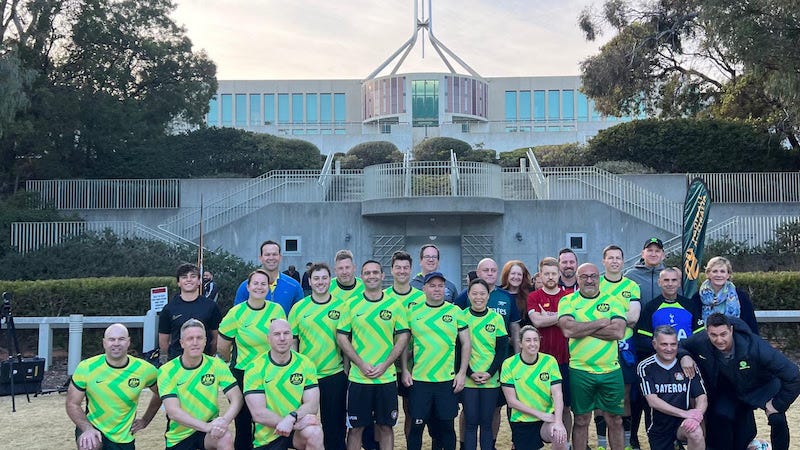
Albanese quickly mumbled something about the presidency of the club being a formality, and he wasn’t even aware of it – if that’s the case, what else is he unaware of – but a sitting Prime Minister presiding over a registered lobbying club is not a technical oversight or a quirk of the bureaucracy; it’s a complete distortion of the democratic process.
Lobbying is supposed to be a regulated activity because the practice itself involves overt attempts to influence government decision-making. When the head of government is formally a part of that structure – the prime minister being lobbied by a group that he is actually the president of – the distinction between governing in the public interest and managing private access to important figures within government is totally compromised. Yet the reaction when caught out was indifference: Albanese started claiming that it really wasn’t such a big deal, and it was treated as a normal activity in politics, something that we should all be unconcerned about.
The obvious question is why such a club like this would need to exist at all. If the purpose was genuinely social or recreational, there would be no reason for lobbyists to be included, let alone for the organisation to be registered as a lobbying group. Politicians and their staff exercising together is one thing but the inclusion of professional lobbyists – whose sole purpose is to influence policy outcomes on behalf of their big business clients – fundamentally changes the nature of this club.
Politics is as much about perceptions as it is about intentions. Even the most honest politician can’t escape the corrosive effect of socialising with vested interests behind closed doors, and the appearance of impropriety – whether it’s real or not – poisons the public trust. And once that trust is lost, the damage has already been done and it’s hard to get that trust back.
Democracy itself depends on the confidence that the system is fair, and not just relying on the MPs who are at the heart of that democracy to wave us all along and tell us that everything will be alright, when it’s clearly not. The same logic needs to be applied to political fundraising dinners – and events such as the annual Midwinter Ball in Canberra – where access to ministers is effectively sold to those who can afford it. These events are routinely defended as inoffensive and benign, and we are constantly told that ministers don’t change their views simply because someone paid for a meal.
Again, this totally misses the point, even if it was true (and by the way, it’s not). Influence doesn’t need to be crude or overt to be real – paying for the access itself is the influence, where it creates a hierarchy in which corporations and wealthy individuals can speak directly to power, and influence that power, while everyone else is held back through the many layers of bureaucracy.
In theory, ministers’ offices exist to manage this imbalance. Staffers can manage requests, resolve mundane matters, and ensure that the minister’s time is reserved for issues that genuinely require their input, and it’s a system that works when access is based on need and the merits of those requests. But it’s a system that fails when money becomes a small shortcut to power, and it’s a process that undermines our democracy and the principle of equal representation.
This is why donations and lobbying needs to be carefully regulated and reformed, if not removed altogether. Banning private political donations – this has been enforced in South Australia and shows that it can be done – reduces dependence on wealthy backers and weakens the hold that entrenched interests have over political parties. We’re not that naïve to think that it will completely remove corruption from politics – the political system always seems to find a way to behave corruptly, despite the rules that might be in place – but anything that reduces the possibility of corruption is something that surely has to be welcomed.
This is an area where the Labor Party could lead federally – as it has done in South Australia – restoring credibility by drawing a clear line between government and paid access by vested interests. Yet there is a lingering sense that the incentives to maintain the current system are far too strong – Albanese has been in parliament since 1996 and knows the system only too well – and that the benefits of these donations and informal influence are too difficult to give up on.
Fabricating the news to achieve an agenda
Another year, and another deeply disappointing performance by the Australia’s mainstream media, which surely must rank among the world’s most captured and compromised news and reporting outlets. The combination of access journalism, caution, and built-in censorship has seen a quick erosion of their credibility, and this applies to commercial and public broadcasters. And why wouldn’t this be the case? They’re all pretty much from the same pool, and with the easy transition of journalists from entities such as News Corporation over to the ABC and SBS, it’s a situation that’s only going to get worse. But what is unclear is whether some journalists are just being careless and sloppy, or whether they’ve crossed that dangerous line of manufacturing claims in the knowledge that there won’t be any consequences.
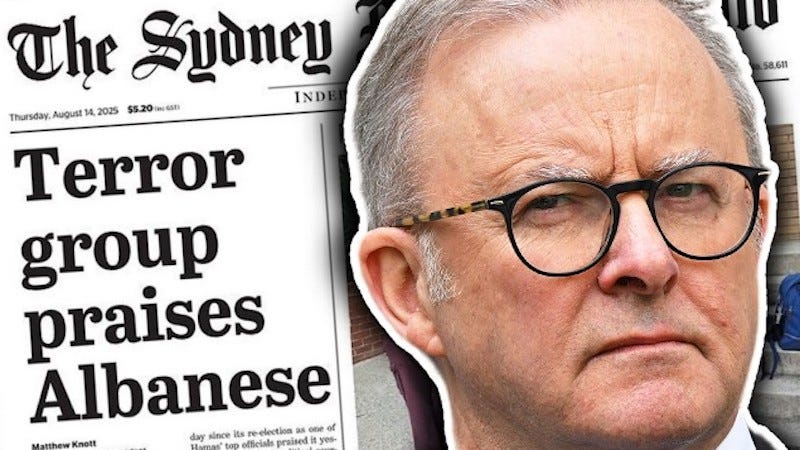
A clear example of this was a story published by Matthew Knott, which appeared in the Sydney Morning Herald and The Age in Melbourne, where the article revealed supposed insights attributed to Hassan Youssef, a senior Hamas figure, and then these claims were used to politically attack Prime Minister Albanese over Australia’s recognition of the state of Palestine. The clear implication was that the journalist had communicated with a key figure inside Hamas, giving the story the imprimatur of authority and importance.
The only problem was – and quickly identified by many observers through a simple search on Google – was that Hassan Youssef has been imprisoned in Israel for many years and he has no means of communicating with any journalists, let alone an irrelevant journalist from faraway Sydney. Rather than confronting the implications of publishing such a false claim, the institutional response was predictable. Journalists at the Sydney Morning Herald closed ranks, suggesting that the episode as a simple mistake; a “cock-up,” not a conspiracy, just a simple oversight, rather than a breach of journalistic standards and outrageously lying to the public. And then, the issue disappeared, stories were modified online, and the journalist in question kept a low profile over the next few months. There was no examination of this “oversight”, there was no correction, and no accountability.
It’s a pattern that now infects all mainstream media: a sensationalist claim is made, amplified across many platforms, thrown into the public debate, and then used to attack a Labor Prime Minister. When the claims are challenged and found to be a complete fabrication, the wagons are circled, the story is either reframed or quietly abandoned, as though the lie had never happened. The initial release of the story did its job – the correction, if it exists at all, arrives too late as if to suggest that the truth of the matter isn’t that important. It was a “cock-up” after all.
The consequence is that mainstream media has become infotainment rather than journalism, where relying on the truth just doesn’t matter anymore. It’s about getting the “eyeballs” and page views, chasing the lucrative A–B demographic, and a case of maximising the metrics of engagement, rather than maximising the factual content of the information that they put out. Who’s got time for the truth when we’re just too busy manufacturing the bullshit and shovelling it out into the public arena?
People are walking away from mainstream media not because they reject journalism, but because they are no longer satisfied with what is being presented too them. Without wanting to blow our own trumpet too hard, it’s the reason why more people are seeking independent voices within political journalism and media reporting – it might be a flawed process that lacks the same resources of their counterparts in the mainstream, but at least they’re not captured by the vested interests that positions the news in a way that favours their financial and ideological persuasions.
When deliberate “mistakes” are quickly forgotten about, and powerful interests are protected, the media loses its credibility and relinquishes that right to claim that it is the authority of reporting matters in the public interest. What remains is a media landscape that continues to sow the seeds of its own demise by accepting and ignoring its own failures – it’s less trusted, less influential and increasingly irrelevant to those it claims to inform. Unless there is a serious understanding of what’s going on within the mainstream media, that exodus is likely to continue, and the damage that it’s doing do public life and the body politic will only get worse.
I now read very little Australian news. Indeed I read about Bondi through reports in New York Times and Washington Post.
When young I read two papers a day.
I think print media had a different balance of summary of what happened to analysis and heavily weighted alarmist campaigning stories.
No illusion that presenting what happened is not a selective task. That I think is point of news reporting. I can work out what I think based on it.
I have never regarded journalists as great analysists or cared for their opinions.
The Australian les the way downwards. For a long time it had more information than others tied to its right wing spin (from about 1974) Then it became almost all spin.
Others followed. Eg The Guardian is a progressive (but not left) version of The Australian.
The Melbourne Age went tabloid in size and followed in spirit. All small minded gotcha focus.
If we are going to move forward, we need to abandon the defunct premise that the mainstream media sees its role as holding the powerful to account. This is a highly mythologised narrative upheld by a smattering of creaky old tropes.
The ‘traditional’ media, like other corporations has one single-minded purpose and that is to maximise profits for their shareholders. Even where corporate media is heavily invested in prosecuting the ideological worldview of powerful proprietors such as Murdoch & Stokes the end game of exerting such influence is always the same. As Murdoch himself said in relation to the Dominion scandal, “It’s not about Red or Blue, it’s about the Green.”
It’s just late-stage hyper-capitalism. The media proprietors lining up to kiss the arse of Trump are no different to the tech company CEO’s and the like. They simply desire to maximise corporate profits and executive bonuses.