


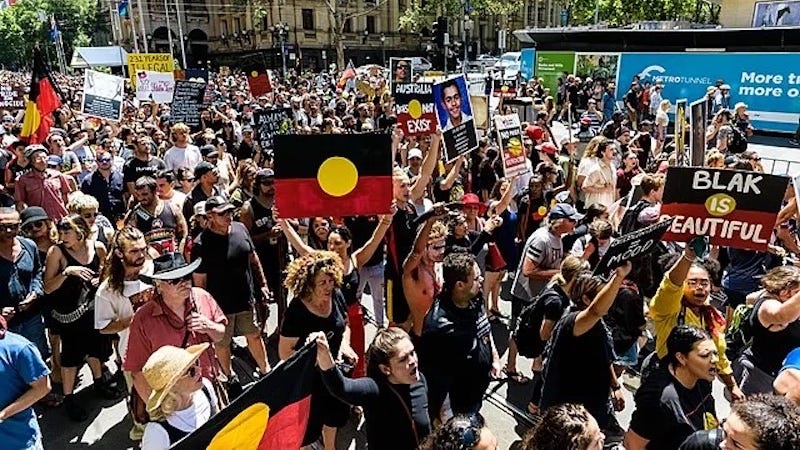
The year in Australian politics began with the issue that has been floating around for many years: January 26; the day that conservatives somehow want to combine celebration, historical amnesia and, above all else, the start of the annual festival of culture wars.
Even before the formal election campaign had commenced, Australia Day/Invasion Day once again became a test case for how the politics of culture war would be used throughout 2025: the then opposition leader Peter Dutton was always going to make sure of that.
By placing local councils “on notice” and pledging that a Coalition government would reinstate mandatory citizenship ceremonies on January 26 within its first 100 days – surely the least important issue for an incoming government to be worried about – Dutton deliberately turned the day into an electoral wedge against the Labor government: this was all about drawing a line between tradition and what conservatives portray as creeping wokeness into everyday life.
In late 2022, the Albanese government gave councils the flexibility to allow citizenship ceremonies to be held within a three-day window either side of Australia Day, a policy change was modest, pragmatic, and no big deal. Yet Dutton framed it as evidence that Australia Day had been tarnished, recast as a “day of shame”, and drowned out by protesters and cancel culture.
Public sentiment, as always, is mixed on this day: some Australians expressed a genuine attachment to January 26 as an occasion to gather, socialise and celebrate. Others speak about discomfort, grief or the ongoing reminder that the date carries too much historical baggage of dispossession and genocide to act as a unifying national day.
A common suggestion is compromise: separate days, dual recognition, or a change of date altogether – if Australia had somehow managed to instigate a National Day of Fascism in the early parts of the twentieth century, how long would it have lasted after 1945? – so a change seems to be the most obvious path. There’s less resistance to making this change to Australia Day compared to previous years – and yes, there were still protests and debate about this issue this year, and there is a sizeable portion of the community that will resist change, but the mass anti-woke uprising that was anticipated by conservatives failed to materialise.
Of course, that didn’t stop the opposition leader from charging head-first into the culture wars: for Dutton, January 26 wasn’t just an issue about commemoration; it was an entry point into a broader strategy of a conservative divide and rule. Australia Day was presented as the first battlefield, followed by disputes over gender identity, transgender rights and, later, used to rail against the Treaty process in Victoria. It’s a consistent pattern: elevate issues that provoke emotional reactions, cast progressive positions as elite or totally disconnected from reality, and then insist that “ordinary Australians” are under attack by activists and Labor-led institutions.
While this tactic might have worked in the past, it’s a strategy that’s out of step with the public mood: opinions about Australia Day will always be divided – that’s a given – but there’s a growing understanding that January 26 is a problematic date for First Nations people, and for many other people in the community. The arrival of the First Fleet in 1788 marked the beginning of dispossession, violence and systemic repression that continues to shape Indigenous lives today. The symbolism of that moment – regardless of whether it’s considered to be an invasion or settlement – can’t be separated from the catastrophic consequences that have followed.
Changing Australia Day in itself, would not resolve these historical injustices instantly just at that point where the date is moved elsewhere. But it would accept our history more honestly and allow for a more inclusive national story. And it’s also understood that this acceptance also needs to take on practical measures: education, health, employment opportunities and the resources required for communities to proceed with genuine self-determination. The disparities are still there – shorter life expectancy, higher incarceration rates, persistent unemployment and intergenerational trauma, as shown by a stalled Closing The Gap process – and these aren’t accidents of history: it’s the legacy of colonisation.
With this in mind, the weaponisation of January 26 by conservatives is becoming increasingly shallow and futile. Rather than dealing with the structural realities of Indigenous disadvantage or proposing meaningful reform – and yes, they often talk about practical Reconciliation but never actually do much about it when they are in office – the opposition chooses outrage over solutions. In that sense, the culture wars that fired up at the start of the year revealed more about the diminishing appeal of those who continue to prosecute them.
Who benefits from these contests of history?
Australia Day this year showed that habit for the Coalition to push history as something that needs to be contested and left unresolved, especially if it’s a version of history that they’re not favourable to. The problem isn’t so much that Australia tells these stories about tradition, the barbecues, flags, public holidays and mateship: those rituals are important to many people, and there’s nothing inherently wrong with this. The problem is that these are the only stories conservative political leaders are prepared to accept. Anything beyond that – dispossession, violence, structural inequality, Reconciliation, or the dreaded Treaty – is regarded as an intrusion to our fun on the day, an inconvenience, or an ideological attack.
If Reconciliation is acknowledged at all by these leaders, it’s tightly constrained: symbolic, conditional and framed entirely on conservative terms, a form of anti-Reconciliation. It’s a version that insists Indigenous Australians should accept a version of history sanitised for the comfort of the majority, rather than one that explores honestly what happened after 1788 and what continues to flow from it. These issues, along with all the other culture war tropes that are usually bundled together on January 26 – are raised not because they represent pressing public policy challenges, but because they offer an opportunity to provoke, to distract and to divide.

But what has changed is the impact of this rhetoric. With conservatives no longer in government in most parts of Australia, these public scare campaigns increasingly lack institutional support: it barely worked when Scott Morrison was in office and tried to make the 2022 election all about wokeness and transgender issues, and it didn’t work from the position of opposition in 2025. Stripped of executive power, culture war messages begins to sound less like leadership and more like background noise and, instead of a culture war, a culture of complaint – a kind of annual ritualised outrage that fails to hit the mark and gains less traction as each year goes by.
Being in government is always difficult but at least there’s a platform to megaphone this type of mindless sloganeering; fewer people are interested in what the opposition has to say and that’s why the Coalition amplified the messages even harder on January 26, just to get a fraction of the traction. Blaming trans people for “ruining sport” or railing against wokeness takes up a lot of energy and becomes an easier substitute for serious policy development. In that sense, these bland culture wars are not about history, gender or identity at all. They are about power – who holds it (and in the case of the Coalition, who wants who hold power), who benefits from it, and how effectively anger can be redirected away from those at the top.
Treaty, symbolism and the fading power of fear
While these issues that festered after Australia Day became a battleground for conservatives in the lead-up to the May federal election, the most substantial development in Australia’s relationship with First Nations people unfolded later on in the year, and with relatively little drama – the same issue Dutton said would be “divisive”, and vowed to do everything in his power to oppose.
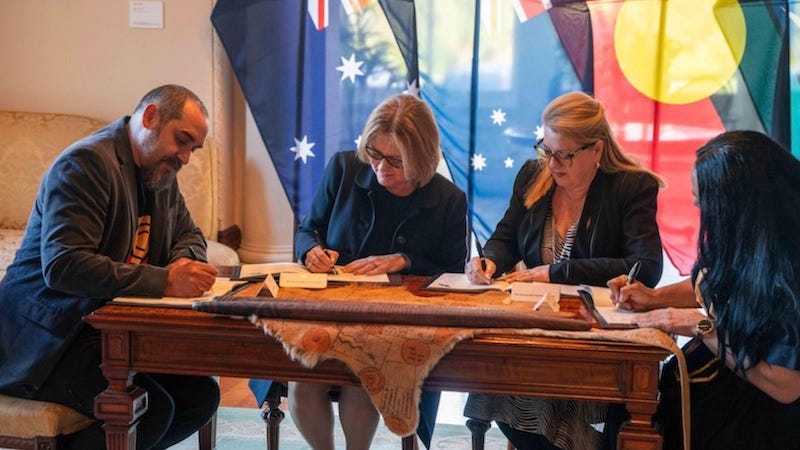
In November, the Victoria parliament passed the country’s first Treaty legislation, after decades of advocacy from Indigenous communities. For the first time in any Australian jurisdiction, a formal framework was established to recognise First Nations peoples with the creation of an independent and permanent representative body.
The dire warnings that had been issued for years from the likes of Dutton – that making a Treaty with First Nations people would somehow fracture the nation, that it would unleash legal chaos, or that it would somehow threaten Australia’s continued existence – failed to materialise. Victoria remained as Victoria. Australia remained as Australia. The sky, quite literally, did not fall in: it’s still up there. The Treaty was introduced, life went on, and the electorate largely absorbed the change without panic or upheaval, and without the presence of Dutton to oppose or rail against it, having lost both his seat and his parliamentary leadership position at the 2025 federal election.
This reality exposed the emptiness of the culture war rhetoric that had preceded it, not just in 2025, but for all the years before. Conservative voices had attempted to link any discussion about changing the date of Australia Day to the spectre of the Treaty, presenting both as part of a fearful and frightening agenda, a strategy that collapsed as soon at the Treaty was implemented in November. Once a policy like this exists in a more concrete form and becomes a reality – removed from all the exaggeration and hysteria – it became much harder to sustain the fear campaigns about it.
The Victorian experience with the Treaty also demonstrated how these processes can be handled: incrementally, consultatively and without the right-wing confrontation. It showed that the Makarrata of truth-telling and Treaty are not radical acts of national self-destruction, but mature attempts to normalise a relationship that has been left unresolved for far too long. In doing so, it provided a template not only for other states, but for the federal government as well – if there is a political will to follow it.
Perhaps most damaging part for these conservative culture warriors is the realisation that once these long-opposed reforms are implemented, they rapidly lose their potency as political scare tactics. How can the culture wars continue if there are no longer the battlefields to wage them on? What if there is no one there to listen to this macabre form of pseudo entertainment: does it still make noise?
It’s a familiar process: after years of alarmism, most issues are quietly accepted once the policy becomes legislation and a part of the normal political processes. Quite often – just like the marriage equality debate that ended in 2017 after the public voted “Yes” in the plebiscite – voters look back and wonder what all the fuss was about. Each successful reform on social issues further erodes the power of fear-based campaigning and leaves the culture war warriors increasingly disconnected from reality.
The Treaty debate, just like the Australia Day debate that preceded it, suggests a broader shift within the community. The electorate might be not uniformly progressive, nor universally persuaded on a wide range of social issues. But it is increasingly weary of endless symbolic battles that are designed to stall progress rather than resolve problems within society. As reality continues to smash many of the long-held conservative myths, the opportunities for providing the ammunition for the culture wars becomes more narrow – and the politics of fear looks more and more like a relic of a passing era.
We didn’t take that into account, but good point. Maybe it’s the cycle of conservatism – media > politics > media > politics. Rinse and repeat.
Culture Wars are as much about media monetising outrage as politics .