


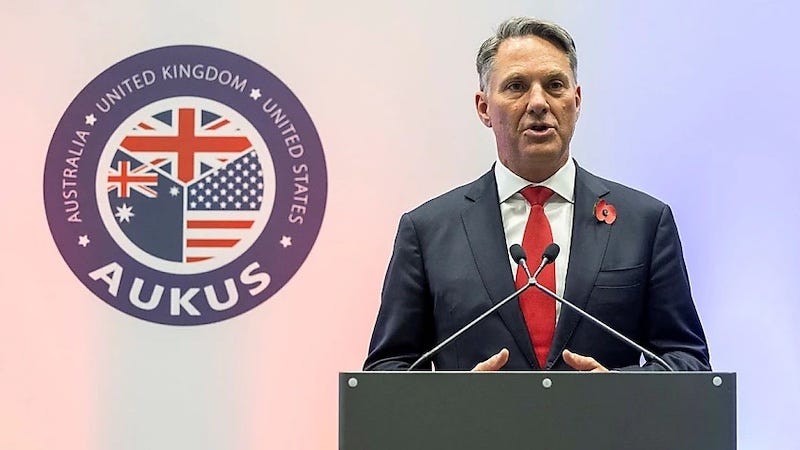
What the government keeps presenting as a steady and supposedly natural evolution of AUKUS – a project inherited from the Morrison government – increasingly looks like one of deals that governments need to keep propping up financially and politically, even when they themselves know that there’s not much substance to it.
Defence Minister Richard Marles has described each stage of AUKUS as the latest agreement in a “natural evolution” of commitments already made, formalised through bilateral and trilateral treaties with the United States and the United Kingdom, and that it is a “treaty that sits under a trilateral treaty” using gobbledygook and language that even he seems to have difficulty understanding.
Throughout the year, AUKUS was framed not as a policy that was open to any form of scrutiny, but as something that’s inevitable – according to Marles – an unstoppable process whose legitimacy rests on repeating this polly-speak ad nauseum, rather than providing any form of rational clarity. Each new payment or announcement is offered as a “demonstration that AUKUS is happening” – whatever that means – as though just making these kinds of statements is evidence of a purposeful progress.
By 2025, Marles’ “evidence of purpose” had resulted in a series of extraordinary financial payments, where Australia transferred $500 million to the United States in February, followed by a further $800 million in July, bringing the total to $1.3 billion in a single year. Yet the public is still unsure about what exactly this money is supposed to be securing. The promise of nuclear-powered submarines is something that may arrive well into the future, and is dependent on technologies, industrial capacities and strategic conditions that might be totally different to the way they exist today. The prospect that Australia will eventually receive ageing or out-of-date boats long after the strategic environment has shifted raises a basic question that still remains unanswered: it is a deal that arrived out of nowhere in 2021, but what problem is AUKUS actually meant to solve?
Official explanations always return to the same abstractions: it’s all about security, deterrence, and support for the “rules-based order” – even though that order fell apart some time ago – and to solidify the alliance with the United States. These clichés are brought up so often that they’ve become substitutes for actual policy. At the same time, the details are shrouded in secrecy, brushed aside during parliamentary scrutiny in the Senate, and removed from public debate altogether. The effect is a defence policy that relies on the trust-me-I-am-the-politician type of thinking, refusing to offer any transparency, and expending public finances without offering accountability. In fact, the more questions that are asked of this Labor government on AUKUS, the less information seems to be coming out, and this game is something the minister seems to revel in.
And whenever questions are asked, the responses are either not given, or deflected with a narrative of fear. Towards the end of the year in Senate Estimates, Australian Greens Senator David Shoebridge asked a wide range of detailed questions about the costings and structure of AUKUS, only to be stonewalled by both Australian Defence Force personnel and the government. Soon after, as if to suggest that Shoebridge was flying too close to the sun by bringing up these questions, Marles began to flood the zone with fear. Chinese naval vessels were operating thousands of kilometres away in the Philippine Sea at the time, yet the minister framed this as a clear threat to Australia’s security, with the underlying message: we’re not going to tell you anything about AUKUS, but we are going to tell you about the threat of China – even though China is Australia’s largest trading partner.
It’s a tired and familiar pattern, always used by the conservatives when they’re in office, but it’s the same message now being used by the Labor government, albeit painted with different colours: a vague or distant action by China is amplified through alarmist headlines; politicians and security agencies then go on to speak of a new and heightened risk.
And then, the funding flows more freely to the department of defence – no questions asked – and the cycle moves on without any serious debate about how much of this is really necessary, and in whose interests this is all in. In this kind of environment, fear becomes not so much a response to the facts on the ground, but a de facto policy in its own right.
The issue here is that much of this thinking is a worldview that belongs to another era, where Australia continues to conduct its foreign affairs as though the Cold War has never ended. For sure, the creators of the post-World War II order are still calling all the shots in 2025 – the US, China, Russia, Britain and France – but the power bases of the world are slowing shifting towards Asia and the Global South, and Australia seems to be unprepared for these shifts.
Instead, Australia’s default position is to seek reassurance from the United States – and to a lesser extent from Britain – even though many international analysts suggest that American power is waning, and being fast-tracked by the incompetence of the Trump administration. By most measures, the United States is displaying many of the indicators historically associated with a decline of empire: chronic overspending, internal social and political divisions, overstretched military commitments and a reduced capacity to sustain the global dominance that it so desires. Of course, decline doesn’t happen overnight, and the United States remains the world’s most powerful military and a leading economic force. But its own trajectory, and compared with that of China, suggests that it won’t be too long before it loses this status.

China, after a period of economic slowdown during the first few years of COVID, is starting to accelerate again. Within five to ten years, it is widely expected to match or surpass the United States across key economic indicators, with a growing military capability to follow. And within this context, the AUKUS deal risks locking Australia into a rigid alliance with the United States, just at a time when flexibility, diplomacy and regional engagement is needed the most.
A look at the broader geopolitical landscape only reinforces this uncertainty. A weakened or destabilised India, changes in international leadership – Narendra Modi and Xi Jinping, and certainly not Donald Trump, are going to be in office for ever – and the persistence of authoritarian leaders in other parts of the world all add to the complexity of these issues. Yet in Australia, this complexity isn’t being met with the nuance and deftness that’s needed at the moment, but with an over-simplification: more weapons, deeper alliances with old imperial friends, and more fear mongering.
The result is a foreign policy that’s shaped by a permanent state of paranoia, rather than a rational analysis – one that treats fear as reason, and equates spending with strength, while leaving the Australian electorate increasingly unsure about what is being defended, from whom, and at what cost.
The cost of small thinking
The fear of China that resides at the heart of Australia’s defence and foreign policy didn’t emerge at the time when AUKUS was announced; it’s embedded far deeper within our political psyche. From the nineteenth century onward, Australia has always depicted Asia as an existential threat – first of all through the “yellow peril” narratives, later on through Cold War paranoia, and now through a modern version of both, with slight variations. Two centuries after it all started, it’s a national paranoia that stubbornly refuses to shift. Instead of trying to recalibrate the reality of Australia’s geography – belonging in the Indo–Pacific region – into a more mature regional understanding, the general political discourse always reduces itself into a narrow circle of fear and, if it’s not China, it’s Indonesia that we need to be fearful of, or any other near neighbour in the South-East Asian region.
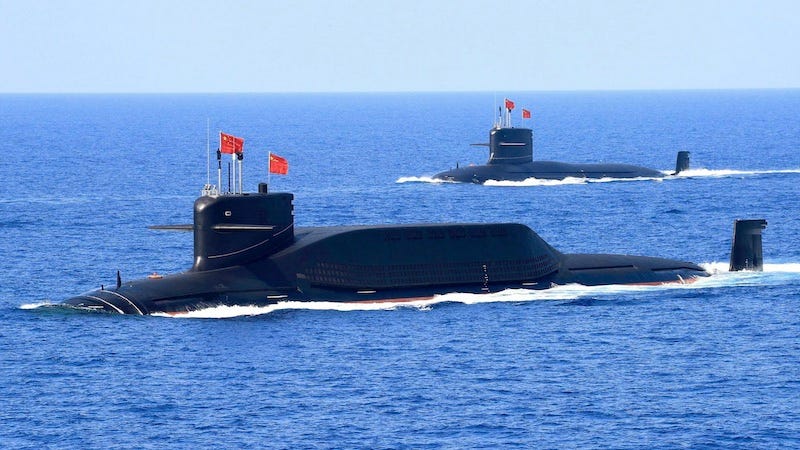
What this mindset overlooks is the basic shift that has been developing in global power. China today is not just a rising state; it’s a central part of the world economy and, politically, makes Australia look like a minnow that’s lost at sea. Despite all the theatrics, it’s likely that Beijing pays little attention to Australia’s domestic agenda and the way it uses fear, paranoia and the exaggerated rhetoric, and this dramatic over-effect on security is more likely to be viewed as superfluous white noise, rather than a serious menace or a threat to China.
Yet within Australia, figures such as Marles continue to recycle the same red-scare tactics that have always been perfected by Coalition governments in the past. His performance as defence minister reflects a failure of imagination by the Labor government, and amplifying distant Chinese naval activities as an imminent danger is not just misleading, it’s a cynical exercise in manufacturing consent.
In this sense, the problem isn’t so much a strategic issue, but a political one. Marles is one of the weakest performers in Cabinet, yet sits in one of the most important roles in government. His public conduct – whether frantically warning us all about far-away fleets in Asia or enthusing about weapons systems with the excitement of an adolescent – as he did at the Indo Pacific International Maritime Exposition in November – has often seemed more like a defence fanboy than of a serious guardian of the national interest, using rhetorical tones that mimics the panic from the early twentieth century, when the imperial decline of Britain was met with old school-tie bluff, bluster and fear, rather than trying to adapt to the changing circumstances of the time.
This should be an issue of concern for this government, because Labor once prided itself on a serious intellectual rigour in foreign policy and defence matters. Figures such as Gough Whitlam, Jim Cairns, Bob Hawke, Gareth Evans, Paul Keating and Kevin Rudd – whatever their flaws – engaged the world with depth, a historical awareness and confidence in the strategies that needed to be pursued in Australia’s interests, and in the interests of the world. Marles pales into insignificance when compared with some of these thinkers, and is more of a factional operator rather than a geopolitical strategist, a numbers man without the political intelligence that graced many others within Labor history.
There’s nothing inherently wrong with being pro-American, but it really depends on how these positions are defined and, as always, the context of that relationship when compared to other world players, such as China. But blind allegiance without clear thinking and analysis is not really much of a strategy, and not holding and using some sort of leverage when dealing with the larger world players is not really diplomacy. Australia’s foreign policy can’t be reduced to jumping at the snap of American fingers, nor endlessly invoking threats of China that justify ever-expanding military commitments and reducing the democratic debate about the big issues that affect all of us.
AUKUS, as well as the look-over-there political tactic of fear that supports it, has become a substitute for good policy. Perhaps leaders such as Marles can’t explain what AUKUS means to Australia, because they can barely explain it to themselves or their Caucus colleagues. If that’s the case, politically, it’s better for the government to pretend that there is certainty when it doesn’t actually exist, offer empty reassurances, and deflect whenever the big questions are asked. How can AUKUS hurt us if we don’t even know what it is? That seems to be the thinking within this government.
It’s a big ask, but until Australia confronts the historical roots of its own geopolitical insecurity – and demands more from those leaders who are responsible for its defence – it will remain trapped between the paranoia of China and a dependency with the United States, and making that mistake of just hoping that all of these security issues will go away, if we pretend that they don’t exist.
Excellent analysis - Sub-Imperial Power by Clinton Fernandes is a great book for people looking for greater theoretical clarity on Australia's relationship with America.
https://open.substack.com/pub/callumscolumn/p/book-review-sub-imperial-power-by?utm_source=share&utm_medium=android&shareImageVariant=overlay&r=6lwvok
Economically, China is more important to us than America, but our defence thinking has fallen behind economic reality.