


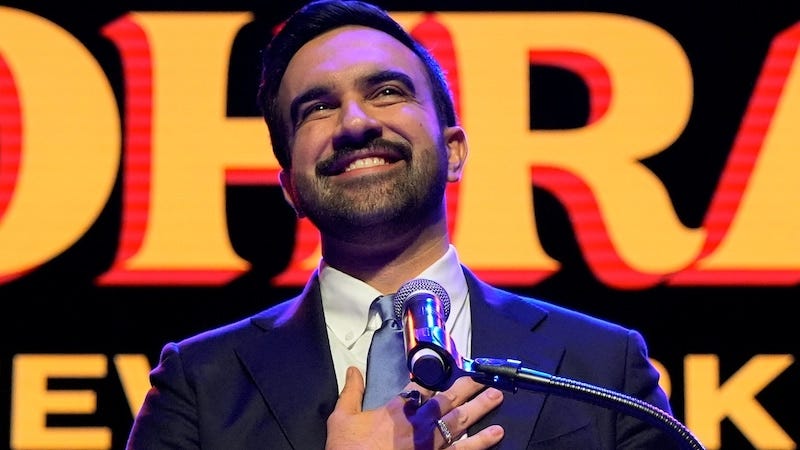
“For as long as we can remember, working people have been told by the wealthy and the well-connected that power does not belong in their hands; fingers bruised from lifting boxes on the warehouse floor, palms calloused from delivery by handle bars, knuckles scarred with kitchen burns – these are not hands that have been allowed to hold power. And yet, you have dared to reach for something greater. Tonight, against all odds, we have grasped it. The future is in our hands; we have toppled a political dynasty.”
These are the powerful words from Zohran Mamdani, the 34-year old Democrat Socialist who, against all the odds, has become New York City’s first Muslim, first African-born, and youngest mayor in over a century. After a grassroots campaign that lasted for over a year, his own hands reached for something greater and went on to succeed: a political landslide that has sent a strong message far beyond the city of New York.
Mamdani’s win over Andrew Cuomo, the former Democratic governor and perhaps the most salient example of establishment politics at its worst, was a shock to America’s political elite. Despite being outspent, lacking major endorsements from within the Democratic party, and facing a barrage of racist attacks and Islamophobic rhetoric – mainly from the Israel lobby and the capitalist billionaire class – Mamdani’s campaign drew its support not from corporations but from ordinary people, from small donations, volunteers, and driven by a belief that politics should serve the many, not just the elite few, as it has done within New York City for some time.
What makes this victory resonate so strongly and makes it so relevant – especially in places like Australia – is that it demonstrates that the deeply entrenched political machines can be defeated, with the right candidate, the right messaging, and the right electoral techniques. Mamdani didn’t just run on platitudes of hope or change: his program was based around the basic issues that affect the cost of living – rent freezes, free childcare, free public transport, cheaper groceries, and higher taxes on the wealthy to fund these initiatives.
In a political climate that’s been largely dominated by cynicism, disinterest and distrust, voters have rewarded his conviction and with the highest voter turnout in New York since 1969, it suggests that if the electorate feels that a candidate is directly speaking to the issues that affect them the most, they will engage politically. Whether Mamdani can fulfil these initiatives will, of course, be the bigger test, but for the time being, his victory shows that establishment politics can be pushed aside with effective grassroots campaigning.
Mamdani also broke a powerful taboo in American politics, where he spoke openly about the genocide in Gaza, condemned Israel’s actions, and questioned the influence of pro-Israel lobbying groups within US politics. That such positions didn’t destroy his campaign but instead helped to galvanise his support suggests that the once-unassailable power of the Israel lobby and the corporate media can be challenged – and may even be a paper tiger – and that political courage, combined with authenticity, can overcome the fear and smear that was prevalent in this campaign.
It’s a moment that provides many lessons for Australian politics: when political parties become too safe, too corporate, and too removed from the people they claim to represent, disillusionment within the electorate continues to grow. The major parties – Labor and Liberal alike – have long relied on the assumption that the electorate has nowhere else to go, but Mamdani’s victory shows that when the working classes finds a voice that speaks to its struggles and aspirations, that assumption can collapse quickly, but only if there are viable alternatives.
The establishment’s reaction, especially from the Israel lobby, to Mamdani was predictable – before, during and after the campaign – and we’ve seen many times before. Jeremy Corbyn in the UK, was demonised into political oblivion and smeared with accusations of anti-Semitism, despite inspiring a generation of young activists; or, in the US, the early hope of Barack Obama, was tempered by the constraints of power and institutionalised behaviours. Yet Mamdani’s position as mayor – outside the rigid machinery of Washington politics – might allow him more freedom to act on his principles.
For Australia, this raises a number of questions for the stultifying and stale brand of donor-style and stakeholder politics that exists in virtually every part of the country, and has done for some time. Could a similar political change emerge here? Could a new voice rise – one unbought by corporations, unafraid to challenge entrenched interests, and willing to call out the hypocrisy of the system?
Mamdani’s triumph suggests that people everywhere may finally be reaching a breaking point with the late stages of neoliberalism; they’re no longer willing to accept a political order that serves vested interests ahead of the public interest. It’s not just a story about New York – it’s virtually an invitation to the rest of the world to change the processes of politics: this is how it can be done.
The lessons for Australian politics
The true significance of Mamdani’s victory lies in something much deeper than the numbers and statistics – it’s the collapse in the authority of the political establishment itself. For decades, New York’s power brokers have relied on fear, division and media-driven narratives to hang onto their power base. Yet, throughout Mamdani’s campaign, every insult, smear, racist attack and inuendo thrown at him totally failed. Totally.
The conservative system’s traditional weapons – branding a Muslim candidate as a terrorist, dismissing him as a socialist, or even worse – a communist – or accusing him of being an unhinged critic of Israel and anti-Semitic – just didn’t work. The people stopped listening to the bullshit.
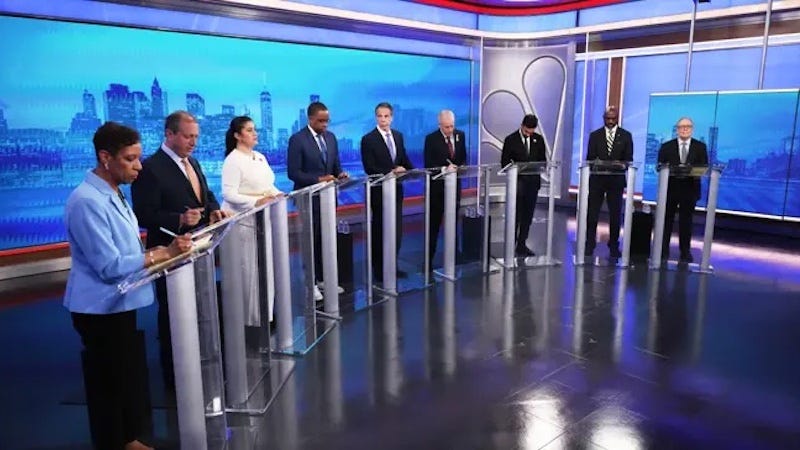
The moment that captured this factor the best occurred during the Democratic primaries debate in June, when each candidate was asked which country they would visit first as the new mayor of New York. Each contender offered the expected answer: Adrienne Adams said she would visit the Holy Land. Cuomo vowed to go to Israel “to combat anti-Semitism”. Whitney Tilson promised multiple trips to Israel and Ukraine, framing them as allies “on the front lines of the global war on terror”. It was the unthinking display of obedience to Israel and showed the orthodoxy of American foreign policy – an absurd moment for a municipal contest which was meant to be about housing, transport and crime. Sure, New York is a big city and has a population of almost nine million people, but it’s not an outpost of Tel Aviv.
Mamdani changed the script and said that he would “stay in New York City… I’ll be standing up for Jewish New Yorkers, meeting them in their synagogues, homes, and on their subway platforms. Israel has the right to exist – as a state with equal rights – but my responsibility is here, to the people of this city.”
In that one answer, he changed the conversation entirely, and sounded like the leader focused on the job, not a politician performing for lobbyists. The others in the primaries race looked rehearsed and insincere; Mamdani looked authentic. To many voters, it was a clear moment – a candidate calling out the bleeding obvious, but what no one else dared to say: that’s the true sign of leadership.
Again, this has implications for Australia. The electorate here might ask: why do our own leaders feel compelled to follow these same scripts? Why do they make ritualised visits to Israel, or repeat the same talking points handed to them by lobbyists and Israeli government-funded “study tours”? Why can’t they speak as plainly as Mamdani did – acknowledge Israel’s right to exist, but also the right of Palestinians to live with dignity and equality?
This isn’t just about foreign policy: it’s about the entire political machinery of Australia as a captured state – the fear of saying something unsanctioned, the instinct to avoid controversy even when truth needs to be stated. Mamdani’s victory shows what happens when a politician breaks that cycle. He didn’t win just because he rejected the pressure from the establishment; he won because he rejected it completely.
If the same courage existed here, perhaps Australian politics could look different. Have we ever heard the Prime Minister Anthony Albanese standing up for the people with bruised and calloused fingers hardened from lifting boxes? He mentions his povo upbringing in housing commission as a political identify, but when did he last speak the real words of hardship and affordability for working people? When did Albanese stand up to the Zionist lobby in Australia to let them know who’s really in control? Or powerful gambling interests?
Maybe leaders would stop genuflecting to power and start serving the people who did elect them, not the people who didn’t elect them. Maybe mainstream media journalists could start reporting the facts rather than regurgitating the handouts that support the establishment narrative. Maybe truth would start to matter again. Just maybe.
Of course, Mamdani could still disappoint, as most political leaders do. Even great reformers can falter under the weight of expectation – as Obama’s presidency ultimately showed. But the point isn’t to achieve some kind of utopian perfection: it’s the willingness to try. Mamdani has shown that honesty engagement, empathy and conviction can still defeat cynicism. If it can happen in New York, considered to be the centre of global capitalism, then it can happen in Australia too. Change begins to happen when a leader stands up to call out the nakedness of the emperor, and decides to tell the truth.
Crushing the machine: Hope, failure and victory
The British conservative Enoch Powell said that all political careers end in failure; the political strategist Stan Greenberg suggested that “every great leader disappoints”, due to the balance required between competing political interests, managing expectations, and failing to deliver what they promised – in most cases – because of the limitations of their power, or through their own inadequacies. It’s almost a guaranteed rule of history.
The moment of victory in politics usually gives way to compromise, fatigue and the grinding machinery of governing. As the incoming mayor Tommy Carcetti is told in the television series The Wire, the job of politics is “eating shit all day long, year after year”. Likewise, von Bismarck’s analogy about laws being like sausages – best not seen while they’re being made – captures the essence of politics: the daily grind of making a jurisdiction function as effectively as possible for its citizens. And it’s hard work.
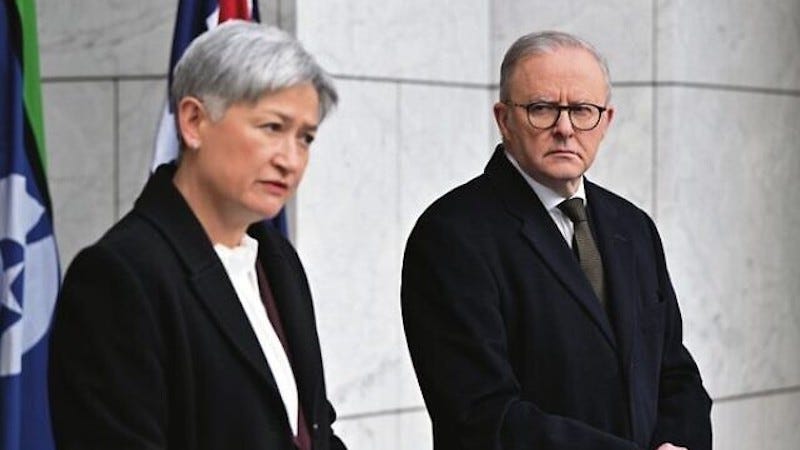
Even the most idealistic leaders are restricted by the system they seek to change. Australians have seen this pattern repeatedly – whether it’s former Victoria Premier Dan Andrews retiring from politics and ruining his myth by revealing himself to be a full-on supporter of Zionism, or figures such as Albanese and Penny Wong constantly showing that moral conviction is often too difficult when it comes to standing up to vested interests, such as the Israel lobby or gambling interests. The lesson is not so much that these people are insincere, but that the harsh realities of politics float within a sea of imperfection.
Time can also force through a kind of amnesty or bring up selective memories: we can forget the flaws of those political figures we may have once worshipped. John F. Kennedy, Clement Attlee, Gough Whitlam, Bob Hawke – each is remembered now as a visionary, even though their eras were also filled with disappointment and division. Winston Churchill, once the embodiment of British defiance, was quickly voted out after the war was won in 1945: people tend to forget that. Yet, there has to be a savoured moment before the disappointment sets in – that brief instant when the impossible becomes real.
The rapper Jay-Z suggested that when Obama’s was inaugurated in 2008, even if his presidency turned out to be the worst possible administration in history, it was the victory that still mattered. It mattered because a man of colour had broken a barrier that was supposed to be unbreakable. That magic evaporated as soon as everyone realised that while he might have looked different, his presidency was not that different to all the ones who preceded him. But, even if was just for a short period, the hope itself was all that mattered.
Mamdani’s election will probably be seen in the same light. Maybe he will falter. Maybe the pressures of city politics will force compromise, or the establishment he defeated will regroup and wear him down. Whenever there’s the first sign of a problem – even if it’s unseasonal or inclement weather that’s out of his control – of course, it all be because of socialism. Communism! Or the fact that he’s a Muslim. Or because of his immigrant background, or a combination of all of these factors. See, we told you so. The establishment will fight back, because they are some of the most grotesque psychopathic characters on the planet – the monsters of capitalism and the mobsters of digital disruption who will never give up.
But for the time being, none of this really matters. What matters is what Mamdani has done in crushing the machine. It’s an issue that should be relevant for Australia, especially in a political environment where imagination seems to be short supply and barely scratches the surface. It shows that the electorate will respond to authenticity, courage and moral clarity, and will take a chance on someone who speaks to issues that matter in their lives rather, than to their donors and assorted vested interests. And, if they feel they have nothing to lose and the current forms of capitalism are not working in their favour, they will back a candidate who refuses to play by the rules set by those who already hold power.
Whether Mamdani ultimately becomes a reformer or a disappointment is almost beside the point. The main message is that the walls of the established political duopoly in Australian politics can be broken down; that the language of politics can change, and that ordinary people – as Mamdani said, those whose hands have never held power – can seize power for themselves. This brief, illuminating moment of the political victory might not last forever, but it will be enough to remind us that politics, at its best, still belongs to the people.

Thank you for this insightful observation , of the hope inspired by People Power , and the
disillusion that can so easily follow.
At this time of the 50 year anniversary of the Dismissal of Gough Whitlam and his visionary government it is interesting to compare aspects of the two men . Whitlam , with so much to repair and provide for the future for ALL Australians , became an obsessive target for Conservatives and their assisting media to be rid of this Labor government which in their view had NO right ever to be in power . The view of the Republicans and Democrats in America is the same . Anyone seen as slightly to the left of a Nazi is regarded as a Communist .
I have just finished reading Virginia Haussegger’s inspiring book , “Unfinished Revolution “ . Not only “ Women’s Liberation”
is slipping backwards , but timid policies of the Labor government as they grovel to America’s dictates are threatening our very democracy and sovereignty . As Gough said , “It’s Time “ once again .
I understand that Mamdani's team were unusually effective at reaching voters, and that the US' complicity in the Israel Genocide is unusually effective at encouraging campaign volunteers and voters to try something new (from the stale bipartisan duopoly for genocide, for US imperialism, and for more Neoliberalism). I understand that his energy & charisma are unusually strong, like Zack Polanski's. So this particular wonderful result appears an (indicative of more) outlier, with the limited influence of Local Government, rather than the medium influence State, or the high influence Federal office/powers.
If Israel's Genocide hadn't remained so disgustingly blatant for 2 years, many more voters likely would have accepted the anti-Islamic slur campaign. Progressivism appears to come and go in waves, and obviously the tide's going out now, even if (like Climate Destabilization) the mean tide is ever rising.
https://www.risingtide.org.au/pb2025
The compassionate and Human Rights and Anti-War movements are still rising, but there are a lot of hateful, violent, ignorant voters antithetical to this decency, and already enjoying incumbency of their representatives. So its never been a more important time for the 'apolitical' masses to discover what they really love and care for, and what they're willing to kindly lend a hand (even just for a few hours a week) to protect. It's double down or fold time at the politics poker table ladies n' gents!