


This week’s briefing outlines the big issues to look out for: the blame game on fuel… silencing dissent and “river to the sea”… neoliberalism coming to an end… and Penny Wong putting Australia last but America First.
Fuel scarcity and the blame game
Australia’s emerging fuel crisis is slowly exposing some long-standing vulnerabilities – falling oil reserves, a heavy dependence on imports, and a political class that’s more interested in managing the optics of politics than managing the risk. The disruptions linked to wars in the Western Asia/Middle East and the Strait of Hormuz have resulted in this complacency from governments of all persuasions being smashed by global instability.
The political responses so far are reading from a very familiar script that we’ve all seen before. The government has been quick to float around ideas of the short-term relief – the possibility of a tweak to fuel excise, anti-price gouging legislation, emergency diesel guarantees – while carefully avoiding the bigger questions about why Australia is so exposed on its energy supplies in the first place.
Blame is likely to be apportioned quite liberally by the critics but the Prime Minister, Anthony Albanese, has done himself no favours by placing himself too closely to the creator of this global chaos, Donald Trump. Most of the electorate is starting to blame Albanese for high fuel prices, but he could have put himself on the front foot immediately by calling out the United States for this foolish war, and saying that Australia could not support this action against Iran. Instead, Albanese was one of the first leaders to commend the attacks by the United States and Israel, even sending Australian personnel and an E-7A Wedgetail surveillance aircraft to show he was going all the way with Donald J. Trump.
A more politically astute politician would have been able to play both sides of the political fence – like Mark Carney in Canada – get the best of both worlds and inoculate himself from this damage, but it’s further evidence that “astute” and “Albanese” are words that do not fit so easily together. Albanese will receive all the blame and opprobrium for the rising fuel prices and, once again, he’s showing great skill in getting the worst of all worlds, not the best.
Meanwhile, the Liberal–National opposition seems determined to treat the crisis as a political opportunity, rather than a challenge to themselves to offer something decent and adult-like to the electorate. Calls for increased domestic production and reserve capacity are hardly new – and are at least five years away – but their sudden urgency carries a whiff of convenience and hypocrisy, having had many refineries close under their watch, and being in office for 20 out of 26 years between 1996 to 2022 but never feeling that there was a need to do anything about this issue. Nothing, until today.
But this is a risky strategy for the Liberal Party – the voters who are facing rising prices and shortages tend to have limited patience for political opportunists who offer nothing more than slogans and photo-opportunities at the petrol bowser, while demanding the Labor government do all the things they never had time for when they were in office.
However, underneath this political noise lies a far more uncomfortable truth: Australia’s energy insecurity and weak levels of reserves – 29 days at the moment – is the product of bipartisan neglect and the constant worship of neoliberalist policies. The real question isn’t so much about who is to blame for these price spikes – they all are – but why successive governments have allowed the system to remain so fragile. Until this issue is confronted, the cycle of crisis and blame is likely to continue for some time to come.
The new world of policing dissent
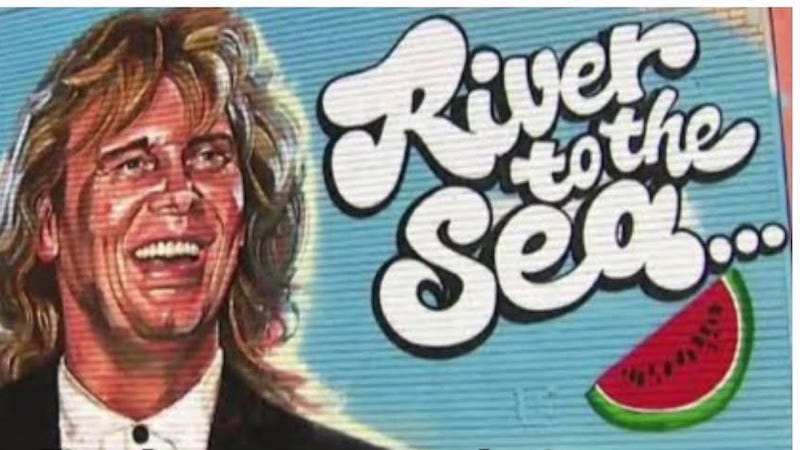
“From the river to the sea” now sits at the centre of a bigger debate about protest, political identity, and the limits of what we are allowed to say in Australia. The police order to remove a public mural from the streets of Brisbane – using lyrics from a John Farnham song written in 1988 – shows how quickly cultural expression has become a political threat when it becomes inconvenient to a select and powerful group of people. And it’s reached the point of the ridiculous, where even news broadcasts were covering over and bleeping out the words “river to the sea”, surely the most egregious overreach by the Zionist movement in Australia, a limit that keeps being expanded.
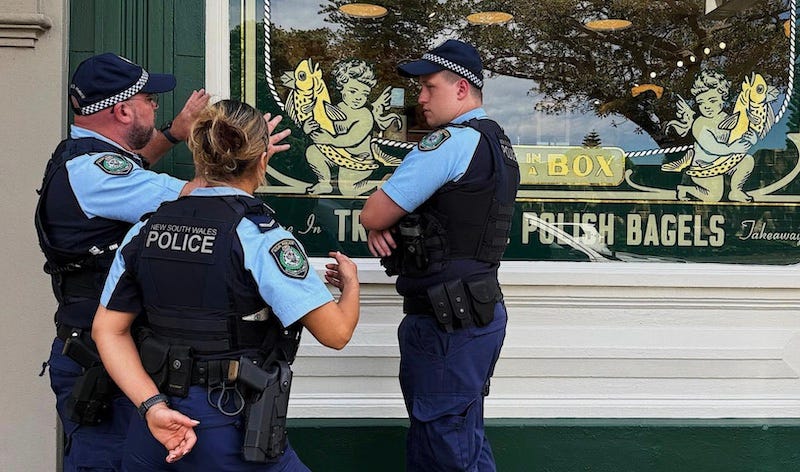
The dispute over “river to the sea” itself is a well-rehearsed one by the Zionists and is now bordering on the cliché: everything, apparently, is antisemitism. But the more revealing issue here is how our politicians and institutions are responding. In Sydney, a Polish bagel house had a barely visible swastika lightly etched into its window and appears to be about two centimetres in size. Most people would clear it off and get on with life but within minutes of their report, three police officers were swiftly dispatched to inspect the scene of the crime and assess its gravity: yes officer, this window is antisemitic, guilty as charged. It would be interesting to see how this compares to the response times of rape, domestic violence, robbery or theft, especially when the victim is an Aboriginal or Islamic person.
Governments and police, especially those in New South Wales and Queensland – have moved decisively toward restricting cultural expression and free speech, tightening protest laws, increasing penalties, and showing a lower tolerance for any form of dissent. These measures are being framed by Premiers David Crisafulli and Chris Minns as the standard tools of public order, yet it’s obvious that their application is targeted towards particular causes: Palestine, climate activism and anti-war demonstrations.
Crisafulli and Minns are weak and pusillanimous leaders who have succumbed to the pressures from the Zionist groups in Australia, and they have this tendency to frame these issues around “public safety”. The risk here is not just the overreach but the selectivity of these issues, where some forms of protest are treated as legitimate expression – neo-Nazis protesting in front of NSW Parliament House, for example, is okay – while others are legislated and criminalised beyond the boundaries of what is acceptable.
Australia is not unique in this pathway of appeasing right-wing Zionist groups – the British Labour Government was humiliated when it enacted legislation banning the words “Palestine Action”, only to be saved from itself by the UK High Court which deemed the legislation to be unlawful – and there is likely to be a quick move here. Legal challenges to these restrictions seem almost inevitable, primarily because they are so ridiculous and disproportionate, but the bigger question is why these laws are being introduced and what the political transaction is – and financial – between these lobby groups, and Australian governments actually are.
Budget games in an age of scarcity
The fuel price rises have arrived just in time for the federal Budget cycle, and we’ll soon find out whether the Albanese government will act decisively in a crisis, or hide behind the language of “discipline” and incrementalism, the Prime Minister’s favourite pastimes.
Rising energy costs are feeding directly into concerns about inflation, interest rates and a recession – yet the policy noise that’s coming out remains cautious, almost to the point of inertia. Of course, governments hold their cards close to the chest in the lead-up to a Budget, but it also might be a case of no news at this stage is not good news.
There’s no shortage of budgetary options that could be on the table. A domestic gas reserve, tighter controls on exports, or windfall taxes on energy producers would all generate revenues for the government coffers, while easing pressure on households. None of these ideas are especially radical in international terms, yet they continue to be treated as hazardous in Australian politics, and if anything that resembles a reform to capital gains tax, or negative gearing or – the shock of horror, mining taxes – the entire sky will collapse and pestilence will arrive to eat away at everything that’s left over.
What makes this moment awkward is the rhetoric that’s taking place on the other side of politics. When Liberal Party MP Andrew Hastie says “no one’s going to reward us [the Liberal Party] for a final last stand on neoliberal politics”, and openly questions the legacy of market-based orthodoxy, it feels like it’s the Labor government that’s being left behind, wedded to the altar of neoliberalism, when even its main proponents are signalling that it be a time to rethink this commitment to a failing ideology that has left most people behind. Start listening Labor, it’s time for a change: neoliberalism is dead, and no-one is mourning.
America First, Australia last
The war and rising tensions in Western Asia/Middle East are following a familiar pattern in Australia: a tightening up of national security issues, quickly followed by a narrowing down of political debate. The prospect of a wider conflict – the United States, Israel attacking Iran and Lebanon, and now with the Houthis joining the wars – has heightened public anxiety, but it has also shown how reactive and conservative the Australian government is with its support of the United States.
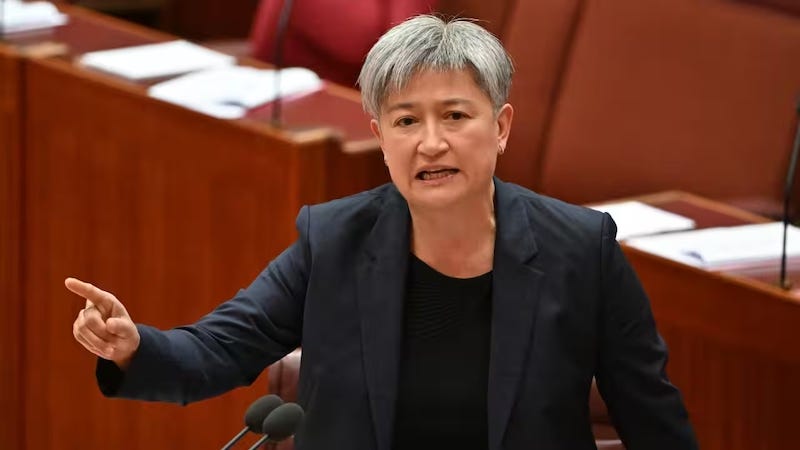
We had to clear out our ears and listen to this over again, just to make sure we heard correctly, but the Foreign Minister Penny Wong – fresh from condemning Iran after Iran was attacked by the United States – said “the relationship with the United States matters more than some domestic political issues about environmental reform”.
While we have always suspected it, just at that moment, we were given a clear idea of where the priorities in foreign policy are for this Labor government – with the United States and Israel – and as with Crisafulli and Minns, it would be worth finding out the value of the Faustian pact Wong has made, surely a substantial one, considering how much of her ethics and principles she has discarded since October 2023.
The AUKUS agreement must be sitting at the centre
of this unprincipled support of the United States. We know so little about this deal but it’s becoming clearer – without it every being stated – that Australia has signed away its military independence to the United States, because no-one in their right mind would behave the way Albanese and Wong have, without having straightjacketed and pushed so hard into such a tight corner where they couldn’t respond in any other way. There’s no other explanation.
I continue to appreciate these cogent, detailed but tight and exact outlines: a real focus in an (understandable but still) torrent of commentary.
Future Australians will probably view this government as traitors that sold our interests for their financial security