


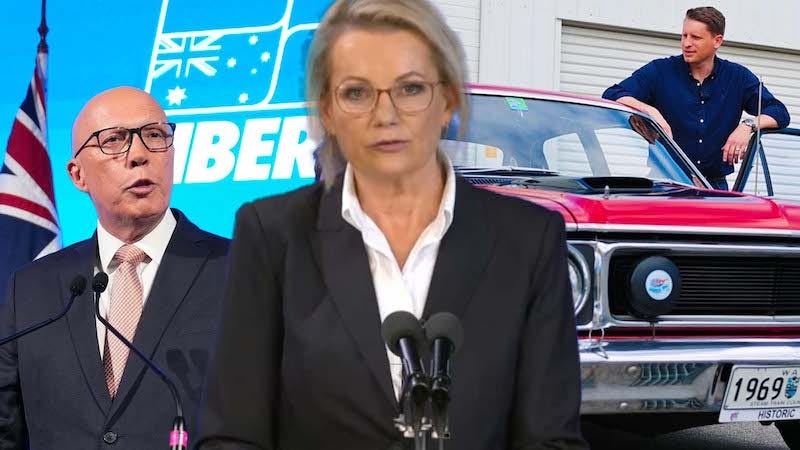
Five months after the Liberal Party’s devastating defeat at the 2025 federal election, the party is drifting in a sea of ineptitude – of its own making – unsure of what it stands for and which direction it should take. Their leader, Sussan Ley, has tried to impose order on the chaos that she inherited from Peter Dutton with a set of “charter letters” to shadow ministers – which contain key performance indicators and a warning against “freelancing” – that were designed to restore discipline and credibility within the party. But these measures suggest a deeper insecurity within the leadership: strong leaders don’t need to enforce loyalty so overtly, especially when they’re in opposition, and Ley’s attempt to project authority highlights how fragile her hold on the party really is.
At the heart of this issue – and the biggest challenge to her authority – is Andrew Hastie. The former SAS officer and now ex–Shadow Home Affairs Minister has become increasingly vocal, using populist rhetoric that uses the tone and tactics of US President Donald Trump. In a recent social media post where he appeared with a 1969 Ford Falcon as the star, Hastie lamented what he sees as the decay of Australian self-reliance: the loss of car manufacturing, the rise of electric soulless vehicles “made in China,” and a culture of “helpless consumers”, portraying himself as the defender of a bygone Australia – a nation of workers, builders, and innovators – while accusing both major parties of betraying that heritage. It’s a clear message directed to the disaffected conservative base: it resonates emotionally and it’s nostalgic, but it’s largely unhinged from economic and historical reality.
Ley’s efforts to restrain Hastie – if that’s what her measures were all about – have failed. His resignation from the shadow ministry over disagreements on immigration policy, frees him up to campaign as an unencumbered conservative crusader: the messiah. This move is a replica of the playbook used by his mentor Tony Abbott, who continues to agitate from wherever he might be. At a recent Conservative Party conference in the UK, Abbott suggested detaining migrants on a “mothership” in the English Channel – itself a nod to Australia’s boat-turnback policies and a signal to conservatives everywhere that punitive migration control are an electoral winning issue. For Hastie, this presents a useful ideological rallying point, one that will destabilise Ley’s leadership and galvanise the Liberal right, all in the one action.
Ley has never enjoyed the luxury of a honeymoon period, although this is rarely afforded to opposition leaders, especially after such a crushing election defeat. From her first days in the role, conservative media figures and internal rivals have questioned her legitimacy and longevity, dismissing her as a placeholder until a more “suitable” male candidate emerges; others on Sky News have suggested that she’s too moderate or too conciliatory to rebuild a fractured conservative movement. Her attempts to move the Liberal Party away from the belligerent masculinity of the Dutton, Morrison and Abbott years might be sincere – and politically necessary – but it’s always going to be a difficult move for a party that prides itself on this form of “muscular” blokey politics.
She has tried to rework the party as inclusive and forward-looking, yet she’s trapped between the factions – one faction pushing towards modernisation, the other nostalgic for a mythic Australia that has, in reality, never existed.
This internal disarray is more than just personal rivalries – if wasn’t Ley–Hastie, it would be someone else: The Liberal Party is confronting a generational and existential identity crisis, as shown by its electoral defeats at the 2022 and 2025 federal elections, and complete annihilation at many state elections over the past decade. Is it still a broad church of liberal and conservative ideas, or is it becoming an enclave of grievance politics, nostalgia and reactionary cultural warfare?
Hastie’s resignation from the frontbench could be the beginning of an organised conservative insurgency, potentially drawing support from One Nation and other populist splinter groups, which would end up being a downward and nihilistic spiral towards oblivion. For Ley, the question is whether she can maintain enough unity and muster up the political stamina to rebuild the party – or whether the Liberal Party will fracture even further, leaving space for a far-right realignment that could one day threaten even Labor’s dominance, as has been seen in British politics with the Reform UK group.
The return of reactionary nostalgia
No one really knows what kind of leader they’ll be until they occupy the position, not even the leader themselves. Sussan Ley is learning that now, as she struggles to balance authority, vision and the endless demands of party management. Hastie, meanwhile, is also discovering something new: how to position himself as the heir apparent without actually taking on any responsibility at all. His constant agitation – over net zero targets, immigration, and even this romanticised revival of car manufacturing – serves two purposes: it’s a populist pitch to conservative voters nostalgic for an older Australia (even if it’s never existed); and it’s a clear message to his colleagues that he’s ready to lead if Ley fails. And on the basis of all of his actions, he’s doing everything he can to ensure she does fail.
Hastie’s campaign is less about ideas than about signalling – rhetorical signposts that speak directly to the party room rather than the public. His calls to “reclaim our national soul” and to restore “real industries” have nothing to do with economic strategy and everything to do with emotional politics. They’re not crafted to persuade the average voter in Parramatta or Perth, but to resonate with disillusioned Liberal MPs who yearn for clarity, conviction and an uncomplicated worldview. It’s an obvious leadership bid, even if it’s undeclared – a pitch not for today, but for tomorrow. We’ve seen this story play out so many times in the past.
