


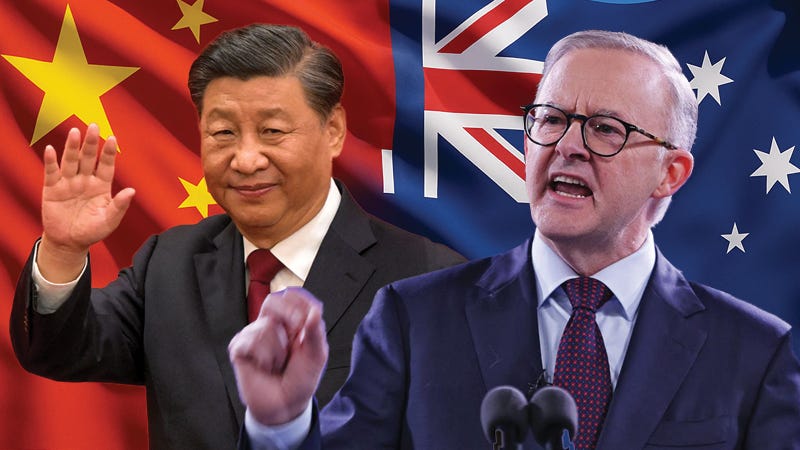
In what should have been recognised as a sign of maturity for Australian foreign policy, Prime Minister Anthony Albanese’s meeting with Chinese President Xi Jinping – their fourth meeting so far – has resulted in a predictable response of conservative hysteria, empty rhetoric and a hyperbole that’s verging on racism. This meeting wasn’t just another round of pleasantries, banquets, visits to the Great Wall or, that tired old cliché the media loves to rev up during state visits to China – “Panda diplomacy” – it was an important step in repositioning Australia’s role in a quickly changing geopolitical landscape.
The Asia–Pacific region is becoming more complicated by the day, with the increasing power of China, a change in allegiances, and the unreliability of a more insular United States to act as a global stabiliser. Within this context, Albanese’s efforts to strengthen ties with China are not acts of “submission” or “appeasement”, as some reactionary commentators have claimed – these are steps toward promoting and protecting Australia’s national interest. And, so far, he’s succeeding.
The Coalition and its media proxies are trapped in a rusted-on Cold War mentality where, just like the Hollywood’s post-war anti-German propaganda movies, China is always to be cast as the villain that can never be trusted or rehabilitated. Within this mindset, every diplomatic act from Xi Jinping is twisted into a narrative of capitulation and suspicion, and every improvement in bilateral relations is somehow narrated as a betrayal of Australian values. From their perspective, China is either perpetually on the verge of internal collapse under the inherent contradictions of communism, or preparing to invade Taiwan, dragging Australia into a catastrophic conflict through its association with the US. Meanwhile, the government’s efforts – just getting on with expanding export markets, stabilising university partnerships, and supporting Australian jobs – are downplayed or ignored entirely. Why run with the positive news when there’s free and readily available anti-China propaganda to propagate?
Albanese is engaging in the difficult but necessary task of foreign policy realism. He’s not indulging China, but negotiating with it. He is not abandoning the United States, but refusing to be blindly linked to it in the same way the Coalition was during its time in office: it’s an outcome the Coalition had years to develop but failed to deliver. During its decade in office, the Coalition government allowed Australia’s most important trading relationship to stagnate to the point of near collapse, especially after 2020, during the early stages of COVID, and made little effort to diversify exports or protect economic sovereignty. Instead, they relied on inflammatory rhetoric, leaning heavily on fear of the “China threat” as a blunt political instrument. Their mishandling of the AUKUS agreement in 2021 is probably the pinnacle of their incompetence: a nuclear submarine deal with unclear terms, a lack of strategic objectives that could be in Australia’s national interest – all because the US told us that we were “underprepared” in case of war with China – and a public left largely in the dark (and still is).
Now that the Labor government is restoring relationships with Beijing, the same conservative commentators who cheered on the diplomatic attacks on China by the Coalition, are claiming that this progress is a sign of weakness. They want China as both an enemy and an economic benefit to Australia – something that defies logic, yet persists because of a deeper discomfort within Australia’s political psyche and the white-man colonialist’s outlook of south-east Asia. There’s a strong undertone of racial anxiety and cultural insecurity as a part of this discomfort: a preference for the familiar white, Western ally over the rise of a confident, non-Western superpower.
And yet, despite this tension, there is no coherent strategy behind the right-wing bluff and bluster. It’s just the usual fear and suspicion, as well as that recycled myth that Australia can only ever be safe and successful if it defers unconditionally to the United States. This isn’t diplomacy: it’s the classic colonial dependency that appears publicly as foolish and self-defeating patriotism.
Of course, China’s government is not without flaws or human rights concerns, but the double standards are always on show when it comes to these concerns. Albanese is expected to confront Xi on these issues or otherwise face accusations of cowardice and “not standing up to China”. But, when it comes to US leaders – especially someone like Donald Trump – there are no such demands. Few in the media ever question whether Albanese should challenge human rights abuses in the United States or the immigration policies brutally implemented by their Immigration and Customs Enforcement. Xi must always be challenged on the treatment of Uyghurs and other Turkic Islamic minorities in Xinjiang – and rightly so – but the US is never asked to be held to account over its treatment of Indigenous Americans, Afro–American and Hispanic communities. Or the human rights violations at the Guantánamo Bay detention camp.
The United States is now a nation where citizens have been deported despite their birthrights, or detained in facilities that resemble open-air prisons, such as “Alligator Alcatraz”. These are violations which are just as severe, if not more so, than the many that are attributed to Beijing. But, for conservatives, China is the only one that needs to be singled out, because the United States is always in the right.
Albanese’s engagement with China is not perfect, but it is grounded in diplomatic pragmatism where he’s trying to navigate a path between old alliances and the emerging realpolitik. Unlike the ideological stubbornness of his critics, Albanese’s approach is a genuine effort to maintain a balance in an increasingly unbalanced world. This isn’t weakness: this is how diplomacy is meant to work and to be used strategically – for Australia’s future – and it might end up being the most important foreign policy decision of the post-Cold War era.
A diplomatic reset but the colonial mindset persists
This visit to Beijing was a lot more than just a symbolic photo opportunity, or an “indulgence”, as the Liberal Senator, James Paterson claimed during the week.
It’s a clear break from the belligerence and mismanagement that defined the Morrison era and, for the first time in years, an Australian prime minister has arrived not with conditions and accusations, but with the intent to listen, negotiate, and rework the Australia–China relationship. And the results are already visible.
All of the punitive trade barriers China had placed on Australian exports – wine, barley, timber, coal, lobster and many others – have now been removed. These weren’t abstract economic disputes or debates at the World Trade Organisation; they had real consequences for Australian producers and regional communities. Albanese’s re-engagement has helped restore access to key markets, creating economic certainty and reversing the damage that never should have occurred in the first place.
This is positive news for Australia, as it is for China. So why is Australia’s conservative media and political class so quick to portray this as a negative? Why is the right’s instinct always to view China not as a country with whom we can work with, but as a looming threat that has to be contained, even to the point of engaging in a war?
This paranoia, unfortunately, is not new. It is the echo of a long and ugly tradition in Australian public life since colonisation in 1788 – a mix of racial anxiety, Anglophile nostalgia, and an enduring sense that our place in the world must always be etched into an imagined Western superiority. The Coalition’s worldview, while not as overtly reactionary as One Nation or the far-right fringe, still clings to a mythic past: a simpler time, supposedly safer, whiter, wealthier. But, as former Prime Minister Paul Keating once observed, these visions of an idealised past are fantasy, and are fabrications that were never grounded in any real sense of history.
It’s a yearning based on a parochialism that refuses to accept that Australia is a part of Asia, and believes that China – like other countries in the south-east Asia region – is a threat to be feared. But have a look at a map: yes, Australia is in Asia, and far far away from either the United States, or from Britain. Keating was right – Australia always has been and it always will be in Asia.
Australia is not in a position to dictate terms to the world’s largest economies. We don’t possess the economic clout to punish Beijing, nor do we have the military capacity to confront Washington. But what we do have is a voice: Australia can offer principled, measured criticism – privately and respectfully – where necessary. That’s what mature diplomacy looks like. And if we are to have any credibility on human rights, we must apply our standards universally – including to our closest allies.
This is why Albanese’s stance is sensible and successful: he’s not grandstanding, nor is he promoting the tough-guy image that Scott Morrison or Tony Abbott wanted to portray when they were engaging with China. Instead, he’s promoting the economic, strategic and cultural ties that are important for Australia’s long-term interests – and for this, he’s being punished by a media class that just refuses to grow up.
Each and every week, we see the same cycle of cynicism: we see outrage instead of nuance, a search for scandal over substance, and if there is no scandal, an invented one. Australia deserves better from its mainstream media. And if we are to meet the challenges of this new century – climate, economic realignment, technological disruption, shifting global alliances – we will need a media that is capable of reporting on the world as it is, not the conservative fantasy that they all want to be a part of.
Australia’s pathway between the world powers
Beyond the diplomacy, there are hard economic realities that highlight Australia’s relationship with China – and these are the realities that are often ignored by sensationalist media through their outdated Cold War mentality.
China is by far Australia’s largest trading partner, accounting for 27 per cent of total exports, valued at around $180 billion annually. In contrast, the United States is just 4.6 per cent of our export market, worth around $30 billion. And sure – $30 billion is still a substantial amount, but it’s small when compared to the size and value of the trade with China. Yet, too often, these facts are ignored.
Instead, the Australian conservatives are obsessed with hypothetical war scenarios: a Chinese invasion of Taiwan, or even more absurdly, of Australia itself, and what is even more absurd is that these fantasies are peddled as an inevitability rather than just a remote possibility. Journalists harass the Prime Minister with gotcha-style hypotheticals, egged on by defence analysts and hawkish think tanks. Their aim isn’t to inform the public, but to manufacture consent for this supposedly impending confrontation, and to continue conditioning the Australian public to fear China as a looming, existential threat.
Meanwhile, US military officials continue to float the idea that conflict with China could erupt by 2027. No evidence is provided, no rationale is outlined and, of course, it’s never needed. But it’s hard to escape the conclusion that 2027 is politically convenient – a stage for destabilisation just before the 2028 US presidential election – and has nothing to do with Australia – but it’s a strategy that assumes that nations like Australia will obediently play along, just because the US says so.
The reality is that Australia doesn’t need to choose sides in a new cold war – or an unlikely hot war – that hasn’t yet begun. In fact, the entire point of diplomacy is to avoid being forced into these kinds of decisions. Australia can maintain its longstanding alliance with the United States while also deepening economic and diplomatic ties with China. That is the essence of modern diplomacy – getting the best out of all relationships, rather than collapsing into subservience to just one, and acting as an independent regional power with its own voice and interests, rather than a US “deputy sheriff”.
And these interests are clear. Australia is a middle power, but it is also a major force in the Asia–Pacific region. The fantasy of a permanent Atlantic allegiance – culturally Anglo, militarily American, and economically self-sufficient – is outdated and unsustainable. Gough Whitlam recognised this in 1971, visiting China even before he became Prime Minister. While he was mocked and ridiculed by the conservatives and the media at the time – US President Richard Nixon made the same move months later and was lauded for doing so.
Nixon’s visit to China is now regarded by many historians as his most significant achievement. And yet, it was Whitlam who beat him to it. Whitlam understood that a future without China at the table would be a poorer, more dangerous one, and Keating’s urge for Australians to recognise that they are part of Asia, is a part of this thinking. That assertion still unsettles those who cling to the illusion of empire and the imagined safety of a bygone Commonwealth.
But the truth is, Australia can’t rely on nostalgia to navigate its place in the modern world of diplomacy. It has to deal with the reality of its geography, its dependencies, and its role as an economic player. And when we antagonise China – as the Abbott, Turnbull and Morrison governments did with their mindless posturing and unproductive provocation – we discovered quickly who benefits the most from this relationship. When China implemented sanctions and tariffs on Australian goods in 2020, it wasn’t Beijing that suffered.
We’re no longer in the 1950s and the world doesn’t bend to the will of the “free world” as once imagined. This is the new reality: Australia must grow up and is growing up, and is looking to its own region, and its own future, not hanging on to the myths of its past. Albanese’s path forward – diplomatic, methodical and based on Australia’s national interest – isn’t “appeasement” or “indulgent”, as claimed by his critics. It’s all about becoming an adult in international affairs. And the sooner Australia embraces and understands this, the better equipped we’ll be to shape our own future, rather than having it shaped for us.
It’s time to call out the mainstream media for what it really is.
News Corps, the largest player by far is an agent of foreign influence (the US and Israeli governments). Seven is a personal influence project for Kerry Stokes and the WA extraction industry interests. Nine is a real estate, sport and gambling company. The ABC is a cowed entity that has practically removed itself from the news business and is led by an ex-News Corp/ FOXTEL CEO and a disgraced former CEO of Nine.
Given the above, it’s a fantasy to expect them to adapt to the reality of the emerging realignments in geopolitics and economics with any purpose around civic responsibility and nuance.
Of course, the US tech giants are even worse and are aligned to a neo-fascist chaos project that expects deference and fealty.
Albanese is light years ahead of the Coalition and the ALP is the one pursuing Australia’s best interests while the agents of America demand we prostrate ourselves before the Mad Orange King.
Now, Albo, about this AUKUS thing …..
I am far from being an Albanese fan, but I think that - so far, at least - he's been handling relarions with both China and the US sensibly enough...nothing brilliant, but rational and competent.