


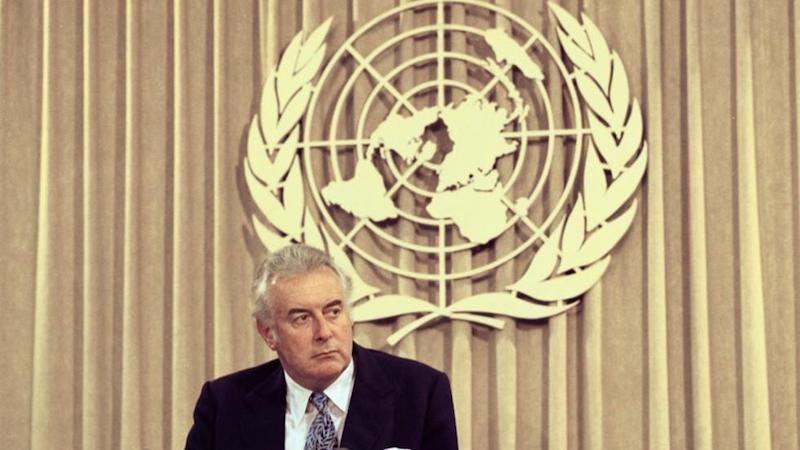
It is hard to imagine Gough Whitlam surviving in the modern Australian Labor Party. The political landscape he once helped to transform has morphed into a managerial, tightly disciplined system that values caution over conviction, and has a great fear of the mainstream media and the many growing vested interests in Australia. Today’s Labor is a party of small incrementalism – Anthony Albanese’s “cautious governing” – risk-averse, poll-driven and managed through the rigid rules of factionalism. Whitlam, the insurgent reformer who dragged a complacent Labor Party into the twentieth century, would have been an awkward fit today, and possibly placed onto meaningless Parliamentary committees to keep him busy and ensure that he couldn’t do any damage to the managerial aspirations of the modern Labor politician. And, of course, his intellectual arrogance, his impatience with bureaucracy, and his refusal to accept mediocrity would have been seen as liabilities rather than the attributes of a strong leader.
The modern Labor Party rewards factionalism, not the rebels, or those who go freelancing for change without the permission from head office. Leaders like Albanese and Bill Shorten emerged after decades of negotiating the labyrinth of factions, mastering the art of consensus and minimising ideological shapeshifting. Whitlam, by contrast, was a visionary who imposed reform from the top down – a moderniser who believed policy and ideas could move a nation forward even at the cost of short-term popularity. In an era when party leadership requires years of internal compromise and the suppression of ego for collective discipline, a figure like Whitlam would have come across many roadblocks, possibly even before the preselection stage – his ambition and defiance would have been incompatible with the culture of strategic caution that defines much of the political class of today, and not just within the Labor Party.
If Whitlam were to rise in this type of political environment, it wouldn’t have been through the usual pathways: he would have emerged from the world of think-tanks, academia, or activist movements – a outsider armed with a burgeoning amount of information and vision. What would this look like? Probably a combination of Kevin Rudd’s policy intellect and Paul Keating’s verbal barbs, using moral conviction to combine these as a political weapon. Such a figure might find support not from the party machine within but from outside of it: the growing number of disillusioned progressive voters who have drifted to the Australian Greens and the independent movement, voters who have grown tired of managerial tone of modern politics, who are calling out for substance, reform and independence from the dominance of corporate interests and the mainstream media – the kind of constituency that once fuelled Whitlam’s revival in the 1960s and early 1970s.
It’s very doubtful that the Labor Party of today, which seems to be beholden to stakeholders, focus groups and the management of risk, would tolerate a leader who would move much faster than the party’s internal bureaucracy. Whitlam’s far-reaching ambitions – for universal healthcare, free tertiary education, equality before the law and cultural sovereignty – would likely be dismissed by today’s strategists as “unelectable”. Yet those same ambitions – and achievements – that Whitlam had in the early 1970s defined the social and moral architecture of modern Australia. His belief that politics should be a tool for national renewal rather than a contest of slogans would clash with a media ecosystem that rewards outrage over ideas, and cookie-cutter conformity over courage.
In the end, Whitlam’s survival in contemporary Labor isn’t just improbable; it would almost be impossible. If he did become a leader in the twenty-first century, he would have probably bypassed the Labor Party altogether, and resided in a new movement based around idealism, environmental awareness and civic reform.
Reimagining a three-year revolution under Whitlam
If Whitlam had returned to Australian politics and won the 2022 federal election (through a Doctor Who-styled distortion of a time paradox), his government would have moved through Canberra’s political complacency like a lightning rod. He would have inherited a fractured, exhausted nation – the fast-tracked neoliberalism of Howard’s decade in office; Labor destroying itself during the Rudd–Gillard years; another nine years of meandering and corruption under the Abbott–Turnbull–Morrison: institutional decay, climate inaction, housing insecurity, cultural apathy and a public service turned into a delivery arm for private contractors.
